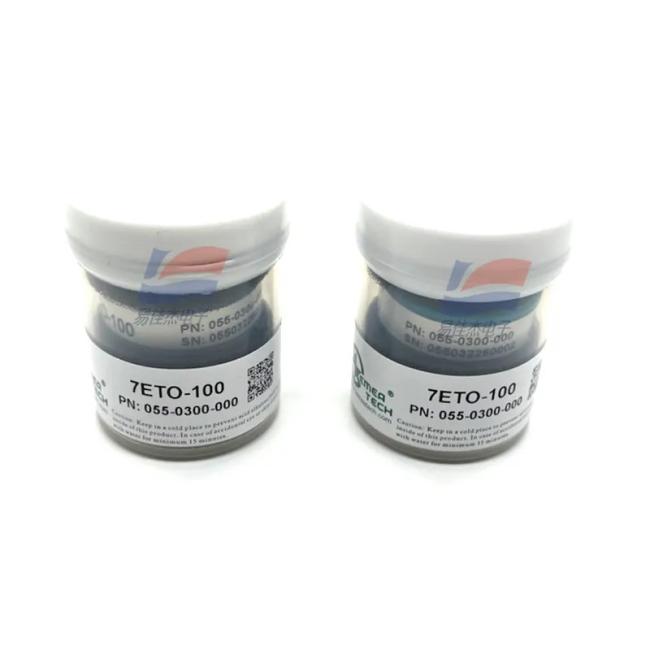
7ETO-100 Ethylene Oxide Gas Sensor For Medical Device Sterilization Pharmaceutical Manufacturing
The 7ETO-100 operates on the electrochemical detection principle, leveraging a three-electrode cell immersed in an electrolyte solution:
- Gas Diffusion: Ethylene oxide gas in the environment diffuses through a porous membrane (gas-permeable membrane) into the sensor’s internal electrolyte.
- Electrochemical Reaction: At the working electrode (cathode), ETO undergoes oxidation, producing electrons, protons (H⁺), and harmless byproducts (e.g., CO₂, H₂O).
- Current Generation: The electrons generated by the oxidation reaction flow through an external circuit to the counter electrode (anode), creating a measurable electrical current. The magnitude of this current is linearly proportional to the concentration of ETO in the sample gas (per Faraday’s Law of Electrolysis).
- Stability Maintenance: The reference electrode provides a stable voltage reference, preventing drift in the working electrode’s potential and ensuring long-term measurement accuracy.
4. Typical Applications
The 7ETO-100 is engineered for scenarios requiring ETO monitoring, with core use cases including:
4.1 Medical Sterilization Industry
Ethylene oxide is widely used to sterilize heat-sensitive medical devices (e.g., surgical instruments, syringes, implants). The 7ETO-100 is integrated into:
- Sterilization Chamber Monitors: Real-time tracking of ETO concentration during the sterilization cycle to ensure effective microbial inactivation.
- Post-Sterilization Ventilation Systems: Detection of residual ETO in sterilized equipment or exhaust air, ensuring levels meet safety standards (e.g., ≤ 1 ppm for personnel exposure) before devices are used or air is released.
4.2 Chemical & Pharmaceutical Manufacturing
In facilities producing ETO or using ETO as a raw material (e.g., for ethylene glycol synthesis, detergent production):
- Fixed-Point Leak Detectors: Installation near pipelines, valves, or reaction vessels to trigger alarms if ETO leaks occur (preventing toxic exposure or fire risks).
- Process Control Systems: Monitoring ETO concentration in reaction streams to optimize production efficiency and ensure product quality.
4.3 Environmental & Occupational Safety
- Portable Gas Detectors: Used by maintenance workers, laboratory staff, or emergency responders to monitor personal exposure to ETO in confined spaces (e.g., sterilization rooms, chemical storage areas) or during leak investigations.
- Indoor Air Quality (IAQ) Monitors: In facilities where ETO may accumulate (e.g., hospitals, pharmaceutical plants), the sensor ensures indoor ETO levels comply with occupational health regulations (e.g., OSHA’s permissible exposure limit (PEL) for ETO: 1 ppm over an 8-hour workday).
4.4 Food Processing (Optional)
In some food sterilization applications (e.g., low-temperature sterilization of packaged foods), the 7ETO-100 monitors residual ETO to ensure food safety and compliance with global food standards.
5. Installation & Operation Guidelines
5.1 Installation Notes
- Location: Mount the sensor in areas where ETO is likely to accumulate (e.g., near sterilization chambers, ETO storage tanks) or where personnel frequent. Avoid direct sunlight, extreme temperatures, or high-humidity (condensing) environments.
- Gas Inlet: For diffusion-type sensors, ensure unobstructed air flow around the sensor (minimum 5 cm clearance from walls/obstacles). For pump-type sensors, connect the gas inlet tube to the sampling point (tube length ≤ 2 meters to avoid response delay).
- Wiring: Follow the sensor’s pinout diagram (provided in the datasheet) for power and signal connections. Use shielded cables for analog signals to reduce electromagnetic interference (EMI).
5.2 Calibration
- Initial Calibration: Perform a two-point calibration (zero calibration with clean air, span calibration with a known ETO concentration gas) before first use.
- Routine Calibration: Recalibrate every 3–6 months (or as required by local regulations) to maintain accuracy. Calibration gas should be certified (NIST-traceable or equivalent) with a concentration close to the sensor’s full scale (e.g., 80 ppm for a 0–100 ppm sensor).
5.3 Maintenance
- Cleaning: Periodically wipe the sensor’s exterior with a dry, lint-free cloth. Do not use solvents or water on the gas inlet membrane.
- Replacement: Replace the sensor if: (1) response time exceeds 60 seconds, (2) accuracy deviates by >10% of FS after calibration, or (3) the sensor reaches its rated lifespan.
6. Safety Precautions
- Toxic Gas Risk: Ethylene oxide is toxic and carcinogenic—always wear appropriate PPE (e.g., gas mask, gloves) when handling ETO or performing sensor maintenance in potentially contaminated areas.
- Flammability: ETO is flammable (explosion limit: 3%–100% by volume in air)—avoid installing the sensor near open flames, sparks, or high-temperature surfaces.
- Sensor Handling: Do not disassemble the sensor (risk of electrolyte leakage, which may cause skin irritation). Dispose of old sensors in accordance with local hazardous waste regulations.
|
Parameter Category
|
Parameter Name
|
Specification
|
Unit
|
Remarks
|
| Target Gas & Sensing Principle |
Target Gas |
Ethylene Oxide (EO/ETO) |
- |
Specialized for EO detection; not compatible with other toxic gases |
| |
Sensing Principle |
Electrochemical (Three-electrode Structure: Working/Counter/Reference Electrodes) |
- |
Ensures high selectivity and low signal drift |
| Measurement Performance |
Detection Range |
0 ~ 100 |
ppm |
Custom ranges (0~50 ppm, 0~200 ppm) available upon request |
| |
Resolution |
≤ 0.1 |
ppm |
Minimum detectable concentration change |
| |
Accuracy |
±5% FS (Full Scale) or ±2 ppm, whichever is larger |
- |
Tested under standard conditions (25℃, 1 atm, 50% RH) |
| |
Response Time (T90) |
≤ 30 |
Seconds |
Time to reach 90% of stable output signal |
| |
Recovery Time (T10) |
≤ 60 |
Seconds |
Time to drop to 10% of stable output signal |
| Electrical Characteristics |
Power Supply Voltage |
5.0 ± 0.2 |
V (DC) |
Regulated power required; avoid overvoltage |
| |
Operating Current |
≤ 50 |
mA |
Typical value during continuous operation |
| |
Output Signal Type |
Option 1: Analog (4 ~ 20 mA DC); Option 2: Analog (0 ~ 5 V DC); Option 3: Digital (UART/I2C) |
- |
Select output type when ordering |
| |
Signal Linearity |
≥ 99% |
- |
Factory-calibrated; no external linearization needed |
| Environmental Adaptability |
Operating Temperature Range |
-10 ~ 50 |
℃ |
Avoid condensation or extreme temperature fluctuations |
| |
Storage Temperature Range |
-20 ~ 60 |
℃ |
Store in dry, dust-free environment |
| |
Operating Humidity Range |
15 ~ 90 |
% RH |
Non-condensing; humidity >90% RH may affect accuracy |
| |
Atmospheric Pressure Range |
86 ~ 106 |
kPa |
Suitable for most low-altitude industrial/medical sites |
| Mechanical & Physical Specs |
Housing Material |
Option 1: ABS Plastic (Standard); Option 2: 316L Stainless Steel (Harsh Environment) |
- |
Stainless steel option resists corrosion |
| |
Gas Intake Mode |
Option 1: Diffusion (Passive); Option 2: Pump-driven (Active) |
- |
Diffusion for general use; pump-driven for long-distance sampling |
| |
Overall Dimensions (L×W×H) |
45 × 30 × 20 (ABS version); 50 × 35 × 25 (Stainless Steel version) |
mm |
Excludes connector/probe; refer to 2D drawing for exact size |
| |
Weight |
≤ 30 (ABS version); ≤ 80 (Stainless Steel version) |
g |
Net weight (excluding cables/fittings) |
| Lifespan & Maintenance |
Typical Operational Lifespan |
≥ 2 |
Years |
Under continuous operation in clean air (EO concentration < 1 ppm); lifespan shortens in high-concentration EO |
| |
Calibration Interval |
3 ~ 6 |
Months |
Recommended for maintaining accuracy; use NIST-traceable EO calibration gas |
![]()