
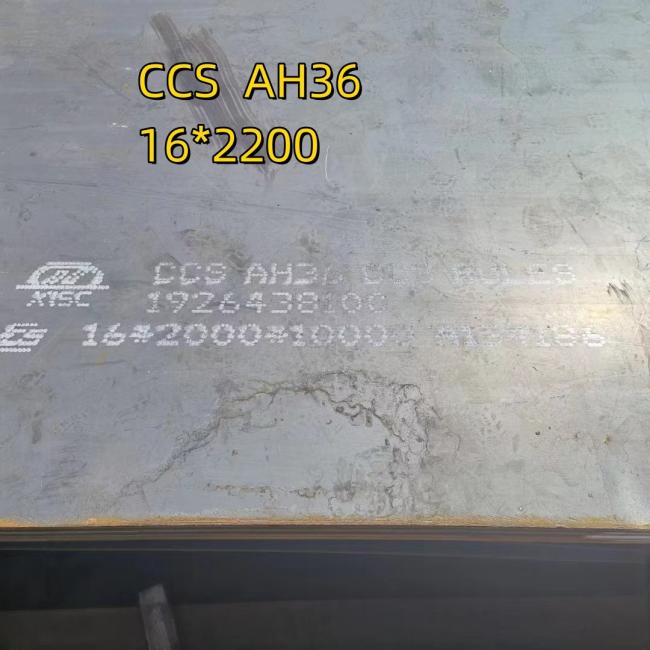
Ship Plate ABS LR CCS Class AH36 Size 2000 x 8000 mm Thickness 10 mm Marine Engineering
Ship Plate ABS LR CCS Class AH36 Size 2000 x 8000 mm Thickness 10 mm Marine Engineering
Materials
Shipbuilding steel material in carbon and alloy steel, compatible with high strength, low temperature and high heat input soldering.
Shipbuiding Standards from Different Countries
Shipbuilding steel plates are produced under the approval of production methods of classification societies in different countries refers to offshore and marine steels.
- ABS (American Bureau of Shipping)
- BV (Bureau Veritas)
- CCS (China Classification Society)
- DNV (Det Norske Veritas)
- GL (Germanischer Lloyd)
- HR (Hellenic Register of Shipping)
- KR (Korean Register of Shipping)
- LR (Lloyd's Register of Shipping)
- NK (Nippon Kaiji Kyokai)
- RINA (Registro Italiano Navale)
- RS (India Register of Shipping)
Grades: A, B, D, E, AH32/36/40, DH32/36/40, EH32/36/40
According to its yield strength, shipbuilding plate of can be divided into below grades:
- Grade A steel is the impact force subjected to normal temperature (20 ° C).
- Grade B steel impact force at 0 °C.
- Grade D steel impact force at -20 °C.
- Grade E steel impact force at -40 °C.
- High-strength shipbuilding steel plate can be further divided into: AH32, DH32, EH32; AH36, DH36, EH36 and AH40, DH40, EH40.
1. The general grades A, B, D, and E are distinguished according to the impact temperature of the steel. The impact values of all grades of steel are the same.
2. High-intensity hull structure steel preheating requirements: For all AH, DH, EH plate thickness greater than 30mm angle, butt joints, shall be preheating to 120 ~ 150 °C before welding.
3. For thickness of the plate ≤ 30mm, the ambient temperature is below 5 ° C, preheated to 75 ° C; Ambient temperature below 0 ° C, preheated to 75 ~ 100 ° C.
Dimensions Range
Thickness Range: 5 mm -150 mm
Width Range: 1500 mm - 3900 mm
Length Range: 6 m, 12 m, coils
Surface Treatment
With anti-rust painting.
Chemical and Mechanical Requirements
|
Elements |
C |
Mn |
Al |
Si |
P |
S |
|---|---|---|---|---|---|---|
|
AH32 |
≤0.18 |
0.7~1.60 |
≥0.015 |
0.10~0.50 |
≤0.04 |
≤0.04 |
|
DH32 |
≤0.18 |
0.90~1.60 |
≥0.015 |
0.10~0.50 |
≤0.04 |
≤0.04 |
|
EH32 |
≤0.18 |
0.90~1.60 |
≥0.015 |
0.10~0.50 |
≤0.04 |
≤0.04 |
|
AH36 |
≤0.18 |
0.7~1.60 |
≥0.015 |
0.10~0.50 |
≤0.04 |
≤0.04 |
|
DH36 |
≤0.18 |
0.90~1.60 |
≥0.015 |
0.10~0.50 |
≤0.04 |
≤0.04 |
|
EH36 |
≤0.18 |
0.90~1.60 |
≥0.015 |
0.10~0.50 |
≤0.04 |
≤0.04 |
C (carbon) is an indispensable strengthening element in steel, but the increase in C content reduces the low-temperature impact toughness of steel and deteriorates the weldability of steel. Therefore, it is necessary to control the C content in the steel.
According to the experience of producing aluminsum-containing steel, in order to ensure the aluminum content in the steel and the fluidity of the molten steel, the method of pre-deoxidation is strictly to control the carbon content of the end point and the alloying of the large-pack alloy to control the oxidation of the molten steel. The way of adding aluminum.
In order to ensure good low temperature impact toughness of the steel grade, the rolling of the 355MPa class ship plate adopts a strict type II controlled rolling process.
|
Mechanical Properties |
|||||||
|---|---|---|---|---|---|---|---|
|
Steel Grade |
Thickness/mm |
Yield point/ MPa |
Tensile strength/ MPa |
Elongation/ % |
V-type impact test |
||
|
Temperature/ ℃ |
Average impact absorption workAkv/J |
||||||
|
Vertical |
Horizontal |
||||||
|
A |
≤50 |
≥235 |
400~490 |
≥22 |
- |
- |
- |
|
B |
≤50 |
≥235 |
400~490 |
≥22 |
0 |
≥27 |
≥20 |
|
D |
≤50 |
≥235 |
400~490 |
≥22 |
-10 |
≥27 |
≥20 |
|
E |
≤50 |
≥235 |
400~490 |
≥22 |
-40 |
≥27 |
≥20 |
|
AH32 |
≤50 |
≥315 |
440~590 |
≥22 |
0 |
≥31 |
≥22 |
|
DH32 |
≤50 |
≥315 |
440~590 |
≥22 |
-20 |
≥31 |
≥22 |
|
EH32 |
≤50 |
≥315 |
440~590 |
≥22 |
-40 |
≥31 |
≥22 |
|
AH36 |
≤50 |
≥355 |
490~620 |
≥22 |
0 |
≥34 |
≥24 |
|
DH36 |
≤50 |
≥355 |
490~620 |
≥22 |
-20 |
≥34 |
≥24 |
|
EH36 |
≤50 |
≥355 |
490~620 |
≥22 |
-40 |
≥34 |
≥24 |
Processing for Different Grades
Grade A and B
The general strength of grade A and B shipbuilding steel plates can meet the requirements of process and mechanical properties through ordinary rolling, so the production process is relatively simple.
Grade D, E (DH32, DH36, EH 32, EH 36)
Grade D and E series (inlcuding AH32/36, DH32, DH36, EH32, EH36) shipbuilding steel plates require good low temperature toughness and good welding performance. The production high-strength shipbuilding steel plate needs to be normalized by means of controlled rolling and controlled cooling or heat treatment processes with more complete equipment. At the same time, the internal steel purity of the supplied billets is required to be high, especially the content of S, P, N, 0 and H in the steel should be strictly controlled.
Alloy Elements Added to Improve Toughness
In order to ensure the performance of high-strength ship plates, micro-alloying technology is adopted. By adding Nb, V, Ti and other alloying elements to the steel, combined with the controlled rolling process, the grain is refined and the toughness is improved.
Direction of Development for Shipbuilding Plate
High strength, high specification, with the ship's large-scale and ety, and changes in coating specifications, the demand for ordinary A-class panels is gradually reduced, and the demand for high-strength panels is increasing, which is concentrated in large ships of 5m wide. Plate, 200-300mm thickness special thick ship board.

2. Delivery time: Usually about 35days
3. Trade Terms: FOB, CFR (CNF), CIF
4. MOQ: 1 Sheet if on stock.
5. Payment Terms:
1) 30% T/T as deposit, the balance is against B/L Copy
2) 100% Irrevocable L/C at sight
3) 30% T/T as deposit, the balance is against Irrevocable L/C at sight.
standard specification covers high strength, quenched and tempered steel plates, is a specification for 100 KSI yield strength, quenched and tempered steel intended for structural applications and is typically known in the industry as United States Steel mill nomenclature T1® , regardless of the manufacturer.
Each grade has a unique chemical composition and may differ in the maximum thickness to which it is rolled, from 1.25 inch to 6 inch, The material thickness affects the mechanical properties. For instance,
Typical Applications:
This material is used for structural applications. In many cases, the term structural refers to buildings, but the material also is used in heavy equipment structures to reduce weight and improve payload capacity, such as in railcars and their components, large mining truck frames, semitrailer frames, and crane boom sections.
Get in Touch
Have questions about our products or want to discuss a custom order? Our team is ready to help you.