
1.8 Degree Holding Torque Stepper Motor
Holding Torque Stepper Motor 2N.M Nema 23 Hybrid Stepper Motor 57mm 1.8 Degree
Description of NEMA23 hybrid stepper motor
1. Forward/Reverse Rotation,Pause and Hold
The forward /reverse rotation of the stepping motor can be controlled by the input sequence of the controlled electric pulses.
In the case of the a stepping motor lock(the motor winding is energized,there is no external electric pulse command),the stepping motor can still maintain a certain torque output.
2. Strictly control the production of parts to improve the quality of parts.
3. Accurate Speed Control
The rotational speed of the stepping motor can be precisely controlled ,By controlling the frequency of the electric pulse.
5. Accurate position Control
The angular displacement of the stepping motor can be precise controlled by the number of electrical pulses.Angle accuracy can be controlled within ±0.09°without any feedback devices.
| Mode No | PST57H265-4P20 |
PST57H265-4P30
|
PST57H265-4L40 |
| Holding Torque | 1.7N.m | ||
| Related Current | 2A/Phase | 3A/Phase | 4A/Phase |
| Resistance | 2 Ω/Phase | 0.9Ω /Phase | 0.5Ω/Phase |
| Inductance | 6MH/Phase | 2.7MH/Phase | 1.6MH/Phase |
| Inertia | 280g.cm2 | ||
| Weight | 0.72kgs | ||
| Length | 55.5mm | ||
| Connection | P | ||
| Mode No | PST57H276-4P30 |
PST57H276-4L40
|
PST57H276-4L50 | |
| Holding Torque | 2N.m | |||
| Related Current | 3A/Phase | 4A/Phase | 5A/Phase | |
| Resistance | 1.1Ω/Phase | 0.65Ω /Phase | 0.37Ω/Phase | |
| Inductance | 4.2MH/Phase | 2.35MH/Phase | 1.8MH/Phase | |
| Inertia | 480g.cm2 | |||
| Weight | 1.1kgs | |||
| Length | 76.5mm | |||
| Connection | P | L |
||
| Mode No | PST60H280-4P30 | PST60H280-4L40 | PST60H280-4L50 |
| Holding Torque | 2.2N.m | 2.2N.m | 2.2N.m |
| Related Current | 3A/Phase | 4A/Phase | 5A/Phase |
| Resistance | 1.2Ω/Phase | 0.65Ω /Phase | 0.36Ω/Phase |
| Inductance | 4.5MH/Phase | 2.5MH/Phase | 1.76MH/Phase |
| Inertia | 520g.cm2 | 520g.cm2 | 520 g.cm2 |
| Weight | 1.2kgs | 1.2kgs | 1.2kgs |
| Length | 80.5mm | 80.5m | 80.5mm |
| Connection | P | L | L |
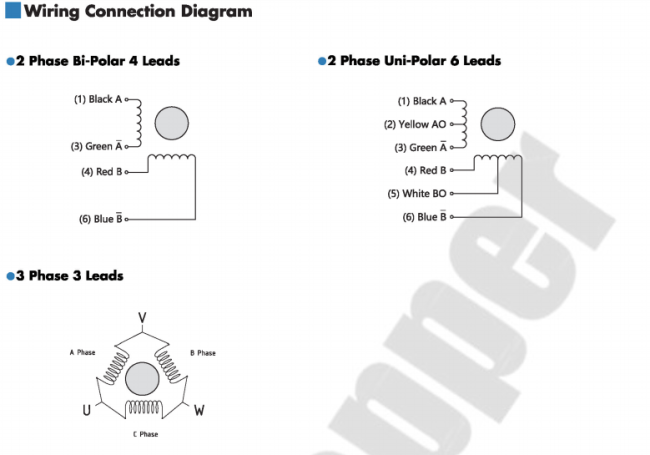
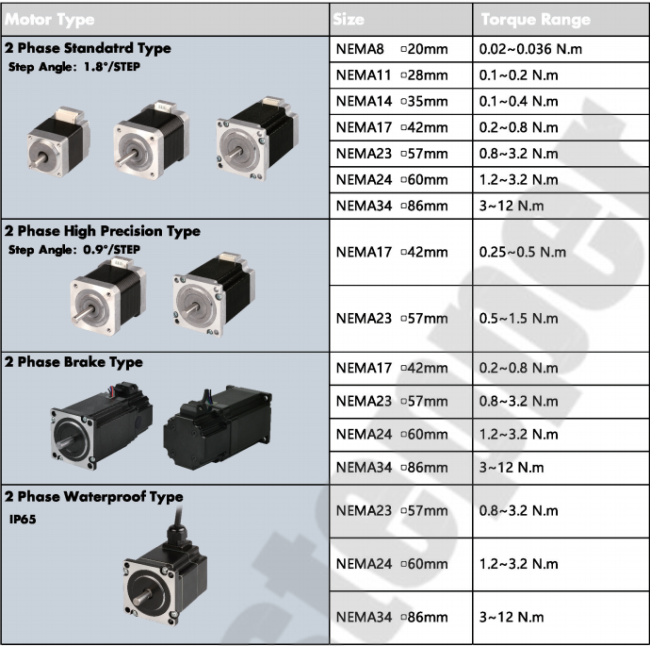
Hybrid stepper motor's specifications

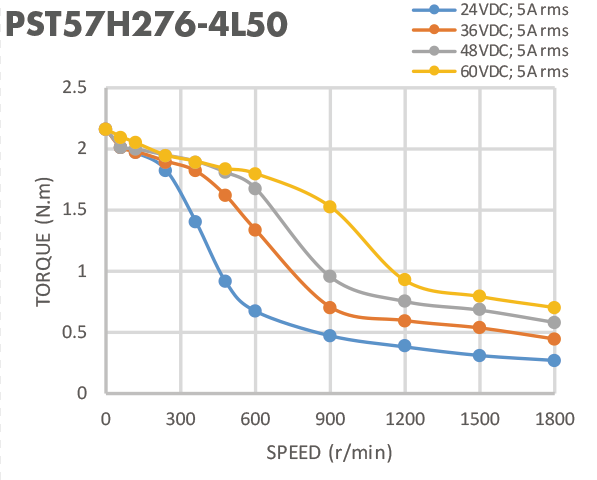
- Stepping Accuracy: ± 5%
- Resistance Accuracy: ± 10%
- Inductance Accuracy: ± 20%
- Temperature Rise: 80°C Max.
- Ambient Temperature: -20°C ... +50°C
- Insulation Resistance: 100MOhm min. 500V DC
- Withstand: 500V AC, 1 Minute
Working principle of stepper motor
To make the motor shaft turn, first one electromagnet is given power, which makes the gear’s teeth magnetically attracted to the electromagnet’s teeth. The point when the gear’s teeth are thus aligned to the first electromagnet, they are slightly offset from the next electromagnet. So when the next electromagnet is turned ON and the first is turned OFF, the gear rotates slightly to align with the next one and from there the process is repeated. Each of those slight rotations is called a step, with an integer number of steps making a full rotation. In that way, the motor can be turned by a precise. Stepper motor doesn’t rotate continuously, they rotate in steps. There are 4 coils with a 90o angle between each other fixed on the stator. The stepper motor connections are determined by the way the coils are interconnected. In a stepper motor, the coils are not connected. The motor has a 90o rotation step with the coils being energized in a cyclic order, determining the shaft rotation direction. The working of this motor is shown by operating the switch. The coils are activated in series in 1-sec intervals. The shaft rotates 90o each time the next coil is activated. Its low-speed torque will vary directly with current.
Stepper motor features
- Smooth surface
- Long lasting life
- Low cost for control achieved
- High torque at startup and low speeds
- Ruggedness
- Simplicity of construction
- Can operate in an open loop control system
- Low maintenance
- Less likely to stall or slip
- Will work in any environment
- Can be used in robotics in a wide scale.
- High reliability
- The rotation angle of the motor is proportional to the input pulse.
- The motor has full torque at standstill (if the windings are energized)
- Precise positioning and repeatability of movement since good stepper motors have an accuracy of 3 – 5% of a step and this error is non-cumulative from one step to the next.
- Excellent response to starting/stopping/reversing.
- Very reliable since there are no contact brushes in the motor. Therefore, the life of the motor is simply dependent on the life of the bearing.
- The motors response to digital input pulses provides open-loop control, making the motor simpler and less costly to control.
- It is possible to achieve very low-speed synchronous rotation with a load that is directly coupled to the shaft.
- A wide range of rotational speeds can be realized as the speed is proportional to the frequency of the input pulses.
Applications of 1.8 degree Stepper Motor
Stepper motors are diverse in their uses, but some of the most common include:
- Textile machines
- Printing presses
- Gaming machines
- Medical imaging machinery
- Small robotics
- CNC milling machines
- Welding equipment
Get in Touch
Have questions about our products or want to discuss a custom order? Our team is ready to help you.