
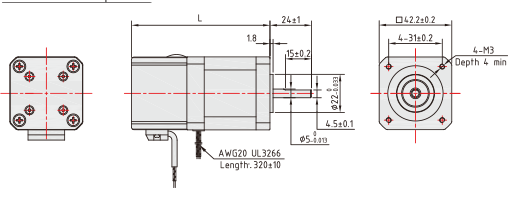
2 Phase NEMA 11 Brake Stepper Motor 1.8 Degree
2 Phase NEMA24 Brake Stepper Motor 1.8 Degree
Bipolar motors
Bipolar motors have a single winding per phase. The current in a winding needs to be reversed in order to reverse a magnetic pole, so the driving circuit must be more complicated, typically with an H-bridge arrangement (however there are several off-the-shelf driver chips available to make this a simple affair). There are two leads per phase, none is common.
A typical driving pattern for a two coil bipolar stepper motor would be: A+ B+ A− B−. I.e. drive coil A with positive current, then remove current from coil A; then drive coil B with positive current, then remove current from coil B; then drive coil A with negative current (flipping polarity by switching the wires e.g. with an H bridge), then remove current from coil A; then drive coil B with negative current (again flipping polarity same as coil A); the cycle is complete and begins anew.
Static friction effects using an H-bridge have been observed with certain drive topologies.
Dithering the stepper signal at a higher frequency than the motor can respond to will reduce this "static friction" effect.
Product description
-
Automatic assembly line
Automatic assembly line, improve production efficiency, low cost without human operation, one line down intelligent mechanical automatic assembly
-
Strictly control the production of parts to improve the quality of parts
-
Automatic machine operation, stable automatic work, high processing efficiency.
Mechanical size 100% meet the requirements, to ensure that there is no greater error in the use process
-
Online testing of technical parameters to ensure the consistency of data product parameters
Specifications
| Model | PST60H268-4L40M | PST60H286-4L50M |
| Holding Torque | 2.2N.m | 3.2N.m |
| Related Current | 4A/Phase | 5A/Phase |
| Resistance | 0.5Ω/Phase | 0.4Ω/Phase |
| Inductance | 1.2MH/Phase | 2MH/Phase |
| Inertia | 340g.cm² | 690g.cm² |
| Black Torque | 1.3N.m | 1.3N.m |
Radial Load&Axial Load
| Motor Size | Shaft Diameter (mm) | Radial Load (N) | Axial Load (N) | ||||||
| Distance from Mounting Surface (mm) | |||||||||
| 5 | 10 | 15 | 20 | 25 | 30 | 35 | |||
| NEMA8 | 4 | 15 | 12 | — | 3 | ||||
| NEMA 11 | 5 | 50 | 35 | 25 | — | 5 | |||
| NEMA 14 | 5 | 50 | 35 | 25 | 20 | — | — | — | 10 |
| NEMA 17 | 5 | 50 | 35 | 25 | 20 | — | — | 15 | |
| NEMA 23 | 8 | 270 | 180 | 130 | 100 | 90 | — | 20 | |
| NEMA 24 | 8 | 200 | 135 | 100 | 82 | 58 | — | — | 30 |
| NEMA 34 | 14 | 620 | 550 | 480 | 390 | 340 | 290 | 260 | 60 |
-
Speed/Torque Characteristics(Reference Value)



Tips: How to overcome the vibration and noises of 2-phase hybrid stepper motor when rotating at low velocity?
The vibration and noise of the stepper motor rotating at low velocity its the intrinsic defects, which can be generally overcome by adopting following schemes:
1. If the stepper motor works at resonance region, the resonance region can be evaded by changing mechanical transmissions such as velocity ratio.
2.Use subdivided driver, which is the most common and simple method.
3.Replace for the stepper motor with smaller stepping angle, like 3-phase or 5-phase stepper motor.
4.Replace for AC servo motor, which can nearly overcome vibration and noise, but the cost is quite high.
5.Add magnetic damper to the shaft of motor, such product has been available in the market, but the mechanical structure is changed a lot.
Get in Touch
Have questions about our products or want to discuss a custom order? Our team is ready to help you.