
Mechanical Vapor Recompression MVR Evaporator Plant

An integrated MVR evaporator plant engineered for energy-efficient evaporation, concentration, and crystallization across chemical, food, and environmental applications. By mechanically recompressing secondary vapor and reusing its latent heat, the plant delivers low OPEX, high recovery, and stable 24/7 operation.
- Energy efficiency: Electric-driven recompression minimizes fresh steam after start-up.
- Process quality: Vacuum/low-ΔT duty protects heat-sensitive products and reduces fouling.
- Throughput & uptime: Continuous operation with redundancy and predictive fouling monitoring.
- Flexible integration: Works with RO/NF, crystallizers, centrifuges, dryers, and ZLD schemes.
- Hygienic & durable: SS316L/duplex wetted parts, drainable layouts, and CIP-ready design.
Secondary vapor is mechanically compressed to raise saturation temperature and reused as the heating medium. Optimized Δ T/LMTD, circulation velocity, and residence time maintain high heat-transfer coefficients and consistent condensate quality.
- Evaporator body: falling film or forced circulation with vapor-liquid separator
- MVR compressor: turbo or Roots with VFD for ΔT/capacity control
- Preheaters, surface condenser, vacuum/NCG handling skid
- CIP skid, anti-scale dosing, and condensate polishing (filters/RO/AC) as required
- PLC/HMI/SCADA with historian; instruments for T/P/flow/conductivity/level
| Parameter | Typical Range* |
|---|---|
| Operation | Continuous, 24/7 (vacuum duty) |
| Electric use (MVR) | ~15-40 kWh per ton of water evaporated |
| Fresh steam demand | Very low after start-up (backup/ancillary only) |
| Turndown | 50-100% with stable ΔT and quality |
| Materials | SS316L / duplex; Ti/Hastelloy on request |
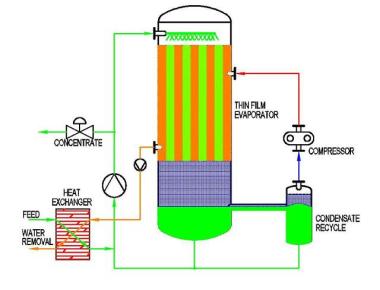
- Feed conditioning: screening/filtration, softening or pH trim, deaeration to reduce scaling/corrosion.
- MVR evaporation: compressor discharge pressure sets ΔT; shell pressure defines boiling point.
- Condensate management: polishing to reuse or discharge specification (conductivity/TOC guard).
- Concentrate handling: to crystallizer/centrifuge/dryer or recycle per ZLD/production requirements.
Can the plant integrate with existing membranes?
Yes. RO/NF pre-concentration commonly precedes MVR to lower energy per unit water removed.
How is scaling managed?
Optimized ΔT/LMTD and velocity, antiscalant dosing, material selection, and scheduled CIP with fouling indicators.
What condensate quality is achievable?
Low conductivity/TOC suitable for reuse after polishing; quality guards ensure consistent compliance.
Get in Touch
Have questions about our products or want to discuss a custom order? Our team is ready to help you.