
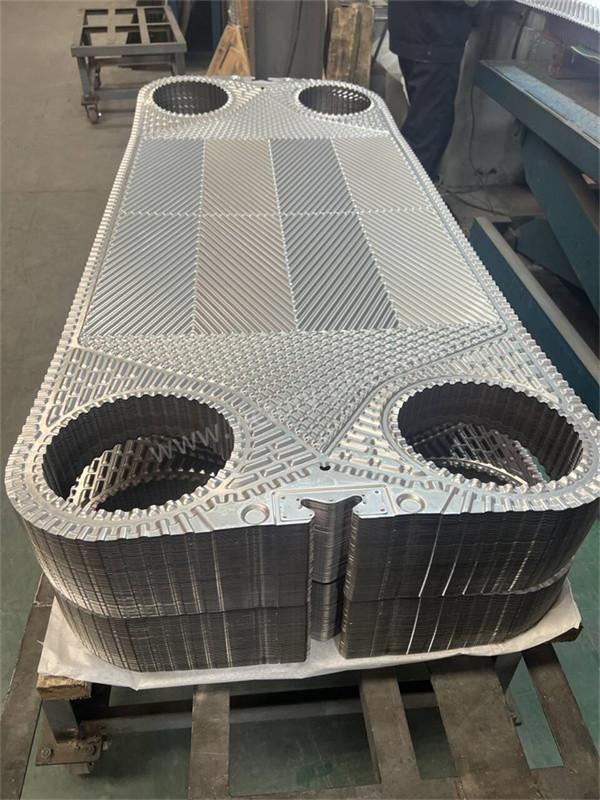
Modular Heat Exchanger Plate for Industrial Operations M20B MX25B MX25M
Product Description
Modular Heat Exchanger Plate for Industrial Operations M20B MX25B MX25M
Heat Exchanger Plates
- Versatility: Their customizable nature allows them to be adapted to different industrial settings and processes, offering a versatile solution.
- Energy Efficiency: By facilitating efficient heat transfer, these plates contribute to energy savings and enhanced operational efficiency.
- Durable Build: Constructed with durable materials, they offer reliability even in demanding industrial applications, reducing maintenance requirements.
Applications:
- Petrochemical and chemical processing
- Oil and gas refining
- Food and beverage processing
- HVAC and refrigeration
- Power generation
- Pharmaceutical manufacturing
The M20B, MX25B, and MX25M customizable heat exchanger plates present an adaptable and efficient solution for industrial heat transfer needs, ensuring optimal performance across a diverse range of industrial applications.
| Brand | Model |
|
|
M3,M6,M6-D,M6M,M6MC,M10B,M10M,M15B,M15M,M15MC,M20M M20B,MX25B,MX25M,M30,TS6,TL6B,TS20,TL10B,TL10P,T20B,T20M,T20P,TL35B P16,P26,P36,AK20,JWP26,JWP36,M6MW,M10BW,MK15BW |
| Material | Specification |
| Stainless Steel |
SUS304 316 316L 310S 904 |
| Titanium and titanium-palladium alloy | TAi TAi-Pd |
| Hastelloy |
C276 D205 B2G |
| Nickel | Ni200 Ni201 |
| Molybdenum | 254 |
Products are mainly suitable for ACCESSEN/GEA (Kelvion)/ APV/ Sondex/ Tranter/ Hisaka/ API/ Funke/ Vicarb/ Mueller/ SWEP/ Fischer/ AGC/ Thermalwave/ ITT/ LHE/ DHP, etc.
Applacations
| Plate material | Suitable for fluids |
| Stainless steel (SUS304.316, etc.) | Purified water, river water, edible oil, mineral oil |
| Titanium and titanium palladium (Ti, Ti-Pd) | Sea water, salt water, salt compounds |
| 20Cr,18Ni,6Mo(254SMO) | Dilute sulfuric acid, dilute salt aqueous solution, inorganic aqueous solution |
| Nickel (Ni) | High temperature, high concentration caustic soda |
| HASTELLOY alloy (C276, D205, B2G) | Concentrated sulfuric acid, hydrochloric acid, phosphoric acid |
Plate heat exchanger plate thickness configuration
- AISI 304 is usually 0.4 or 0.5 mm thickness
- AISI 316 is always 0.5 and 0.6 mm
- 254 SMO (high alloy) typically 0.6 mm
- Titanium plates are always 0.5 and 0.6 mm
- Some have thicker plates (for high pressure applications)
- Some PHEs have 0.4 mm (low pressure operation)
- Hastelloy C-276 (nickel alloy) typically 0.6 mm
Production Process:
- Raw material preparation: High-quality stainless steel plates are selected as raw materials due to their excellent corrosion resistance and thermal conductivity. The plate thickness is determined based on product specifications and design requirements.
- Cutting and leveling: The stainless steel plates are accurately cut using machine tools to meet the design requirements. After cutting, leveling treatment is performed to ensure a smooth and even surface.
- Stamping: The flattened plates undergo stamping using a hydraulic press to create specific herringbone patterns. The resulting plates have a high turbulence coefficient, promoting efficient heat transfer. Precise control is maintained during the stamping process to prevent plate deformation or damage.
- Surface treatment: The plates undergo surface treatment such as polishing, sandblasting, or coating to enhance corrosion resistance and heat transfer performance. The choice of treatment method depends on specific requirements.
- Assembly and inspection: The plates are assembled according to the design requirements, forming a detachable plate heat exchanger with rubber gasket seals or a fully welded plate heat exchanger through argon arc welding. Tight fitting and absence of gaps are ensured during assembly. A rigorous performance pressure test is conducted after assembly, and a factory report is issued to verify compliance with quality standards.
![]()
![]()

Get in Touch
Have questions about our products or want to discuss a custom order? Our team is ready to help you.