
Explosion-Proof Industrial Decanter Centrifuge for Flammable Materials
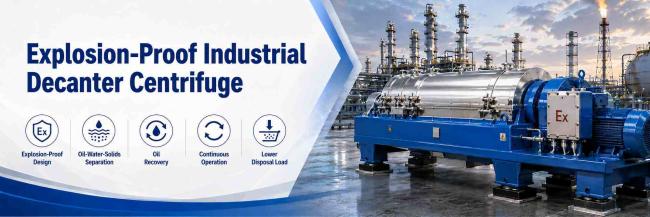
Explosion-Proof Industrial Decanter Centrifuge is designed for continuous separation of oily sludge, flammable industrial slurry, and oil-water-solid mixed materials in potentially hazardous working conditions.
Compared with general-purpose decanter centrifuges, this model focuses on explosion-proof configuration, oil recovery, safe operation, enclosed separation, stable solids discharge, and reduced oily residue volume.
- Refinery oily sludge treatment
- Tank bottom sludge separation
- Coking oily residue treatment
- Oil depot cleaning waste liquid treatment
- DAF scum separation
- API separator sludge treatment
- CPI separator scum treatment
- Oily industrial residue reduction
- Oil-water-solid mixed sludge treatment
- Flammable industrial slurry pretreatment
Explosion-proof configuration should be considered when the feed material or site condition may involve flammable vapor, volatile oil, combustible gas, or ignition risk.
Typical conditions include:
- Oily sludge with volatile hydrocarbons
- Tank bottom sludge from oil storage systems
- Refinery sludge or oil-water-solid residue
- Coking tar residue or oily industrial sludge
- Flammable liquid phase in the feed
- High-temperature oily slurry
- Closed workshop with vapor accumulation risk
- Site classified as a hazardous area
- Customer requirement for explosion-proof motor, electrical cabinet, or instruments
Explosion-proof design is not only a motor issue. It may involve motor, electrical cabinet, sensors, grounding, sealing, ventilation, site layout, and operation safety.
| Configuration Item | Available Options / Purpose |
|---|---|
| Machine type | Two-phase decanter or three-phase tricanter, selected according to separation target |
| Explosion-proof motor | Selected according to site hazardous area requirement |
| Explosion-proof control cabinet | Optional for hazardous working environments |
| Electrical components | Explosion-proof or protected electrical components according to project requirement |
| Grounding design | Helps reduce static electricity risk |
| Sealing design | Helps reduce vapor leakage and odor release |
| Closed structure | Suitable for oily, odorous, or volatile sludge separation |
| Heating interface | Optional when heating is required to reduce oil viscosity |
| Feed conditioning | Homogenization, demulsification, or heating can be integrated before separation |
| Material options | SUS304, SUS316L, or customized materials according to corrosion condition |
| Wear protection | Optional when sludge contains sand, coke particles, or abrasive solids |
| Control system | PLC / VFD control, torque protection, vibration alarm, temperature monitoring |
| Skid-mounted option | Feed pump, dosing unit, heating unit, control cabinet, pipelines, valves, and tanks can be integrated |
The final configuration should be selected according to oil content, water content, solids content, viscosity, temperature, volatility, and safety requirements.
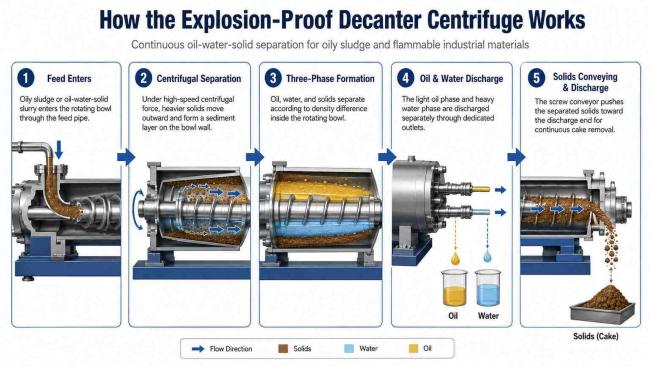
- Oily sludge or oil-water-solid mixed slurry enters the rotating bowl through the feed pipe.
- Under high-speed centrifugal force, the heavier solids move outward and form a sediment layer on the inner wall of the bowl.
- In a three-phase tricanter configuration, the light oil phase, heavy water phase, and solid phase are separated according to density difference.
- The separated oil phase is discharged through the light liquid outlet. The water phase is discharged through the heavy liquid outlet. The screw conveyor continuously pushes the separated solids toward the discharge end.
| Model | Diameter (mm) | Length (mm) | Length-to-diameter rate | G force | Max solid discharge (m³/h) | Weight (kg) | Dimension (L×W×H) (mm) |
|---|---|---|---|---|---|---|---|
| PDC-10 | 250 | 1000 | 4 | 4080 | 0.4 | 1000 | 2410×800×1080 |
| PDC-12 | 4200 | 1350 | 4 | 3500 | 0.6 | 1200 | 2610×800×1080 |
| PDC-12 | 4200 | 1350 | 4.5 | 3180 | 1.2 | 1800 | 3495×840×1180 |
| PDC-18 | 4000 | 1600 | 4.5 | 3180 | 1.2 | 3200 | 3497×1020×1385 |
| PDC-18 | 450 | 2150 | 4 | 2500 | 2 | 3800 | 4447×1080×1385 |
| PDC-20 | 400 | 2250 | 4.5 | 2500 | 3.5 | 4000 | 4580×1140×1470 |
| PDC-21 | 530 | 2280 | 4.3 | 2500 | 5 | 5000 | 4924×1170×1540 |
| PDC-26 | 655 | 2800 | 4.3 | 2270 | 8 | 7000 | 4300×1900×1350 |
Explosion-proof motor, electrical control, grounding, sealing, and safety-related configurations can be selected according to site requirements.
For oily sludge, the machine can separate recoverable oil, water phase, and solid residue continuously.
Recovered oil can reduce waste value loss and improve resource recovery when the feed contains recoverable oil.
The centrifuge helps reduce the volume of oily sludge residue and lowers downstream disposal, drying, or treatment load.
Heating, homogenization, and demulsification can improve oil-water-solid separation when the sludge is viscous or emulsified.
The closed continuous structure helps reduce manual handling, odor release, and exposure risk compared with open batch treatment.
Flexible Industrial Configuration
The system can be configured with feed pump, heating unit, dosing unit, control cabinet, oil tank, water tank, solids conveyor, and skid-mounted accessories.
With proper heating, homogenization, demulsification, stable feeding, and suitable machine configuration, this explosion-proof industrial decanter / tricanter centrifuge can typically help achieve:
- 60–90% recoverable oil recovery, depending on oil content and emulsification level
- 70–95% solid capture rate, depending on particle size and feed condition
- 40–80% oil reduction in water phase, depending on pretreatment and separation target
- 30–70% oily sludge residue volume reduction
- Lower downstream disposal or incineration load
- More stable oil-water-solid separation
- Reduced manual handling of oily sludge
- 16–24 hours/day continuous operation under stable feed and proper safety conditions
Actual results depend on oil content, water content, solids content, viscosity, temperature, emulsification level, demulsifier effect, feed stability, and operating settings.
For strongly emulsified oily sludge, pretreatment testing is recommended before final model selection.
To recommend a suitable explosion-proof industrial decanter or tricanter centrifuge, please provide:
- Feed material name
- Industry application
- Capacity requirement, in m³/h or tons/day
- Oil content
- Water content
- Solids content
- Particle size or solid characteristics
- Viscosity
- Temperature
- Whether the oil is free oil or emulsified oil
- Current pretreatment method, such as heating, demulsification, or homogenization
- Target oil recovery rate
- Target water phase quality
- Target solid residue moisture or oil content
- Volatile or flammable components, if any
- Site hazardous area classification, if available
- Required explosion-proof level or local safety standard
- Corrosion condition
- Abrasion condition
- Required operating hours per day
- Site voltage and control preference
- Need for skid-mounted system or not
For oily or flammable materials, explosion-proof requirement and site safety condition must be confirmed before quotation.
For oily sludge and oil-water-solid mixed materials, a three-phase tricanter centrifuge is usually recommended because it can separate oil, water, and solids at the same time. If the target is only solids-liquid separation, a two-phase decanter may also be considered.
Explosion-proof configuration is required when the material or site may involve flammable vapor, volatile oil, combustible gas, or hazardous area operation. The final requirement depends on the site safety classification and local standards.
Yes. It can be used for tank bottom sludge if the feed contains recoverable oil. Heating, homogenization, and demulsification may be required to improve separation performance.
Heating is often helpful when oily sludge has high viscosity or poor fluidity. It can reduce viscosity and improve oil-water-solid separation. The required temperature should be confirmed according to the material.
It may treat emulsified oily sludge, but pretreatment is usually important. Demulsifier selection, mixing condition, temperature, and residence time can strongly affect separation results.
If you have local customer channels or project resources involving refinery oily sludge, tank bottom sludge, coking oily residue, oil depot cleaning waste liquid, DAF scum, API / CPI separator sludge, or other oily industrial separation projects, Peony welcomes cooperation.
Peony can support local agents, distributors, and project partners with technical model selection, three-phase separation configuration, explosion-proof design recommendation, process proposal, equipment manufacturing, installation guidance, commissioning support, spare parts, and after-sales service.
Please send us your target market, customer type, project background, and cooperation proposal. Our team will evaluate the opportunity and provide technical and commercial support for suitable projects.
Get in Touch
Have questions about our products or want to discuss a custom order? Our team is ready to help you.