
Three Phase Decanter Centrifuge for Grease Trap Waste Separation
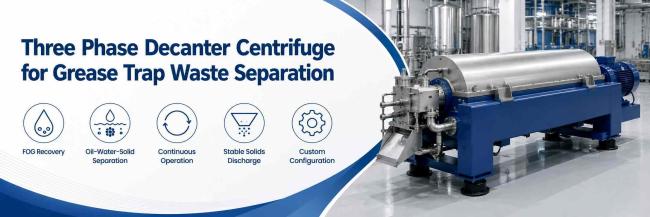
Three Phase Decanter Centrifuge for Grease Trap Waste Separation is designed for continuous separation of grease, wastewater, and solid residue from grease trap waste and FOG-rich collected streams.
Grease trap waste is usually collected from restaurants, commercial kitchens, food courts, canteens, hotels, and food service facilities. It often contains floating grease, wastewater, food particles, sand, settled sludge, fibers, and other suspended solids.
A three phase decanter centrifuge helps separate the collected waste into recoverable grease, liquid phase, and solid residue. This reduces disposal volume, improves waste handling efficiency, and supports grease recovery or further treatment.
This centrifuge is suitable for grease trap waste treatment and FOG waste recovery projects, including:
- Grease trap waste separation
- Grease interceptor waste treatment
- FOG waste recovery
- Restaurant grease waste processing
- Commercial kitchen grease waste separation
- Food service wastewater grease removal
- Grease-rich sludge dewatering
- Oil-water-solid separation from vacuum truck collected waste
- Pretreatment before wastewater treatment
- Resource recovery from grease trap sludge
A three phase decanter centrifuge separates grease trap waste into three main phase.
| Output Phase | Typical Composition | Main Purpose |
|---|---|---|
| Grease Phase | Fats, oils, grease, floating oil layer | Recover usable grease and reduce oil load |
| Liquid Phase | Wastewater and water-rich liquid | Separate water from grease and solids |
| Solid Phase | Food particles, sand, sludge, fibers, grit | Remove heavy residue continuously |
The actual separation result depends on grease content, water content, solids content, particle size, temperature, viscosity, and the condition of collected waste.
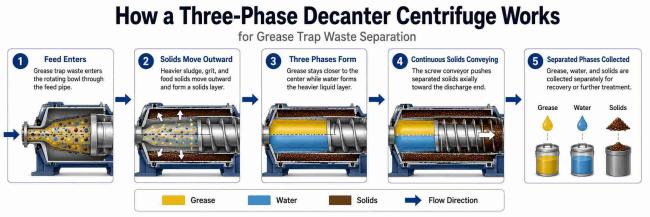
Grease trap waste enters the rotating bowl through the feed pipe.
Under centrifugal force, heavier solids such as sand, grit, food particles, fibers, and sludge move outward and form a solids layer on the bowl wall.
The water-rich liquid phase forms the heavier liquid layer, while the grease phase stays closer to the center as the lighter liquid phase.
The screw conveyor rotates at a controlled differential speed and continuously pushes separated solids toward the discharge end.
At the same time, the grease phase and liquid phase are separated internally and collected according to the process design.
| Model | Diameter (mm) | Length (mm) | Length-to-diameter rate | G force | Max solid discharge (m³/h) | Weight (kg) | Dimension (L*W*H) (mm) |
|---|---|---|---|---|---|---|---|
| PDC-10 | 250 | 1000 | 4 | 4080 | 0.4 | 1000 | 2410*800*1080 |
| PDC-12 | 4200 | 1350 | 4 | 3500 | 0.6 | 1200 | 2610*800*1080 |
| PDC-12 | 4200 | 1350 | 4.5 | 3180 | 1.2 | 1800 | 3495*840*1180 |
| PDC-18 | 4000 | 1600 | 4.5 | 3180 | 1.2 | 3200 | 3497*1020*1385 |
| PDC-18 | 450 | 2150 | 4 | 2500 | 2 | 3800 | 4447*1080*1385 |
| PDC-20 | 400 | 2250 | 4.5 | 2500 | 3.5 | 4000 | 4580*1140*1470 |
| PDC-21 | 530 | 2280 | 4.3 | 2500 | 5 | 5000 | 4924*1170*1540 |
| PDC-26 | 655 | 2800 | 4.3 | 2270 | 8 | 7000 | 4300*1900*1350 |
The centrifuge helps recover grease from trap waste and reduce oil load in the remaining wastewater.
Grease, wastewater, and solids are separated continuously in one machine.
By removing grease and heavy solids, the total mixed waste volume can be reduced before further treatment or disposal.
The screw conveyor continuously removes sludge, sand, grit, and food residue.
Separating grease and solids early helps reduce the load on wastewater treatment, storage tanks, and biological treatment systems.
Sealed structure, continuous discharge, and flushing options can reduce odor, manual cleaning, and operational mess.
Under suitable feed and operating conditions, the system can typically help achieve:
- 60–90% recoverable grease recovery
- 50–80% suspended solids reduction in the separated liquid phase.
- 30–60% reduction in mixed waste volume
- 30–60% reduction in oil load before downstream wastewater treatment.
- 8–24 hours/day continuous operation
Final performance depends on feed composition, grease content, water content, solids content, sand content, temperature, viscosity, emulsification level, and operating parameters.
To recommend a suitable three phase decanter centrifuge for grease trap waste separation, please provide:
- Processing capacity, in m³/h or tons/day
- Feed source: restaurant trap, grease interceptor, vacuum truck waste, or mixed FOG waste
- Grease content
- Water content
- Solids content
- Sand / grit content
- Particle size or impurity type
- Feed temperature
- Feed viscosity or fluidity
- Emulsification level
- Whether large debris is screened out
- Whether heating is available
- Target grease recovery rate
- Target liquid phase quality
- Target solids discharge condition
- Odor control requirement
- Cleaning and flushing requirement
- Required operating hours per day
- Site voltage and control preference
- Need for skid-mounted system or not
It is used to separate grease, wastewater, and solids from grease trap waste or FOG-rich collected waste.
Used cooking oil recovery mainly treats collected waste oil. Grease trap waste separation treats a dirtier mixture of FOG, wastewater, sludge, sand, grit, and food residue.
Usually yes. Screening is recommended to remove plastics, bones, packaging pieces, and large hard objects before centrifugation.
Heating is often helpful because grease viscosity changes with temperature. Suitable heating can improve grease release and separation stability.
Yes. By removing grease and solids early, the system can reduce oil load, suspended solids, and mixed waste volume before downstream treatment.
If you have customer resources or project opportunities in grease trap waste treatment, FOG recovery, restaurant waste treatment, commercial kitchen wastewater, or oil-water-solid separation, Peony welcomes cooperation.
We support distributors, agents, and project partners with model selection, process advice, customized configuration, equipment manufacturing, installation guidance, spare parts, and after-sales service.
Send us your market, customer type, and project details. Our team will help evaluate the suitable separation solution.
Get in Touch
Have questions about our products or want to discuss a custom order? Our team is ready to help you.