
Two Phase Decanter Centrifuge for Livestock Manure
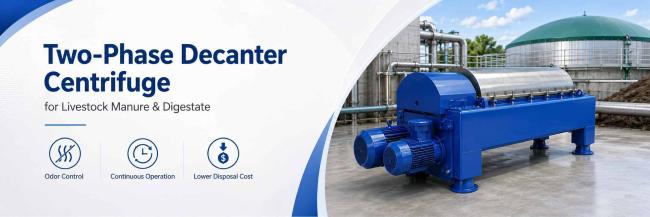
Livestock Manure & Digestate Decanter Centrifuge is designed for continuous solid-liquid separation of livestock manure, digestate, and organic sludge.
For most livestock manure and digestate applications, the recommended configuration is a two-phase decanter centrifuge because the main target is to separate solid manure residue from liquid wastewater, reduce front-end treatment load, and support solid fertilizer utilization.
- Pig farm manure wastewater
- Cattle farm wastewater
- Poultry farm wastewater
- Aquaculture sludge discharge
- Biogas digestate and biogas residue
- Organic sludge from agricultural wastewater treatment
Typical materials include manure solids, fibers, organic sludge, suspended solids, digestate residue, and wastewater liquid phase.
- The feed mainly contains solids + liquid, not oil-water-solid three phases.
- It can continuously remove manure residue, fibers, and organic sludge.
- It helps reduce the load on downstream tanks, lagoons, biological treatment, or evaporation systems.
- If the feed contains recoverable oil or fat.
- If the process requires oil-water-solid separation.
- If the slurry contains large stones, plastic, or straw without proper screening.
- Manure wastewater or digestate enters the rotating bowl through the feed pipe.
- Under centrifugal force, heavier manure solids, fibers, and organic sludge move outward.
- The screw conveyor continuously pushes the separated solids toward the discharge end.
- The clarified liquid phase is discharged through the liquid outlet.
- The separated solids can be used for composting, organic fertilizer, drying, or further resource treatment.

| Model | Diameter (mm) | Length (mm) | Length-to-diameter rate | G force | Max solid discharge (m³/h) | Weight (kg) | Dimension (L×W×H) (mm) |
|---|---|---|---|---|---|---|---|
| PDC-10 | 250 | 1000 | 4 | 4080 | 0.4 | 1000 | 2410×800×1080 |
| PDC-12 | 4200 | 1350 | 4 | 3500 | 0.6 | 1200 | 2610×800×1080 |
| PDC-12 | 4200 | 1350 | 4.5 | 3180 | 1.2 | 1800 | 3495×840×1180 |
| PDC-18 | 4000 | 1600 | 4.5 | 3180 | 1.2 | 3200 | 3497×1020×1385 |
| PDC-18 | 450 | 2150 | 4 | 2500 | 2 | 3800 | 4447×1080×1385 |
| PDC-20 | 400 | 2250 | 4.5 | 2500 | 3.5 | 4000 | 4580×1140×1470 |
| PDC-21 | 530 | 2280 | 4.3 | 2500 | 5 | 5000 | 4924×1170×1540 |
| PDC-26 | 655 | 2800 | 4.3 | 2270 | 8 | 7000 | 4300×1900×1350 |
| Item | Typical Range / What to Confirm |
|---|---|
| Feed material | Pig manure wastewater, cattle farm wastewater, poultry wastewater, aquaculture sludge, digestate |
| Solids content | Usually 2–12% |
| Oil content | Usually low; not the main target |
| Particle characteristics | Fibrous, organic, sticky, uneven particle size |
| Viscosity | Low to medium; may increase with high fiber content |
| Temperature | Usually 15–60°C |
| Corrosion risk | Medium; confirm ammonia, chloride, pH, and cleaning chemicals |
| Capacity requirement | Confirm by m³/h or tons/day |
| Target result | Lower SS, solid recovery, odor load reduction, fertilizer use |
- Continuous automatic operation
- Reduced front-end treatment load
- Better separation of manure solids and liquid
- Lower suspended solids in wastewater
- Supports solid fertilizer utilization
- Helps reduce odor source load
- Compact footprint
- Optional wear protection for sand-containing manure slurry
With proper screening, grit removal, and stable feeding, this decanter centrifuge can typically achieve:
- 75–90% solid capture rate
- 60–85% suspended solids reduction
- 18–30% cake solids content
- 70–82% final cake moisture
- 25–50% slurry volume reduction
- 30–60% lower downstream treatment load
- 16–24 hours/day continuous operation
Actual results depend on manure type, fiber content, sand content, feed solids, polymer dosing, and operating settings. Pilot testing is recommended when the feed varies significantly.
Is this machine suitable for pig manure and biogas digestate?
Yes. It is suitable for pig manure wastewater, cattle manure wastewater, poultry wastewater, aquaculture sludge, and biogas digestate.
Is polymer dosing required?
It is optional. Polymer dosing can improve solid capture and cake formation, especially when the feed contains fine suspended solids.
Is grit removal necessary?
Yes, it is strongly recommended when the manure slurry contains sand, stones, or mineral particles. This reduces wear and improves stable operation.
Can the separated solids be used as fertilizer?
Yes. The separated solid cake can be used for composting, drying, organic fertilizer production, or further resource treatment, depending on local regulations and feed composition.
What information is needed for model selection?
Please provide feed type, capacity, solids content, fiber content, sand content, target cake moisture, operating hours, and downstream treatment plan.
To recommend a suitable model, please share:
- Farm type
- Feed material name
- Capacity requirement
- Solids content
- Sand or grit content
- Fiber content
- Target cake moisture
- Polymer dosing preference
- Operating hours
- Downstream use of solid cake
- Site voltage or control preference
Our engineering team can suggest a suitable two-phase decanter centrifuge configuration for your livestock manure or digestate treatment project.
Contact Peony for Partnership
If you have local customer channels or project resources in livestock manure treatment, biogas digestate, organic fertilizer production, or agricultural wastewater treatment, Peony welcomes cooperation.
Send us your target market, customer type, project background, and cooperation proposal. Our team will evaluate the opportunity and provide technical and commercial support for suitable projects.
Get in Touch
Have questions about our products or want to discuss a custom order? Our team is ready to help you.