
ASTM A182 F304 Stainless Steel Tube Sheet Heat Exchanger Tube Plates
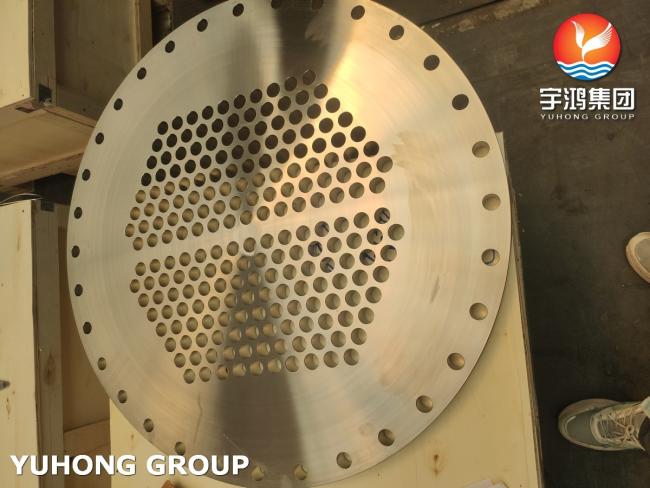
ASTM A182 F304 / UNS S30400 Stainless Steel Tubesheet Heat Exchanger Tube Plates
A tubesheet (or tube plate) is a crucial component in heat exchangers and other similar systems. The design can vary based on the type of heat exchanger (shell-and-tube, air-cooled, etc.) and the specific requirements for pressure, temperature, and fluid type. Tubesheet provides structural support for the tubes, preventing them from moving and ensuring a tight seal. It separates the two fluid streams, allowing heat transfer while preventing mixing. The available materials including: stainless steel, carbon steel, titanium, alloy steel and cladding steel depending on the using environment & application.
Specification
| Type of materials | Technical requirements * according to |
| Duplex Stainless Steel | ASTM/ASME SA182 F44, F45, F51, F53, F55, F60, F61 |
| Stainless Steel | ASTM/ASME SA182 F304,304L,F316,316L, F310, F317L, F321, F347 |
| Carbon Steel | ASTM/ASME A105, A350 LF1, LF2, A266, A694, A765 Gr.2 |
| Alloy Steel | ASTM/ASME SA182 F1, F5, F9, F11, F12, F22, F51, A350-LF3 |
| Titanium | ASTM/ASME SB381, Gr.1, Gr.2, Gr.5, Gr.7, Gr.12, Gr.16 |
| Copper Nickel | ASTM/ASME SB151, UNS 70600(Cu-Ni 90/10), 71500(Cu-Ni 70/30) |
| Brass, Al-brass | ASTM/ASME SB152 UNS C10100, C10200,C10300,C10800,C12200 |
| Nickel Alloys | ASTM/ASME SB169,SB171, SB564, UNS 2200, UNS 4400, UNS 8825 UNS 6600, UNS 6601, UNS 6625 |
| Alloy 20 | ASTM/ASME SB472 UNS 8020 |
| Hastelloy | ASTM/ASME SB564, UNS10276 ( C 276 ) |
| Claded materials | ASTM/ASME SB898, SB263, SB264 or closer explosion cladding, making materials of 2 in 1 or 3 in 1. |
| Titanium- Steel, Nickel-Steel,Titanium- Copper, Stainless Steel- Carbon Steel, Alloys- Steel etc. |
Types of Tubesheets:
-
Flat Tubesheets: Commonly used in shell-and-tube heat exchangers. They provide a flat surface for the tubes to be installed.
-
Drilled Tubesheets: Feature holes where tubes are inserted. The hole size and spacing are critical for efficient heat transfer.
-
Partition Tubesheets: Used in applications where separate fluid streams are required, often creating different sections in a heat exchanger.
Design Considerations:
-
Thickness: Tubesheets are designed to withstand pressure and temperature variations, so the thickness may vary based on these factors.
-
Hole Size and Spacing: Engineers must consider the diameter and arrangement to optimize fluid flow and heat transfer.
-
Thermal Expansion: Due to changes in temperature, tubesheets must accommodate thermal expansion to prevent stress or damage.
Welding and Joining:
-
Tubesheet Welding: The tubes are often welded to the tubesheet for leak prevention, ensuring a strong connection that can withstand pressure fluctuations.
-
Seal Welds: These may be added to improve sealing between the tube and the tubesheet.
-
Manufacturing Techniques: Precision is key in the manufacturing process to avoid any misalignment when inserting tubes.
Corrosion Resistance:
-
Given the harsh conditions (chemicals, heat), choosing the right material is essential to prevent corrosion. Stainless steel and titanium are frequently utilized.
-
Protective Coatings: Sometimes, coatings are applied to enhance corrosion resistance, especially in aggressive environments.
Maintenance:
-
Regular inspection schedules can help catch problems early, extending the lifespan of the heat exchanger.
-
Cleaning procedures may be necessary to remove deposits that can accumulate on the tubesheet over time.
Application
-
Chemical Process Plants: Used for cooling, heating, or condensing fluids.
-
Power Generation: Critical in steam generation and cooling systems.
-
Oil & Gas Industry: Involved in processes like heat recovery and refrigeration.
Get in Touch
Have questions about our products or want to discuss a custom order? Our team is ready to help you.