
Alloy Steel P22 High Frequency Welded Finned Tube For Heat Recovery
Alloy Steel P22 High Frequency Welded Finned Tube For Heat Recovery
Overview
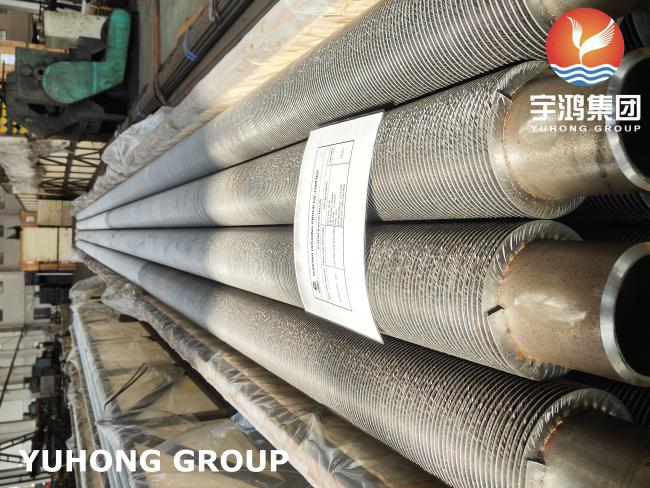
Alloy steel High Frequency Welded (HFW) fin tubes are commonly used in various industrial applications where heat transfer efficiency and corrosion resistance are crucial. These tubes are constructed by welding fins onto a base tube, typically using a high-frequency welding process.
High Frequency Welded (HFW) fins are commonly used in the manufacturing of finned tubes. These fins are created by welding a strip of material onto a base tube using a high-frequency welding process. The high-frequency welding method offers several advantages, including:
- Efficiency: HFW fins can be produced efficiently and quickly, making them a cost-effective option for mass production.
- Quality: The high-frequency welding process results in strong and consistent bonds between the fin and the tube, ensuring reliable performance.
- Heat Transfer: HFW fins provide enhanced heat transfer capabilities due to the increased surface area created by the fins, improving the overall efficiency of heat exchangers and similar systems.
- Versatility: HFW fins can be made from various materials, including carbon steel, stainless steel, and alloy steel, allowing for customization based on specific application requirements.
- Corrosion Resistance: Depending on the material used, HFW fins can offer excellent corrosion resistance properties, making them suitable for use in challenging environments.
High Frequency Welded Finned Tube Reference
| Fin Type | Base Pipe Material | General Fin Material | Outside Diameter of Base Pipe | Fin Pitch | Fin Height | Fin Thickness |
|---|---|---|---|---|---|---|
| Frequency Welded (HFW) | Stainless steel Alloy steel Carbon steel | Stainless steel Alloy steel Carbon steel | 16-219MM | 3-25MM | 5-30MM | 0.8-3MM |
A335 P22 Chemical Composition
|
Grade |
C |
Mn |
P |
S |
Si |
Cr |
Mo |
|
P22 |
0.05-0.15 |
0.30-0.60 |
0.025 |
0.025 |
0.50 max |
1.90-2.60 |
0.87-1.13 |
A335 P22 Mechanical properties
|
Grade |
Tensile strength(MPa) |
Yield strength(MPa) |
Elongation(%) |
Impact energy(J) |
Hardness |
|
P11 |
≥ 415 |
≥ 205 |
≥ 22 |
≥ 35 |
≤ 163HB |
|
P12 |
≥ 415 |
≥ 220 |
≥ 22 |
≥ 35 |
≤ 163HB |
|
P22 |
≥ 415 |
≥ 205 |
≥ 22 |
≥ 35 |
≤ 163HB |
|
P5 |
≥ 415 |
≥ 205 |
≥ 22 |
≥ 35 |
≤ 187HB |
|
P91 |
585~760 |
≥ 415 |
≥ 20 |
≥ 35 |
≤ 250HB |
|
P92 |
≥ 620 |
≥ 440 |
≥ 20 |
≥ 35 |
250HB |
Application
-
Heat Exchangers: HFW fin tubes are widely used in heat exchangers for applications such as HVAC systems, chemical processing, power generation, and refrigeration.
-
Boilers: These tubes are utilized in boilers for power plants, industrial facilities, and other applications where high-pressure and high-temperature conditions are present.
-
Oil and Gas Industry: HFW fin tubes are employed in oil refineries, petrochemical plants, and offshore platforms for heat recovery, process heating, and other thermal applications.
-
Air Conditioning and Refrigeration: These tubes are used in air conditioning units, refrigeration systems, and heat pumps to enhance heat transfer efficiency.
-
Automotive Industry: HFW fin tubes can be found in automotive radiators and heat exchangers to manage engine temperatures effectively.
-
Chemical Processing: Industries such as pharmaceuticals, food processing, and specialty chemicals utilize HFW fin tubes for precise temperature control and efficient heat exchange.
-
Power Generation: In power plants, these tubes are used in condensers, heat recovery steam generators (HRSGs), and other heat transfer systems.
-
Renewable Energy: HFW fin tubes play a role in renewable energy applications like solar thermal systems for efficient heat collection and transfer.
Get in Touch
Have questions about our products or want to discuss a custom order? Our team is ready to help you.