
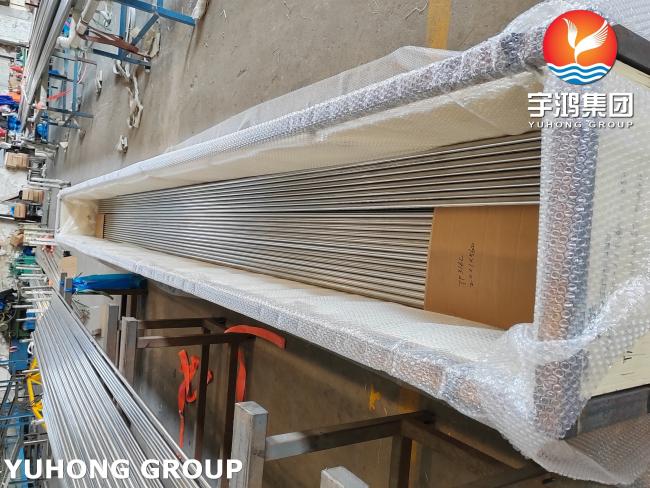
ASTM A269 TP316L Stainless Steel Seamless Tube Bright Annealed Tubing
ASTM A269 / ASME SA269 TP316L Bright Annnealed Stainless Steel Seamless Tube
ASTM A269 tubing cover pickling and bright annealed surface finish. A269 TP316L bright annealed seamless tubes represent an excellent choice for applications requiring both durability and performance. Their resistance to corrosion, high-temperature resilience, and smooth surface finish make them particularly favored in industries where material integrity is critical. Dimensions of the tubes can range widely, from small diameters (under 1 inch) to larger sizes (up to several inches). Wall thickness can also vary based on specific application requirements.
Advantages
- Versatility: Can be used in a wide range of temperatures and environments, making it suitable for many industries.
- Long Lifespan: High resistance to corrosion contributes to longer service life and lower overall maintenance costs.
- Ease of Fabrication: TP316L can be readily welded and fabricated using standard techniques, facilitating its use in complex assemblies.
- Health and Safety: Its hygienic properties make it a safe choice for food and pharmaceutical production.
Equivalent Grades of ASTM A269 TP316L Stainless Steel Seamless Tube
| GRADE |
WERKS TOFF NR. |
UNS | JIS | BS | GOST | AFNOR | EN |
| SS 316L | 1.4404 / 1.4435 | S31603 | SUS 316L | 316S11 / 316S13 | 03Ch17N14M3 / 03Ch17N14M2 | Z3CND17‐11‐02 / Z3CND18‐14‐03 | X2CrNiMo17-12-2 / X2CrNiMo18-14-3 |
Chemical Composition of ASTM A269 TP316L Stainless Steel Seamless Tube
| Grade | C | Mn | Si | P | S | Cr | Mo | Ni | Fe |
| SS 316L | 0.035 max | 2.0 max | 1.0 max | 0.045 max | 0.030 max | 16.00 - 18.00 | 2.00 - 3.00 | 10.00 - 14.00 | 68.89 min |
Physical Properties of ASTM A269 TP316L Stainless Steel Seamless Tube
Grade |
Density (kg/m3) |
Elastic Modulus (GPa) |
Mean Co-eff of Thermal Expansion (µm/m/°C) | Thermal Conductivity (W/m.K) |
Specific Heat 0-100°C (J/kg.K) |
Elec Resistivity (nΩ.m) |
|||
| 0-100°C | 0-315°C | 0-538°C | At 100°C | At 500°C | |||||
| 316/L/H | 8000 | 193 | 15.9 | 16.2 | 17.5 | 16.3 | 21.5 | 500 | 740 |
Manufacturing Process
- Steelmaking: The initial step involves melting scrap stainless steel and alloying it with various elements to produce the desired chemistry.
- Piercing: The solid round steel bars are heated and pierced to form a hollow tube, often using a rotary piercing process.
- Elongation: The hollow tube is elongated to increase its length and achieve the desired diameter.
- Annealing: Tubes are heat-treated to relieve stresses and enhance their properties. The bright annealing process occurs in a controlled atmosphere, preventing oxidation.
- Pickling/Passivation: Post-annealing, tubes undergo a treatment to remove scale and enhance the protective oxide layer that contributes to corrosion resistance.
- Testing: Various tests such as hydrostatic testing, eddy current testing, and dimensional checks are conducted to ensure quality and adherence to specifications.
Applications
-
Pharmaceutical Industry: Used in the construction of tanks, pipelines, and instrumentation where cleanliness and corrosion resistance are vital.
-
Food and Beverage: Employed in applications such as milk processing and brewing equipment.
-
Chemical Manufacturing: Often used in the manufacture of reactors, evaporators, and heat exchangers.
-
Oil and Gas: Suitable for use in offshore applications where corrosion resistance is a critical aspect.
-
Marine Applications: Commonly used in marine environments due to its resistance to seawater corrosion.
Get in Touch
Have questions about our products or want to discuss a custom order? Our team is ready to help you.