
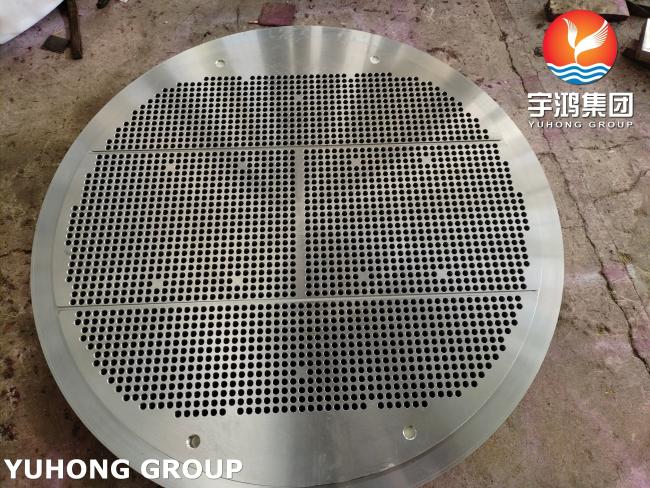
Alloy Steel Forgings Sa336 F5n Tubesheet Heat Exchanger Parts
ALLOY STEEL FORGINGS SA336 F5N TUBESHEET HEAT EXCHANGER PARTS
The SA336 F5N material is a type of forged alloy steel typically used in high-temperature and pressure applications, such as in boilers, pressure vessels, or heat exchangers.A tubesheet is a thick plate that contains holes to hold the tubes of a heat exchanger or boiler. It serves as a critical component in ensuring the integrity and efficiency of these systems, by keeping the tubes fixed in place while allowing for the transfer of heat.
Key points about ASME SA336:
-
Material Composition: The ASME SA336 specification covers several grades of alloy steel used in high-temperature applications. Some of the most commonly used grades under this specification include:
- Grade F1: Carbon-Manganese-Silicon alloy.
- Grade F5: Chromium-Vanadium alloy.
- Grade F9: Chromium-Molybdenum-Vanadium alloy.
- Grade F11: Chromium-Molybdenum alloy.
- Grade F22: Chromium-Molybdenum alloy (more resistant to oxidation).
These alloys are specifically designed to resist heat, pressure, and corrosion at elevated temperatures.
Common Grades:
- SA336 F5N: A common grade in the SA336 standard, used in heat exchangers, pressure vessels, and other high-temperature applications.
- SA336 F9: Known for its improved resistance to oxidation and creep at higher temperatures, commonly used in more demanding power generation environments.
ASME SA336 Grade Table
| Grade | Alloy Composition | Typical Applications | Properties |
|---|---|---|---|
| F1 | Carbon-Manganese-Silicon | Pressure vessels, steam boilers, and heat exchangers at temperatures up to 900°F (480°C). | Moderate strength, good toughness and weldability at high temperatures. |
| F5 | Chromium-Vanadium (0.5–0.75% Cr, 0.1–0.2% V) | Steam turbines, heat exchangers, gas turbines, and high-temperature piping systems. | Improved resistance to creep, oxidation, and high-temperature fatigue. |
| F5B | Chromium-Vanadium | High-temperature structural components. | Similar to F5 but with enhanced properties for better high-temperature performance. |
| F9 | Chromium-Molybdenum-Vanadium (0.5–0.6% Cr, 0.25–0.35% Mo, 0.1–0.15% V) | Power plant pressure vessels, heat exchangers, boilers, turbines, and pipelines. | Higher creep strength and oxidation resistance, suitable for higher-temperature applications (up to 1050°F or 565°C). |
| F11 | Chromium-Molybdenum (1–1.5% Cr, 0.5–0.8% Mo) | High-temperature piping, boilers, pressure vessels, and heat exchangers. | Offers good strength and resistance to thermal fatigue and corrosion. Commonly used in fossil-fuel power plants and refineries. |
| F22 | Chromium-Molybdenum (2.25% Cr, 1% Mo) | High-temperature service, superheaters, reheater tubes, steam turbines. | Excellent high-temperature strength and resistance to creep, oxidation, and corrosion. Common in fossil-fuel plants and chemical refineries. |
| F91 | Chromium-Molybdenum-Vanadium (9% Cr, 1% Mo, 0.2% V) | Superheater tubes, boilers, steam turbines in ultra-supercritical plants, power plant piping. | Excellent resistance to high-temperature oxidation, corrosion, and creep. Used in high-stress, high-temperature applications. |
| F92 | Chromium-Molybdenum-Vanadium (9% Cr, 1% Mo, 0.2% V) | Boilers, pressure vessels, and heat exchangers. | Very high creep resistance and excellent weldability at elevated temperatures, widely used in fossil fuel and nuclear power plants. |
Get in Touch
Have questions about our products or want to discuss a custom order? Our team is ready to help you.