
Aluminium Brass ASME SB111 C68700 U Bend Heat Exchanger Tube For Refinery Coolers
ASME SB111 C68700 U Bend Boiler Tube Application
1. Marine & Offshore Systems
- Seawater Cooled Condensers & Heat Exchangers: Shipboard condensers (main engine cooling), Offshore oil rig heat exchangers (cooling hydraulic systems, lube oil), Desalination plants (multi-stage flash evaporators).
2. Power Generation (Fossil & Nuclear)
- Steam Surface Condensers: Coastal/nuclear power plants (seawater-cooled condensers), Waste heat recovery units (exhaust gas boilers).
3. Chemical & Petrochemical Processing
- Application: Corrosive Fluid Heat Transfer: Refinery coolers (hydrocarbon processing), Ammonia condensers (fertilizer plants).
4. HVAC & Refrigeration
- Chillers & Evaporators: Compact design fits shell-and-tube evaporators (e.g., industrial chillers), Seawater-cooled HVAC (tropical coastal buildings), Industrial refrigeration systems.
5. Industrial Process Cooling
- High-Temperature/Pressure Exchangers: Meets strict dimensional tolerances for high-pressure systems, Brewery/distillery wort coolers, Pulp & paper mill heat recovery.
ASME SB111 C68700 Bend Boiler Tube Strength
1. Mechanical Properties of C68700 Aluminum Brass The SB111 specification ensures the tube meets certain strength criteria.
Typical room-temperature properties for C68700 (ASTM B111, ASME SB111) are:
| Property | Value |
| Tensile Strength (UTS) | 380 – 520 MPa (55,000 – 75,000 psi) |
| Yield Strength (0.2% Offset, YS) | 140 – 310 MPa (20,000 – 45,000 psi) |
| Elongation (in 50mm) | 35 – 45% (varies with temper) |
| Hardness (Rockwell B) | 50 – 85 HRB |
| Modulus of Elasticity | 100 – 110 GPa (14.5 – 16 Msi) |
2. Factors Affecting Strength
A. Temperature Effects
- At Elevated Temperatures (~150–250°C / 302–482°F):
- Tensile strength decreases by ~20–30%.
- Risk of creep deformation if stressed near yield limits.
- Below 0°C (32°F):
- Becomes slightly stronger but more brittle (impact resistance drops).
B. Corrosion & Erosion Impact
- Dezincification or pitting can reduce effective wall thickness, lowering pressure-bearing capacity.
- Erosion-corrosion (high-velocity seawater) may accelerate wear.
C. U-Bend Stress Considerations
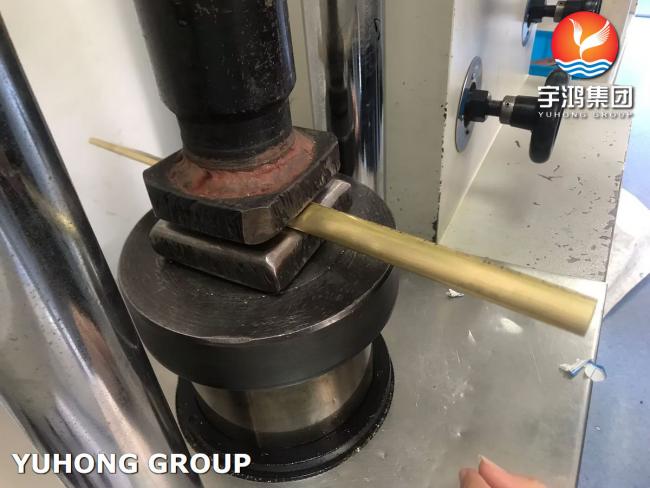
- The bent region is work-hardened, increasing local strength but risking stress cracking if improperly annealed.
- Residual stresses from bending may require stress relief annealing.
3. Strength Comparison with Other Heat Exchanger Tubes
| Material | Tensile Strength (MPa) | Yield Strength (MPa) | Key Advantage |
| C68700 (Al Brass) | 380–520 | 140–310 | Best for seawater corrosion |
| C70600 (90/10 Cu-Ni) | 290–400 | 120–200 | Better sulfide resistance |
| C71500 (70/30 Cu-Ni) | 350–550 | 140–350 | Higher strength than C70600 |
| Titanium Gr. 2 | 345–483 | 275–345 | Lightweight, no corrosion |
| Carbon Steel | 400–550 | 205–250 | Cheap but rusts easily |
4. Design & Operational Strength Limits
- Max Allowable Pressure: Depends on tube diameter/wall thickness (use ASME BPVC Section VIII for calculations).
- Fatigue Life: Excellent for cyclic thermal loads (U-bend accommodates expansion).
- Avoid: Over-tightening in tube sheets (can collapse thin-walled tubes). Excessive vibration (may cause fretting wear).
5. Testing & Certification
- Hydrostatic Test: Ensures no leaks at 1.5x design pressure.
- Eddy Current/UT Testing: Checks for defects affecting strength.
- Certifications: ASTM B111 / ASME SB111, EN 12451 (EU).
Get in Touch
Have questions about our products or want to discuss a custom order? Our team is ready to help you.