
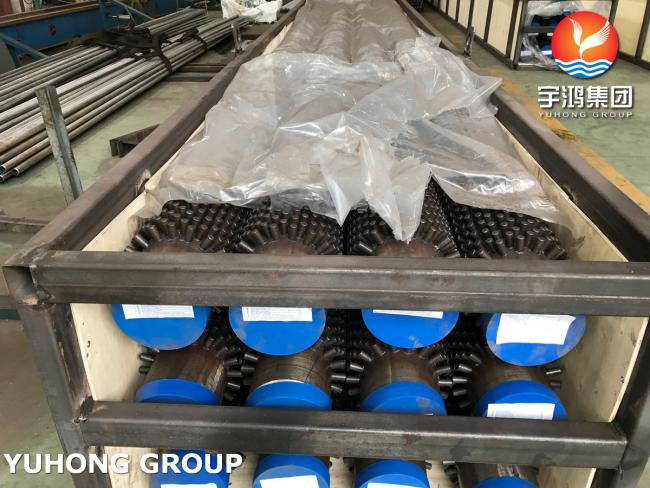
ASTM A213 T9 Studded Alloy Steel Seamless Tube For Air Heaters And Economizers
Key Features of ASTM A213 T9 Studded Tube
1. Material Composition
- Grade T9 is a low-alloy steel containing ~9% chromium and ~1% molybdenum, providing improved oxidation and corrosion resistance at elevated temperatures compared to carbon steel.
- Conforms to ASTM A213, which covers seamless ferritic and austenitic steel boiler, superheater, and heat-exchanger tubes.
2. Studded Design
- Studs (pins or projections) are resistance-welded to the tube's outer surface to improve heat transfer in gas-to-liquid or gas-to-steam applications.
- Common stud materials include carbon steel, stainless steel, or alloy steel depending on service conditions.
3. Standards & Specifications
- ASTM A213: Covers seamless tubes for high-temperature service.
- ASME SA213: Equivalent ASME Boiler and Pressure Vessel Code version.
- Stud welding standards: Typically follows AWS C1.1 for resistance welding.
4. Benefits of Studded Tubes
- Enhanced heat transfer due to increased surface area.
- Reduced fouling & improved gas flow in flue gas applications.
- Better durability in high-temperature corrosive environments.
5. Manufacturing & Testing
- Seamless tube fabrication (mandrel-rolled or extruded).
- Stud welding performed under controlled conditions.
- Nondestructive testing (NDT) such as hydrostatic, ultrasonic, or eddy current testing.
- Chemical & mechanical testing per ASTM A213 requirements.
ASTM A213 T9 Studded Tube Application
The ASTM A213 T9 studded tube is specifically designed for high-temperature, high-pressure environments where enhanced heat transfer and resistance to oxidation/corrosion are critical. Below are some key applications where this tube excels:
1. Waste Heat Recovery Boilers (WHRB)
- Used in HRSGs (Heat Recovery Steam Generators) in power plants and refineries to recover heat from exhaust gases (e.g., gas turbine flue gas).
Why T9?
- Resists sulfidation & oxidation in flue gas environments (up to ~1,100°F / 593°C).
- Studs increase heat absorption efficiency from hot gases.
2. Coal-Fired & Biomass Boilers
- Convection pass & economizer sections where flue gas temperatures are high (~800–1,200°F / 427–649°C).
Why Studded?
- Prevents ash fouling by disrupting gas flow.
- Improves heat pickup in low-temperature zones.
3. Fluidized Bed Boilers (CFB & BFB)
- Used in circulating fluidized bed (CFB) and bubbling fluidized bed (BFB) boilers.
Why T9?
- Resists erosion-corrosion from abrasive bed materials.
- Molybdenum content helps with creep resistance under cyclic loads.
4. Refinery & Petrochemical Heaters
- Fired heater convection sections (e.g., crude oil heaters, reformer furnaces).
Why Studded Tubes?
- Maximizes heat recovery from hot combustion gases.
- Reduces hot spots by improving heat distribution.
5. Air Heaters & Economizers
- Regenerative/recuperative air heaters in power plants.
Why T9?
- Handles sulfur-bearing flue gases better than carbon steel.
- Studs prevent fly ash buildup and improve thermal efficiency.
Get in Touch
Have questions about our products or want to discuss a custom order? Our team is ready to help you.