
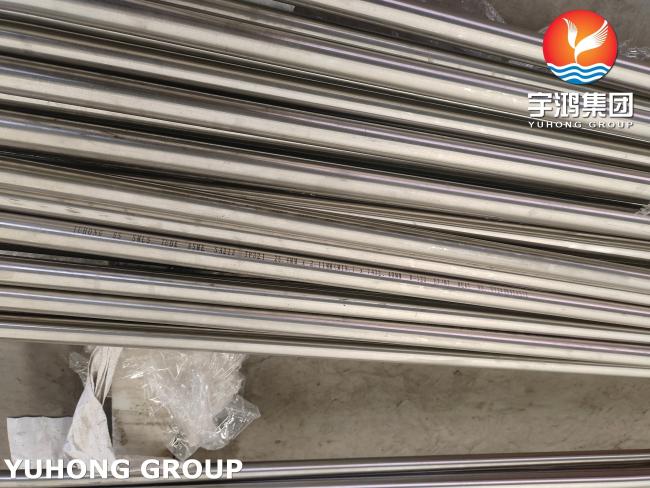
ASME SA213 TP321 Stainless Steel Seamless Tube U Bend Tube Heat Exchanger Tube
ASTM A213 TP321 / UNS S32100 Seamless Stainless Steel Tube Heat Exchanger Tubing
The titanium (Ti) addition, which is typically ≥ 5x(C+N)%, prevents chromium carbide precipitation over time. During the critical "sensitization" temperature range (~800°F - 1500°F / 427°C - 815°C), titanium carbides/nitrides form preferentially to chromium carbides, thereby "sequestering" the carbon and leaving the chromium in solution to maintain corrosion resistance.
Note: This stabilization process requires time at temperature. In very rapid thermal cycles (like certain welding heat-affected zones), there might not be sufficient time for the titanium to fully do its job, potentially leaving a small zone susceptible. This is why proper heat treatment post-fabrication is still critical for severe service.
Equivalent Grade of ASTM A213 TP321/TP321 Stainless Steel Seamless Tubing
| Grade | UNS No | Old British | Euronorm | Swedish SS | Japanese JIS | ||
| BS | En | No | Name | ||||
| 321 | S32100 | 321S31 | 58B, 58C | 1.4541 | X6CrNiTi18-10 | 2337 | SUS 321 |
| 321H | S32109 | 321S51 | - | 1.4878 | X10CrNiTi18-10 | - | SUS 321H |
Mechanical & Physical Properties of ASTM A213 TP321/TP321 Stainless Steel Seamless Tubing
| Density | 8.0 g/cm3 |
| Melting Point | 1454 °C (2650 °F) |
| Tensile Strength | Psi – 75000 , MPa – 515 |
| Yield Strength (0.2%Offset) | Psi – 30000 , MPa – 205 |
| Elongation | 35 % |
Chemical Composition of ASTM A213 TP321/TP321 Stainless Steel Seamless Tubing
| SS 321 | SS 321H | |
| Ni | 9 – 12 | 9 – 12 |
| Cr | 17 – 19 | 17 – 19 |
| C | 0.08 max | 0.04 – 0.10 |
| N | 0.10 max | |
| Fe | Balance | |
| Mn | 2 max | 2 max |
| Si | 0.75 max | 0.75 max |
| S | 0.03 max | 0.03 max |
| P | 0.045 max | 0.045 max |
| Ti | 5xC min 0.60% max |
4xC min 0.60% max |
It's Not One Grade, But a Family (Gr. T321H).
-
The Nuance: Many people specify "TP321" without realizing there's a crucial high-temperature cousin: TP321H.
-
TP321 has a broader carbon range (0.04-0.08%).
-
TP321H has a controlled, higher carbon content (0.04-0.10%) with a mandatory minimum of 0.03%. This higher carbon directly increases its short-term high-temperature tensile and creep strength.
-
-
The Implication: For lower-temperature corrosion applications, TP321 is fine. But for high-temperature pressure parts like superheaters and headers where creep strength is the design-limiting factor, TP321H is the mandatory choice. Using the wrong one can lead to under-design and premature failure.
The "Solution-Annealed" Condition is Everything
-
The Nuance: The optimal properties of TP321 are achieved only in the solution-annealed condition (typically heated to ~1950°F / 1065°C and rapidly quenched). This state dissolves all carbides into a uniform austenitic structure.
-
The "Gotcha": Any subsequent welding or high-temperature service puts the material back into the "sensitization" temperature range. While the Ti provides protection, the microstructure is changing. For critical applications, verifying the condition of the tube after fabrication (often via metallography or corrosion tests like ASTM A262 Practice E) is essential.
1. Power Generation (Fossil Fuel & Biomass)
2. Petrochemical & Refining
3. Chemical Processing Industry
4. Oil & Gas (Upstream & Midstream)
5. Other Industrial Applications
Get in Touch
Have questions about our products or want to discuss a custom order? Our team is ready to help you.