
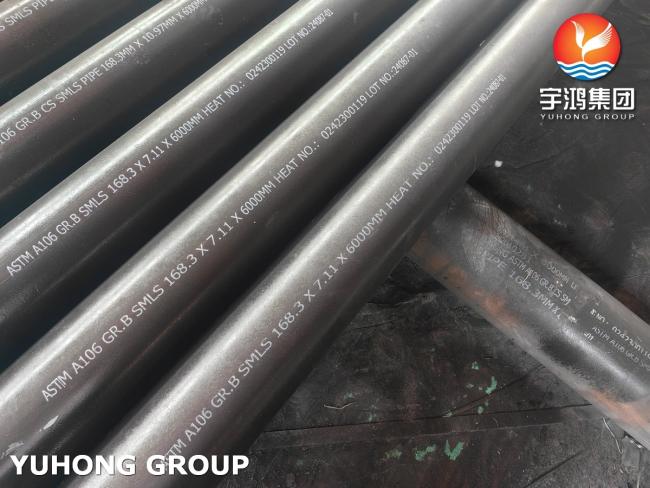
ASTM A106 GR.B Carbon Steel Heat Exchanger Seamless Tube for Oil & Gas
ASTM A106 GR.B Carbon Steel Heat Exchanger Seamless Tube for Oil & Gas
1. Overview of ASTM A106 GR.B Standard
ASTM A106 is the American Society for Testing and Materials (ASTM) standard that specifies seamless carbon steel pipes for high-temperature services.
-
Grade B is a middle-grade material in the specification, offering excellent mechanical properties such as tensile strength and yield strength while maintaining good weldability and machinability characteristics.
-
These tubes are commonly utilized in heat exchangers, boilers, superheaters, pipelines, and pressure vessels due to their ability to withstand high heat and pressure.
2. Key Features
-
Material Composition:
ASTM A106 GR.B is made of seamless carbon steel with typical alloying elements, including carbon (C), manganese (Mn), phosphorus (P), sulfur (S), and silicon (Si). The chemical makeup ensures high strength while providing resistance to wear and corrosion. -
Seamless Construction:
The seamless nature ensures uniformity in shape and strength, making the material free from internal or external welding joints. This reduces the risk of failure under pressure and high-temperature applications. -
Heat Exchanger Suitability:
Its thermal stability and resistance to mechanical stress make it an ideal choice for use in heat exchanger tubing, where efficient heat transfer is crucial.
3. Technical Specifications
-
Chemical Composition (Typical):
Element Maximum Percentage (%) Carbon (C) ≤ 0.30 Manganese (Mn) 0.29–1.06 Phosphorus (P) ≤ 0.035 Sulfur (S) ≤ 0.035 Silicon (Si) 0.10–0.35 -
Mechanical Properties:
Property Value (Minimum) Tensile Strength 60,000 psi (415 MPa) Yield Strength 35,000 psi (240 MPa) Elongation (%) As per ASTM A530/A530M
4. Applications in Heat Exchangers
In a heat exchanger, the critical function of seamless carbon steel tubing is efficient transfer of heat between two media. ASTM A106 GR.B tubes meet these demands due to their:
- High thermal conductivity for effective heat transfer.
- Strength to withstand high-pressure fluids or gas.
- Resistance to thermal shock during abrupt temperature changes.
- Compatibility with various corrosion inhibitors used in heat exchanger applications.
Typical Uses:
- Condensers
- Boilers
- Economizers
Get in Touch
Have questions about our products or want to discuss a custom order? Our team is ready to help you.