
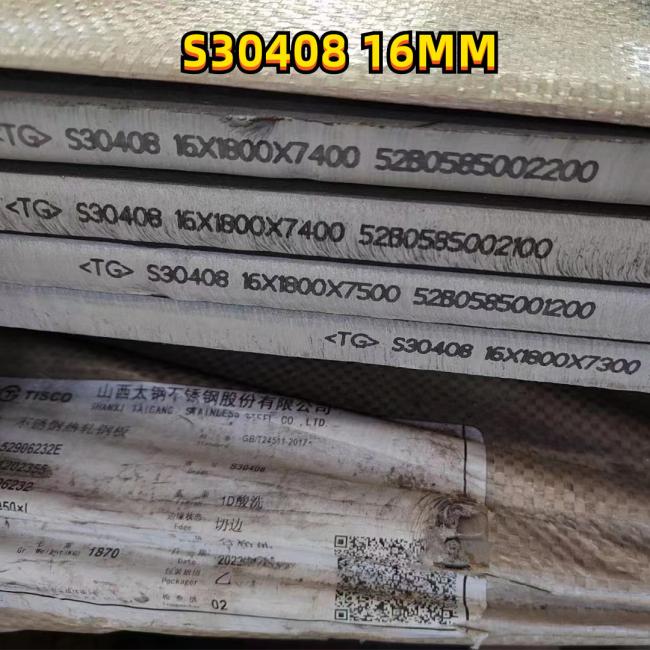
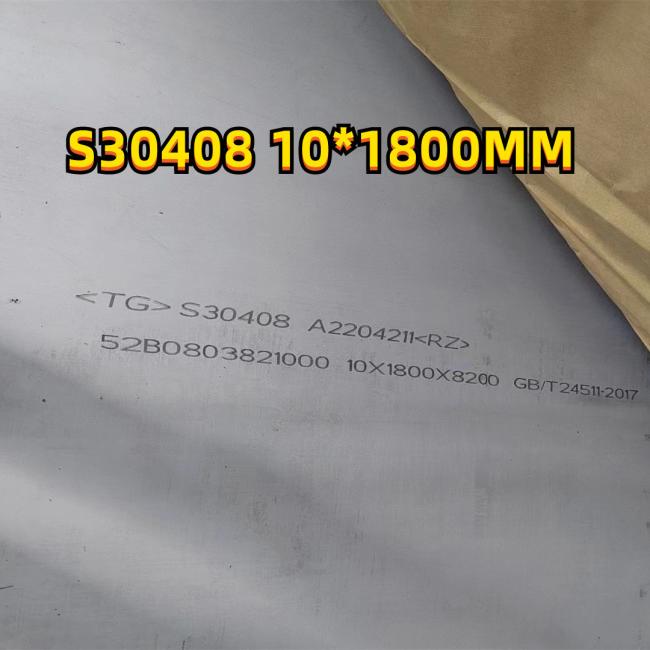
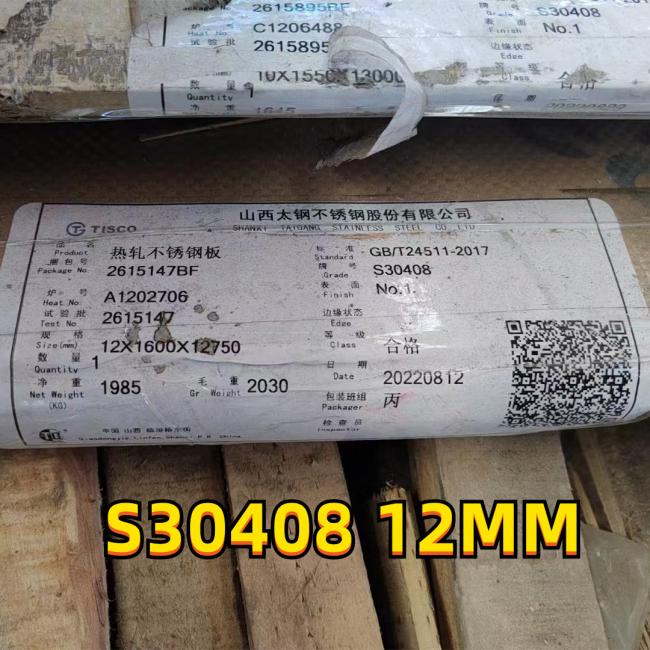
ASTM A240 BA Stainless Steel Plate TP304 S30408 2000mm Width for Boiler
Hot Rolled ASTM A240 TP304 S30408 Stainless Steel Plate 2000mm Width Used For Boiler
General Properties
Alloy 304 series stainless steel austenitic, which has a minimum of 18% chromium and 8% nickel. Type 304 has a maximum carbon of 0.08% . It is the standard “18/8 stainless” that is commonly found in pans and cooking tools. Alloy 304 is the most versatile and widely used alloy in the stainless steel family. Ideal for a wide variety of home and commercial applications, Alloy 304 exhibits excellent corrosion resistance and has a high ease of fabrication, outstanding formability. The austenitic stainless steels are also considered to be the most weldable of the high-alloy steels and can be welded by all fusion and resistance welding processes.
Specifications: UNS S30400
Alloy 304 Stainless Steel is used in a wide variety of home and commercial applications, including:
- Kitchen benches, sinks, troughs, equipment, and appliances
- Chemical containers, including for transport
- Food processing equipment, particularly in beer brewing, milk processing, and wine making
- Heat exchangers
- Architectural trim and molding
- Woven or welded screens for mining, quarrying & water filtration
- Automotive and aerospace structural use
- Nuts, bolts, screws, and other fasteners in the marine environment
- Construction material in large buildings
- Dyeing industry
Standards:
- ASTM/ASME: UNS S30408 / S30403
- EURONORM: 1.4301 / 1.4303
- AFNOR: Z5 CN 18.09 / Z2 CN 18.10
- DIN: X5 CrNi 18 10 / X2 CrNi 19 11
Corrosion Resistance:
- Resistance to moderately aggressive organic acids is a result of the 9 to 11% nickel that the 304 alloys contain.
- Resistance to corrosion in oxidizing environments is a result of the 18 to 19% chromium that the 304 alloys contain.
- The 304, 304L, and 304H may be considered to perform uniformly in most corrosive environments.
Heat Resistance:
- Continuous use of 304 in the 800-1580°F range is not recommended if subsequent aqueous corrosion resistance is important.
- Good oxidation resistance in intermittent service to 1600°F and in continuous service to 1690°F.
1.Chemical Composition and Mechanical Properties(In Quenched & Tempered State):
|
Chemical Composition
|
Mechanical Properties(In Quenched & Tempered State) | ||
| C | ≤0.08 | Tensile strength(MPA) | ≥520 |
| Si | ≤1.00 | Yield strength (MPA) | ≥205 |
| Mn |
≤2.00 |
Elongation(δ5/%) | ≥ 40 |
| Ni | 8.00-11.00 | Reduction in Area (ψ/%) | ≥ 60 |
| Cr | 18.00-20.00 | Impact (J) | -- |
| P | ≤0.030 |
Hardness |
Delivery hardness:≤187HB
|
| S | ≤0.030 | ||
2.Product Application Areas:
Our products have been used in all kinds of areas, such as aviation,aerospace,navigation,nuclear energy,chemical
industry,electronic information,achine manufacture, petrochemical, automotive,instrument and meter, Communication ,
transportation, and medical instruments, etc.
3.Similar steel grade & equivalent steel materials:
| USA | Japanese | Gemany | British | France | International | Chinese |
| ASTM&AISI&SAE | JIS | EN DIN | EN BS | EN NF | ISO | GB |
| 304 | SUS304 | 1.4301 | 1.4301 | 1.4301 | ------ | S30408 |
Properties of 304 Alloy
Welding Characteristics:
Excellent welding properties; post-weld annealing is not required when welding thin sections. Two important considerations in producing weld joints in the austenitic stainless steels are:
- avoidance of cracking
- preservation of corrosion resistance
Processing – Hot Forming:
- To forge, heat uniformity to 2100 / 2300 °F
- Do not forge below 1700 °F
- Forging can be air cooled without danger of cracking
Processing – Cold Forming:
- Its austenitic structure allows it to be deep-drawn without intermediate annealing, Making this the stainless steel grade of choice in the manufacturing of sinks, hollow-ware and saucepans.
- These grades work harden rapidly. To relieve stresses produced in severe forming or spinning, parts should be full annealed or stress relief annealed as soon as possible after forming.
Machinability:
- The use of chip breakers is advised since the chips can be stringy. Stainless steel work harden rapidly, heavy positive feeds, sharp tooling, and a rigid set-up should be used.of cut below the work-hardened layer resulting from the previous passes.
Get in Touch
Have questions about our products or want to discuss a custom order? Our team is ready to help you.