
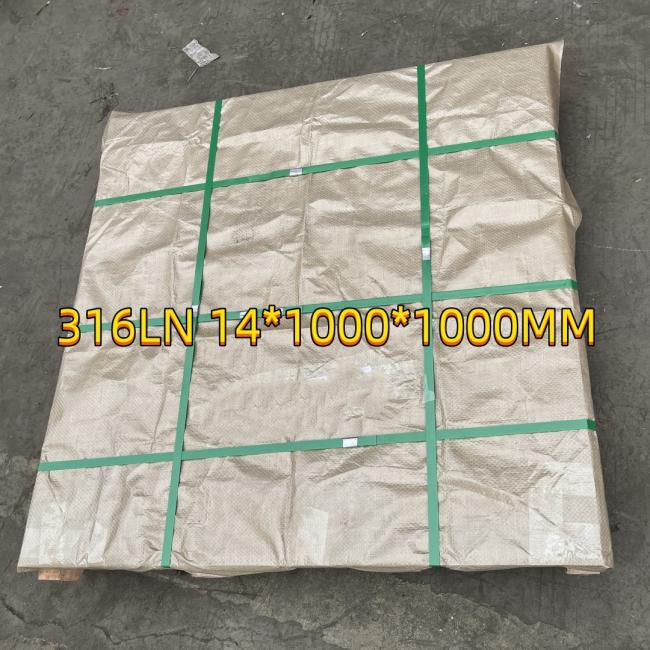
AISI 316LN Stainless Steel Plate ESR UNI EN 10088-1 X2CrNiMoN 17 13-3 14MM
Stainless Steel AISI 316LN ESR UNI EN 10088-1 X2CrNiMoN 17 13-3 [1.4429] Plate 14MM
Type 316LN stainless steel is austenitic steel suitable for the fabrication of many products. Due to its molybdenum content, it can be used in applications that require increased corrosion resistance.
It has a more stable austenitic structure, which means it provides a lower magnetic permeability. The nitrogen content adds additional resistance to sensitization.
Similar to types 316 and 316L stainless steel, type 316LN provides great resistance to general corrosion and pitting/crevice corrosion.
Common Names:
- Stainless steel type 316N is commonly known as Chromium-Nickel steel.
Executive Standards/Grades:
- JIS: G4303
- ASTM: ASTM A240, ASTM A213, ASTM A276 and so on.
- DIN: 1.4406
- UNS: S31653
- EN: X2CrNiMoN17-13-3
- SUS: SUS316LN
Chemical Properties:
Type 316LN stainless steel has the following chemical composition:
- Carbon – 0.03%
- Manganese – 2.00%
- Chromium – 16.0% – 18.0%
- Nickel – 10.0% – 14.0%
- Molybdenum – 2.0% – 3.0%
- Sulphur – 0.03%
- Phosphorus – 0.045%
- Silicon – 1.00%
- Nitrogen – 0.10 – 0.30%
- Iron – Balance
Mechanical Properties:
- Hardness (HRB) – 95 (maximum)
- Elongation (%) – 60
- Yield Strength (Mpa) – 205
- Tensile Strength (Mpa) – 515
- Poisson’s Ratio – 0.27 – 0.30
Physical Properties:
- Density (8000 Kg/M3)
- Elastic Modulus (Gpa) – 200
- Thermal Conductivity (Btu/ft hr ⁰ F) – 8.4 – 16.3
- Specific Heat (Btu/lb/°F) – 0.116 at 200 oF
- Electrical Resistivity (µohm/cm) – 7.4
Key Features:
- Low-carbon, nitrogen-enhanced version of Type 316, providing higher resistance to sensitization
- Its nitrogen content provides solid solution hardening, increasing the minimum specified yield strength
- Excellent resistance to oxidation and low rate of scaling at temperatures up to 1650oF
- Provides more resistance to atmospheric and other types of corrosion
- Is considered one of the most weldable of the stainless steels
- Hot forming can be performed in the range of 1560 – 2100 oF
- Type 316LN can be formed and fabricated by any cold forming operation
Forms Available:
Stainless steel type 316LN is available in different forms such as:
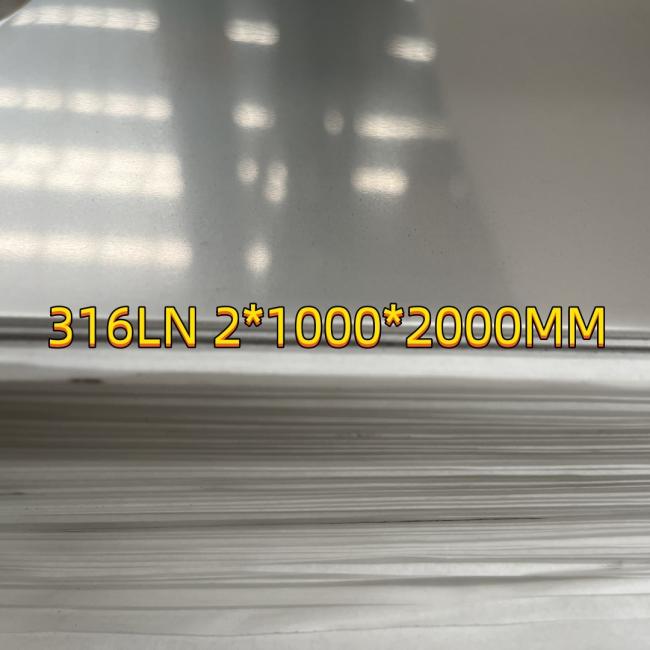
- Sheet
- Seamless
- Coiled
- Rod coil
- Plate
Applications:
Because of its properties, stainless steel type 316LN has a wide range of applications including:
- Chemical processing
- Pulp & paper industry
- Pharmaceutical applications
- Applications with high magnetic fields
- Surgical instruments
- Orthopedic implants
- Chemical and cryogenic tanks
Possible Alternatives Grades:
Type 316LN stainless steel has some possible alternatives that can be used. Such as:
- 316Ti – Better resistance to temperatures.
- 317L – Very similar to type 316LN, both with high average alloy composition.
- 316L – Similar properties, also with low carbon content.
- 316Cb – Moderately low tensile strength, also formulated for primary forming into wrought products.
FAQs:
- What differences and similarities between type 316 and type 316LN stainless steel?
Like type 316 stainless steel, type 316LN provides good resistance to general and pitting/crevice corrosion. Both types offer high creep, tensile strength, and stress-rupture and elevated temperatures. Yet, the nitrogen in type 316LN adds extra resistance to sensitization and some solid solution hardening, raising the minimum specified yield strength.
- Can type 316LN stainless steel be cold-formed?
Type 316LN can be cold formed by all known operations. The strength and hardness of the material will be increased by cold forming operations.
Contact us:
&Person: Mr Gao
&Whatspp/Mobile: +86 18068357371
&Wechat: wxsgms
Products Show
Get in Touch
Have questions about our products or want to discuss a custom order? Our team is ready to help you.