
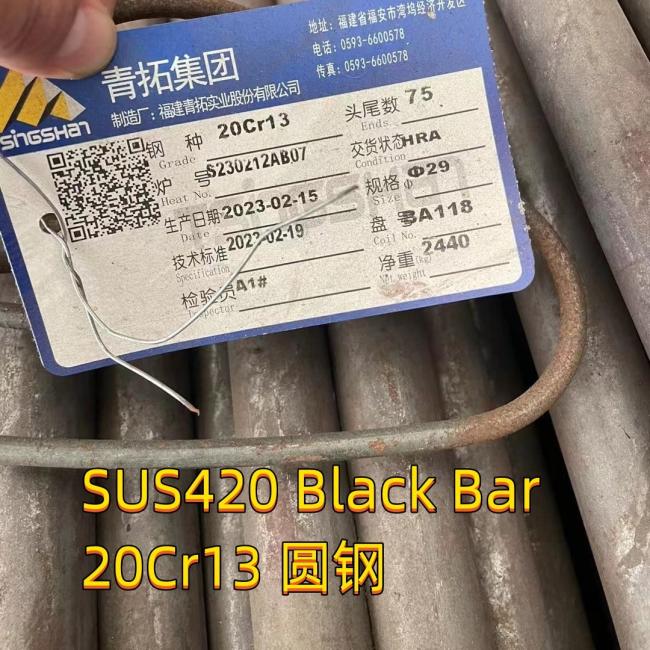
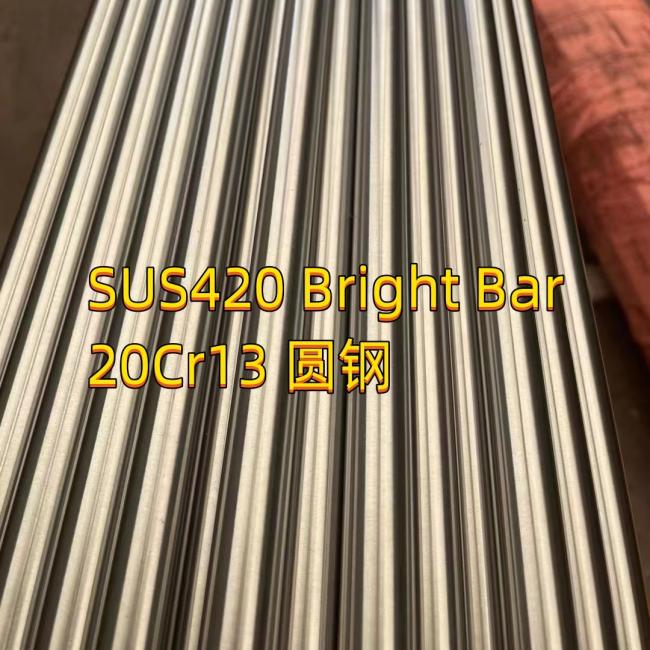
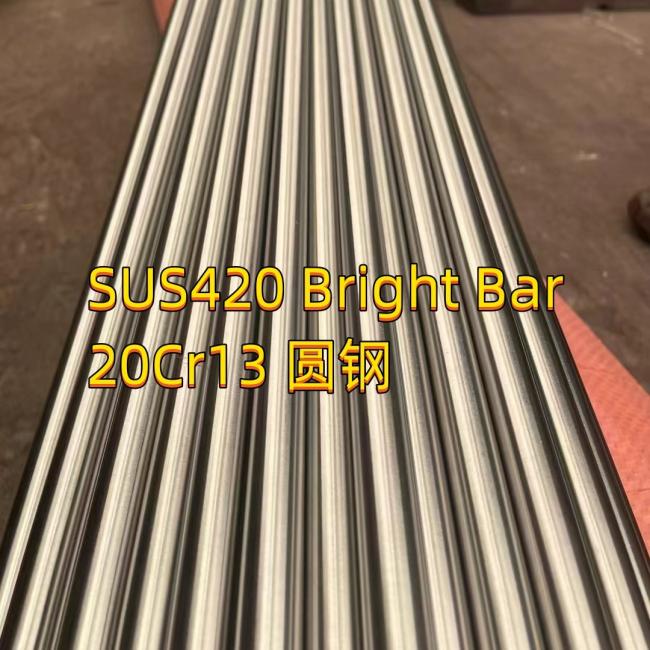
SUS420 Stainless Steel Bar Round Rod 1.4037 X65Cr13 AISI 420 11.6 H11 Length 3m
SUS420 1.4037 X65Cr13 AISI 420 Stainless Steel Bar Dia 11.6 H11 Round Rod Length 3m
420 STAINLESS STEEL ROUND BAR
Get to know 420 stainless steel: the material that delivers strength and reliability.
420 stainless steel is a popular and versatile material that is known for its exceptional strength and durability. It is a martensitic alloy, which means that it contains a high amount of carbon and has been heat-treated to increase its hardness. This gives it a unique combination of properties that make it ideal for a wide range of applications.
One of the key benefits of 420 steel is its high level of corrosion resistance. This makes it particularly useful in harsh environments where other materials may corrode or deteriorate over time. Additionally, itis known for its excellent wear resistance, which means that it can withstand high levels of friction and abrasion without breaking down.
Another advantage of 420 steel is its affordability. Compared to other high-performance alloys, it is relatively inexpensive and widely available, making it a cost-effective option for many applications.
420 Steel Commonly Uses
- pharmaceutical equipment
- Shear blades
- Needle valves
- Surgical equipment
- Cutlery
420 Stainless Steel Properties
Physical Properties
Melting Point
Density
Specific Gravity
Modulus of Elasticity in Tension
English
1450 – 1510 ℃
7.75g/cm3
Gravity 7.7
200 GPa
Chemical Properties:
| C | Mn | Si | P | S | Cr | |
|---|---|---|---|---|---|---|
| 420 | 0.15 max |
1.00 max |
1.00 max |
0.04 max |
0.03 max |
min: 12.0 max: 14.0 |
Mechanical Properties:
| empering Temperature (°C) | Tensile Strength (MPa) | Yield Strength 0.2% Proof (MPa) |
Elongation (% in 50mm) |
Hardness Brinell (HB) |
|---|---|---|---|---|
| Annealed * | 655 | 345 | 25 | 241 max |
| 399°F (204°C) | 1600 | 1360 | 12 | 444 |
| 600°F (316°C) | 1580 | 1365 | 14 | 444 |
| 800°F (427°C) | 1620 | 1420 | 10 | 461 |
| 1000°F (538°C) | 1305 | 1095 | 15 | 375 |
| 1099°F (593°C) | 1035 | 810 | 18 | 302 |
| 1202°F (650°C) | 895 | 680 | 20 | 262 |
| * Annealed tensile properties are typical for Condition A of ASTM A276; annealed hardness is the specified maximum. | ||||
Applications of 420 Stainless Steel in Various Industries
- Aerospace: It is commonly used in the aerospace industry to manufacture structural components, such as fasteners and fittings. Its high strength, durability, and corrosion resistance make it ideal for these critical applications.
- Medical: 420 steel also used in the medical industry to produce surgical instruments, such as forceps, scissors, and scalpels. Its ability to withstand repeated sterilization and its resistance to corrosion make it an excellent choice for these types of applications.
- Cutlery: 420 steel is often used in the production of high-quality knives and cutlery. Its hardness and wear resistance allow it to maintain a sharp edge even after repeated use, while its corrosion resistance helps to prevent rust and staining.
- Industrial machinery: 420 steel is frequently used in the manufacturing of industrial machinery and equipment, such as pumps, valves, and gears. Its toughness and resistance to wear and abrasion make it an ideal material for these heavy-duty applications.
- Automotive: The steel is used in the automotive industry for a variety of applications, including exhaust systems and engine components. Its ability to withstand high temperatures and its resistance to corrosion and oxidation make it a reliable choice for these types of applications.
Comparing 420 Steel to Other Popular Stainless Steel Alloys
When compared to other popular stainless steel alloys, such as 304 and 316, 420 steel stands out for its hardness and wear resistance. While 304 and 316 are more corrosion-resistant, 420 offers a higher level of hardness, making it more suitable for applications that require resistance to wear and abrasion.
In terms of machinability, 420 steel is considered relatively easy to work with and can be cut, shaped, and formed with common machining tools. It is also more affordable than some other high-performance stainless steel alloys, making it a cost-effective option for many applications.
However, one potential disadvantage of 420 steel is its lower level of corrosion resistance compared to other stainless steel alloys. This means that it may not be the best choice for applications where it will be exposed to harsh or corrosive environments, such as marine or chemical applications.
Forte Precision Metals is here for you if you need an efficient steel round bar supplier and a centerless ground bar supplier who provides you with quality 420 steel stocks! We work closely with our clients to ensure that their precision ground bars are delivered to the correct specifications.
APPLICATIONS:
Alloy 420 is used for a variety of applications where good corrosion and outstanding hardness is necessary. It is not usually used at temperatures exceeding 800oF (427oC) due to quick hardening and loss of corrosion resistance. Examples of applications that use alloy 420 include:
- Cuttery
- Knife blades
- Surgical instruments
- Needle valves
- Shear blades
- Scissors
- Hand tools
STANDARDS:
- ASTM/ASME: UNS S42000
- EURONORM: FeMi35Cr20Cu4Mo2
- DIN: 2.4660
Get in Touch
Have questions about our products or want to discuss a custom order? Our team is ready to help you.