
Custom Stamped and Continuous-Brazed Liquid Cooling Plates for Energy Storage EV Batteries & IGBT
Trumony designs and mass-produces stamped aluminum liquid cooling plates sealed by continuous brazing, offering an ideal balance of thermal performance, cost efficiency, and production scalability. As an in-house factory, we deliver fully customized solutions — from initial concept and flow channel design to prototype validation and high-volume delivery — all within one streamlined workflow. Our plates keep battery packs and power electronics within safe temperature limits, supporting the demanding requirements of North American and advanced Asian markets.
- Volume-Optimized Manufacturing: Stamping enables rapid, low-cost production once tooling is established, perfect for programs scaling to thousands or millions of units annually.
- Consistent Thermal Performance: Every stamped channel reproduces identically, ensuring cell-to-cell temperature uniformity across your entire production batch.
- Leak-Proof Joints: Continuous brazing in a controlled-atmosphere furnace creates a full metallurgical bond over the entire plate surface, verified by 100% helium leak testing.
- One-Stop Customization: Plate dimensions, channel depth, surface coatings, and connector types are all tailored to your system without outsourcing any step.
- Compliant Materials and Processes: Our aluminum alloys and finishes meet RoHS, REACH, and UL requirements; production follows IATF 16949-aligned quality systems.
We form coolant channels by precision-stamping aluminum sheet between dedicated tooling dies. This allows complex patterns — serpentine, multi-parallel, or dimpled turbulator arrays — that enhance heat transfer while maintaining smooth, low-pressure-drop flow paths. After stamping, the channel plate and a cover sheet pass through a continuous braze furnace under a nitrogen atmosphere. The clad brazing layer melts uniformly and forms a single, inseparable component. No batch-to-batch variation, no post-braze machining, and a proven seal that endures thousands of thermal cycles.
-
Parameter Specification Base Material Aluminum 3003, 6061, 6063 (other alloys upon request) Coolant Type Water-glycol mixture, dielectric fluids, refrigerants Manufacturing Process CNC machining, vacuum brazing, friction stir welding (FSW) Max Operating Pressure Up to 500 kPa (custom higher pressure designs available) Leak Rate < 1×10⁻⁹ Pa·m³/s (helium mass spectrometer tested) Surface Treatment Hard anodizing, electroless nickel plating, anti-corrosion coating, passivation Thermal Conductivity ≥ 180 W/m·K (base material) Temperature Uniformity ΔT ≤ 2°C across the plate surface Customizable Options Dimensions, flow channel layout, inlet/outlet positions, fitting types, mounting holes Certifications ISO 9001, IATF 16949 (for automotive), UL, RoHS, REACH compliant Design Support CFD thermal simulation & flow analysis report provided before tooling
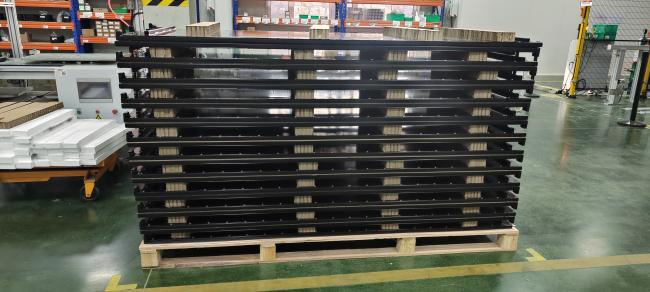
Maintains temperature differences under 2°C across entire racks of cells, supporting 10,000-cycle lifetimes and safe operation in containerized or cabinet systems.
Fits between pouch or prismatic cells in passenger cars, buses, and light commercial vehicles. Handles fast-charging heat loads while preserving range and battery warranty.
Replaces bulky extruded heat sinks with thin, lightweight cold plates that sit directly beneath semiconductor substrates in traction inverters, wind converters, and industrial motor drives.
Coolant enters the stamped channel network through an inlet port, flows directly under the heat-generating components, and absorbs thermal energy via forced convection. The stamped internal features — dimples, ribs, or pin-fins — repeatedly disrupt the boundary layer, boosting heat transfer without requiring excessive flow rates. Warmed fluid exits and releases heat at a remote radiator or chiller before recirculating. The continuous brazed cover permanently seals the flow path, eliminating gaskets and O-rings that could degrade or leak over time.
- Share Your Requirements
Tell us your heat load (watts), physical envelope (L×W×H), coolant type, and preferred inlet/outlet locations. Even rough sketches help. - Design & Simulation
Our engineers create a preliminary channel layout and run computational fluid dynamics (CFD) analysis to predict temperature distribution and pressure drop. We iterate with you until the design is frozen. - Prototyping
Stamping tools are fabricated in-house. We deliver functional prototype samples for your testing — typically within 4–6 weeks. - Validation & Mass Production
After your approval, we scale to pilot and full production. Continuous brazing ensures every plate matches the validated performance of the prototypes.
Yes. Our die design handles custom contours, mounting tabs, and irregular plate outlines. Stamping is inherently repeatable, so complex shapes are produced consistently.
We perform 100% helium leak testing on every production unit, achieving leak rates far below automotive standards. Test records are traceable by batch.
That's perfectly fine. We support low-volume prototype runs using soft tooling or hybrid methods before committing to high-volume stamping dies. Your initial investment stays low.
Absolutely. Our team offers design-for-manufacturing feedback, CFD thermal reports, and even structural FEA if needed. We act as an extension of your engineering team.
It depends on your coolant and environment. E-coat works well with water-glycol and protects against corrosion. Hard anodizing adds electrical isolation for direct cell contact. We recommend the best option during the design phase.
Describe your cooling challenge and we'll return a concept sketch, CFD preview, and budget quotation within 48 hours. Tap into Trumony's stamping and continuous brazing expertise to move your thermal design from concept to production faster.
Get in Touch
Have questions about our products or want to discuss a custom order? Our team is ready to help you.