
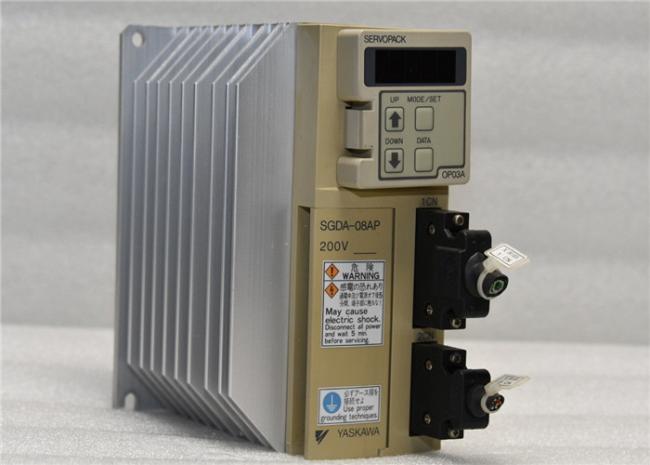
Industrial Yaskawa 200-230V Servo Drive SERVOPACK 750W CNC/ROUTER SGDA-08AP
Industrial Yaskawa 200-230V Servo Drive SERVOPACK 750W CNC/ROUTER SGDA-08AP
Quick Details
SGDA-08AP
• 750W (0.13HP) Rated Capacity
• 200-230 V AC Input
• 230 V Max Output
• Position Control (Digital Input)
Features
Compact Design
Easy Operation
Simple Wiring
Improved Environmental Resistance
Description
The Yaskawa SGDA Servopack features superior functions and performance. Its compact design allows a volume ratio approximately 1/4 that of the conventional servo amplifier model. The SGDA features an auto-tuning function, JOG operation, various monitoring functions, and a PC monitoring function. It is also compatible with incremental encoders or absolute encoder feedback. The servo amplifier circuit board has been coated with varnish to improve environmental resistance.
SGDA-02VP
SGDA-03BP
SGDA-03BP+SGMP-03B312
SGDA-03BPY122
SGDA-03SP
SGDA-04AH
SGDA-04AP
SGDA-04APP
SGDA-04AS
SGDA-04AS+SGM-04A3NT12
SGDA-04ASP
SGDA-04BS
SGDA-04VP
SGDA-04VP
SGDA-04VS
SGDA-05ADG+SGMG-05A2A
SGDA-08AP
SGDA-08APP
SGDA-08APPY128
SGDA-08AS
SGDA-08ASP
SGDA-08ASP SGDA-08AS
SGDA-08VP
SGD-A3AN
SGD-A5AN
SGD-A5BH
SGDA-A3AP
SGDA-A3BPM
SGDA-A3BS
SGDA-A3BS
SGDA-A3CPY14
SGDA-A3VP
SGDA-A3VS
SGDA-A5AP
SGDA-A5AS
SGDA-A5ASY109
SGDA-A5BP
SGDA-A5BS
SGDA-A5VP
SGDA-A5VPY197
conductor.
In the set-up shown in Figure 1.1, the source of the magnetic Weld is a bar magnet, which produces a magnetic Weld as shown in Figure 1.2.
The notion of a ‘magnetic Weld’ surrounding a magnet is an abstract idea that helps us to come to grips with the mysterious phenomenon o fNSNSNSNSFigure 1.2 Magnetic Xux lines produced by a permanent magnet
Electric Motors 3
magnetism: it not only provides us with a convenient pictorial way ofpicturing the directional eVects, but it also allows us to quantify the ‘strength’ of the magnetism and hence permits us to predict the various eVects produced by it
We will see that in order to make the most of the mechanism, we need to arrange a very strong magnetic Weld, and make it interact with manyconductors, each carrying as much current as possible. We will also see later that although the magnetic Weld (or ‘excitation’) is essential to the working of the motor, it acts only as a catalyst, and all of the mechanical output power comes from the electrical supply to the conductors on which the force is developed. It will emerge later that in some motors the parts of the machine responsible for the excitation and for the energy converting functions are distinct and self-evident. In the d.c. motor, for example, the excitation is provided either by permanent magnets or by Weld coils wrapped around clearly deWned projecting Weld poles on the stationary part, while the conductors on which force is developed are on the rotor and supplied with current via sliding brushes. In many motors,
however, there is no such clear-cut physical distinction between the ‘excitation’ and the ‘energy-converting’ parts of the machine, and a single stationary winding serves both purposes. Nevertheless, we will
Wnd that identifying and separating the excitation and energy-converting functions is always helpful in understanding how motors of all types operate.
Current in conductor
Figure 1.1 Mechanical force produced on a current-carrying wire in a magnetic Weld 2 Electric Motors and Drives before turning to ways in which the mechanism is exploited to produce rotation. The concept of the magnetic circuit will have to be explored, since this is central to understanding why motors have the shapes they do. A brief introduction to magnetic Weld, magnetic Xux, and Xux density is included before that for those who are not familiar with the ideas involved
Thus, both torque and horsepower must be carefully examined.
Torque. Torque is an applied force that tends to produce rotation and is measured in lb-ft or lb-in.
All loads have a torque requirement that must be met by the motor. The purpose of the motor is
to develop enough torque to meet the requirements of the load.
Actually, torque can be thought of as "OOUMPH". The motor has to develop enough "OOUMPH"
to get the load moving and keep it moving under all the conditions that may apply.
Horsepower. Horsepower (hp) is the time rate at which work is being done. One hp is the force
required to lift 33,000 lbs 1 ft in 1 min. If you want to get the work done in less time, get yourself
more horses!
Here are some basic equations that will help you understand the relationship between hp, torque,
and speed.
hp = (Torque x Speed)/5250 (eq. 1)
Torque = (hp x 5250)/Speed (eq. 2)
As an example, a 1-hp motor operating at 1800 rpm will develop 2.92 lb-ft of torque.
* Break-away torque: torque required to start a load in motion (typically greater than the torque required to maintain motion).
* Accelerating torque: torque required to bring the load to operating speed within a given time.
* Running torque: torque required to keep the load moving at all speeds.
* Peak torque: occasional peak torque required by the load, such as a load being dropped on a conveyor.
* Holding torque: torque required by the motor when operating as a brake, such as down hill loads and high inertia machines.
However, when we put a compass needle (which is itself a permanent magnet) in the Weld we Wnd that it aligns itself as shown in Figure 1.2. In the upper half of the Wgure, the S end of the diamond-shaped compass settles closest to the N pole of the magnet, while in the lower half of the Wgure, the N end of the compass seeks the S of the magnet. This immediately suggests that there is a direction associated with the lines of Xux, as shown by the arrows on the Xux lines, which conventionally are taken as positively directed from the N to the S pole of the barmagnet.
OTHER SUPERIOR PRODUCTS
Get in Touch
Have questions about our products or want to discuss a custom order? Our team is ready to help you.