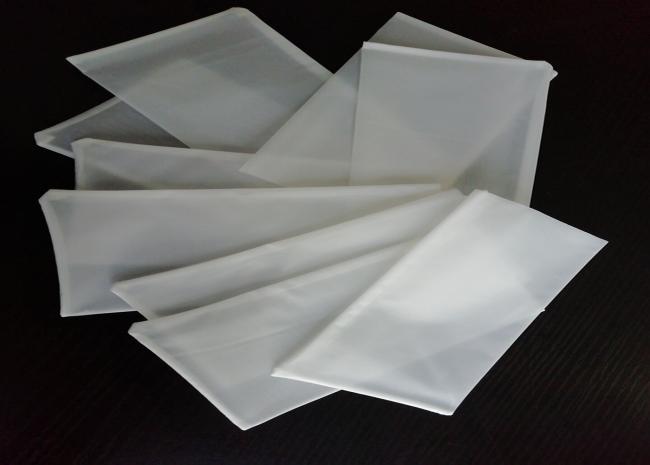
36-72 micron rosin press filter bag for dry sift,hash and kief.
36 micron offers the highest level of filtration and better yields.
90-115 microns rosin press filter bag are best for cannabis flower.
90 Micron rosin press filter bag offers the highest level of filtration which results in the highest quality output.
115 micron rosin press filter bag offers a high level of filtration and better yields

100% Material 90/120 Micron Screen Printing Materials Food Grade Nylon Filter Rosin Bag
Price:
Negotiable
MOQ:
1000 piece
Delivery Time:
5-8 work days
Brand:
R&K
Product Description
90/120 micron food grade customizable and convenient multifunctional nylon filter rosin bag
Product Introduction
❀ Name:nylon filter rosin bag
❀ Material:100% polyamide
❀ Weave:plain
❀ Mesh:60 80 100
❀ Opening:90/120 micron
❀ Color:white
❀ Application:water filter,fruit juice,milk filer and so on.
❀ Feature:Premium quality food grade nylon bag with double reinforced stitching.
❀ More size:1.75*5 inch,2*4 inch,2.5 *4 inch,2.5 * 4.5 inch 3*5 inch.
Product Attributes
△ It has excellent resistant for almost solvent ,it will operating continuously at temperature up to 100℃ in the chemical PH range 7-14
△ Melting point is between 210℃-250℃
△ Softness point is between 180 ℃- 230℃
△ Low coefficient of friction
△ Good abrasion resistance
Product Application
Product Specification
| Item | Mesh count | Thread diamaeter | Mesh opening | Fabric thickness | Weight |
| JPP 30 | 76 | 120 | 213 | 255 | 94 |
| JPP 56 | 140 | 60 | 120 | 85 | 44 |
| JPP 80 | 200 | 50 | 75 | 90 | 43 |
| JPP 120 | 305 | 40 | 43 | 70 | 42 |
Seam types for Rosin press filter bags
Stitchless-Ultrasonic seaming:
This method employs frictional heat caused by high frequency mechanical oscillations.This method employs frictional heat caused by high frequency mechanical oscillations. This creates the heat required for welding and the material is plasticised. This type of seam should eliminate gaps for material to escape through and could be applied to any micron fabric.
Weakness: This seam was by far the weakest of all the seams.It did not hold up even under light pressure. Material easily escaped through the seams.
Stitchless-Thermal Bonding:
A process by which materials to be joined are heated causing the thermoplastic materials to melt. They are then compressed by applying pressure, which causes an intermingling of polymers. A seam is formed as the material cools and solidifies. This seam should create an impermeable seam. Disadvantages are seam stiffness and fiber degradation caused by excessive heat.
Weakness: This seam was stronger than ultrasonic seaming. But not as strong as sewing. We saw some promise in this method for hash processing, but due to the high heat used to make the seam, it can’t be used on smaller micron fabrics.
Sewing:
The advantage of traditional sewing is strength. The disadvantage is the stitch leaves gaps in the seam that can allow material to pass through the seam.
Conclusion: This seam was by far the strongest. The mesh fabric will tear before the seam blows out.

Similar Products
Get in Touch
Have questions about our products or want to discuss a custom order? Our team is ready to help you.
Company
Hebei Reking Wire Mesh CO.,Ltd
Location
Floor 20,Wangjiao building,North xinshi road,Qiaoxi district,Shijiazhuang,Hebei,China P.C.:050051