
PLC Sonochemical Ultrasonic Liquid Processor For Graphene Dispersion
High Power Ultrasonic Sonochemical Processing For Graphene Dispersion
Principle of Ultrasonic Graphene Dispersion
Ultrasonic graphene dispersion equipment uses ultrasonic cavitation to disperse agglomerated particles. It is to put the particle suspension (liquid) to be processed into a super-strong sound field and process it with an appropriate ultrasonic amplitude. Under the additional effects of cavitation, high temperature, high pressure, micro jets, strong vibration, etc., the distance between molecules will increase continuously, which will eventually cause the molecules to break and form a single molecular structure. This product is especially effective for dispersing nanomaterials (such as carbon nanotubes, graphene, silicon dioxide, etc.).
Graphene dispersion purpose
There are a lot of graphite materials in nature, and graphite with a thickness of 1 mm contains about 3 million layers of graphene. Single-layer graphite is called graphene, which does not exist in the free state, and it exists in the form of graphite sheets laminated with multiple layers of graphene. Since the interlayer force of the graphite sheet is weak, it can be exfoliated layer by layer by external force, thereby obtaining a single-layer graphene with a thickness of only one carbon atom.
Ultrasonic-assisted liquid phase exfoliation greatly improves the efficiency of graphene extraction.The application of ultrasonic equipment in the preparation of graphene is mainly in the volumetric thermal layer method and the redox method. These two methods are simpler to operate and cost less than other preparation methods. Due to the cavitation in the liquid, the micro-jet, vibration and other phenomena are formed.
On the microscopic level, the suspended particles in the liquid act as a high-speed stirring, dispersing, breaking and separating.
The application of ultrasonic equipment in the preparation of graphene is mainly in the volumetric thermal layer method and the redox method. These two methods are simpler to operate and cost less than other preparation methods. Due to the cavitation in the liquid, the micro-jet, vibration and other phenomena are formed.
On the microscopic level, the suspended particles in the liquid act as a high-speed stirring, dispersing, breaking and separating.
Features:
1. Reliable for heavy duty sonication processes
2. 24*7 hours continuous operation
3. Industrial grade
4. Colored touch display
5. PLC remote control
6. Automatic Frequency tuning
| Model | RPS-C40-50 |
| Frequency | 20Khz |
| Working frequency | 20KHz |
| Rated power | 3KW |
| Working power | 30%-100% of the rated power, the greater load, the greater power. |
| Amplitude | 0-100μm.Adjustable range:50%-100%. |
| Working temperature | <300℃ |
| Ultrasonic cavitation intensity | 0~5(w/cm²) |
| Reactor material | 304/316 stainless steel |
| Working time | 24H/D |
| Packing size | 210*60*160cm |
| G.W. | 330KGS |
Ultrasonic is the use of physical technology to produce a series of conditions close to those in the chemical reaction medium. This energy can not only stimulate or promote many chemical reactions, accelerate the speed of chemical reactions, but can even change the direction of chemical reactions and produce some effects. Sonochemistry can be applied to almost all chemical reactions, such as extraction and separation, synthesis and degradation, biodiesel production, treatment of microorganisms, degradation of toxic organic pollutants, biodegradation treatment, biological cell crushing, dispersion and aggregation, etc.
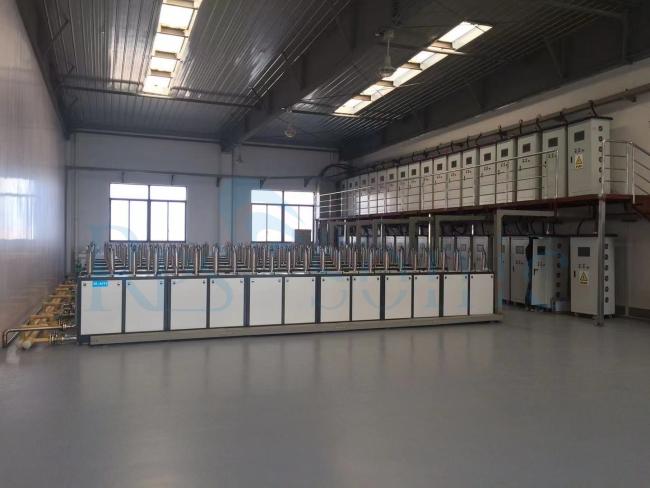
Industrial-grade ultrasonic particle agglomeration dispersing machine is mainly used for large-scale industrial production. Ultrasonic sonochemical processing equipment has high power, high efficiency, and large radiation area. It is suitable for large-scale industrial production. It has real-time monitoring of frequency power, adjustable power, and overload alarm functions. The length is 930mm. The industrial-grade ultrasonic particle agglomeration disperser has an energy conversion efficiency of 95%.
Ultrasonic dispersion refers to the process of dispersing and de-agglomerating particles in the liquid through the mechanism of the cavitation effect of ultrasonic waves in the liquid using liquid as a medium. Ultrasonic technology, as a physical means and tool, can produce various conditions in liquids. This phenomenon is called sonochemical action, and related ultrasonic equipment is called ultrasonic sonochemical equipment (referred to as sonochemical equipment). Ultrasonic dispersion equipment is an application of sonochemical equipment, which can be used for water treatment, solid-liquid dispersion, de-agglomeration of particles in liquid, and promotion of solid-liquid reaction. Industrial-grade ultrasonic particle agglomeration dispersing machine is mainly used for large-scale industrial production. The tens of millions of industrial-grade high-power ultrasonic sonochemical processing equipment developed and produced by RPS-SONIC has high power, high efficiency, and large radiation area, suitable for large-scale industrial production, and has an energy conversion efficiency of 95%.
The above is the working principle and application of ultrasonic graphene dispersion equipment, hope to help more people to better understand ultrasonic graphene dispersion equipment, so as to accelerate the development of ultrasonic equipment.
Get in Touch
Have questions about our products or want to discuss a custom order? Our team is ready to help you.