
380V Metal Ultrasonic Soldering Welding For Copper Terminals And Wires 0.05 - 0.9Mpa
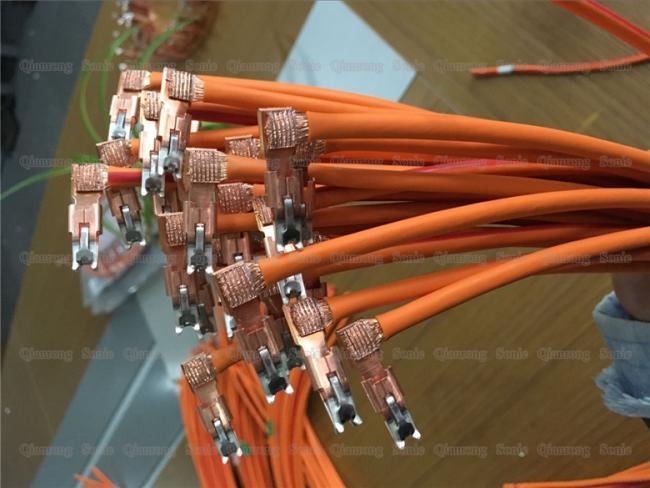
20Khz Ultrasonic Terminal Metal Welding Soldering Copper Terminals and Wires
Description:
The principle of ultrasonic welding is to convert 50/60 Hz power frequency to 20 kHz or more by ultrasonic generator. The converted high frequency electrical energy is again converted by the transducer into mechanical vibration of the same frequency, and then the mechanical motion is transmitted to the welding head through a set of amplitude varying amplitude modulators. The welding head transfers the vibration energy to the joint of the workpiece to be welded, in which the vibration energy is converted into mechanical energy and thermal energy by friction, so that the workpiece to be processed is welded. Ultrasonic waves can be used not only to weld hard thermoplastics, but also to weld metals.
Ultrasonic welding of plastics generally uses the way the welding head vibrates perpendicular to the workpiece. For some thin plastic parts, the direction of vibration of the welding head can be parallel to the workpiece. When ultrasonic welding of metal, the direction of vibration of the welding head is parallel to the workpiece.
Specifications:
| Item No | QR-D2020A | QR-D2030A | QR-D2050A |
| Power | 2000W | 3000W | 5000W |
| Air Pressure | 0.05-0.9MPa | 0.05-0.9MPa | 0.05-0.9MPa |
| Frequency | 20KHZ | 20KHZ | 20KHZ |
| Voltage | 220V | 220V | 380V |
| Weight of horn | 55KG | 60KG | 88KG |
| Dimension of Horn | 550*280*380mm | 550*280*430mm | 550*380*660mm |
| Generator Size | 540*380*150mm | 540*380*150mm | 540*380*150mm |
Other ultrasonic metal spot welding precautions:
Ultrasonic metal spot welding is widely used in a wide range of applications, including automotive components, high voltage electrical appliances, and electronic components.
1. Ultrasonic metal welding Due to the attenuation during ultrasonic transmission, the general welding thickness is less than 5mm.
2. The function of the grain is anti-slip, and the shape of the welding head and the grain are determined according to the workpiece size, material and amplitude requirements. The working weight is the key consideration, and the reason is the inertia amount.
3. It is important to consider the resonance of the ultrasonic vibration stroke, which will cause the weldment to break and desold.
4. The fixture design must not violate the ultrasonic principle.
5. Ultrasonic welding can weld and destroy, and energy control must be done.
What is a welding defect?
In the welding process of metal objects, welding defects are often formed in the welded joints, which can be divided into three categories.
1. Appearance defects (surface defects) are defects that can be found on the surface of a workpiece without the aid of an instrument. Common appearance defects include undercuts, welds, dents, and weld deformations, and sometimes surface vents and surface cracks.
2, stomata and slag inclusions
3, the atomic bond in the crack weld is destroyed, the gap formed by the formation of a new interface is called crack
4. Incomplete penetration means that the base metal is not melted and the weld metal does not enter the joint root.
20Khz Ultrasonic Terminal Metal Welding Soldering Copper Terminals and Wires

Get in Touch
Have questions about our products or want to discuss a custom order? Our team is ready to help you.