
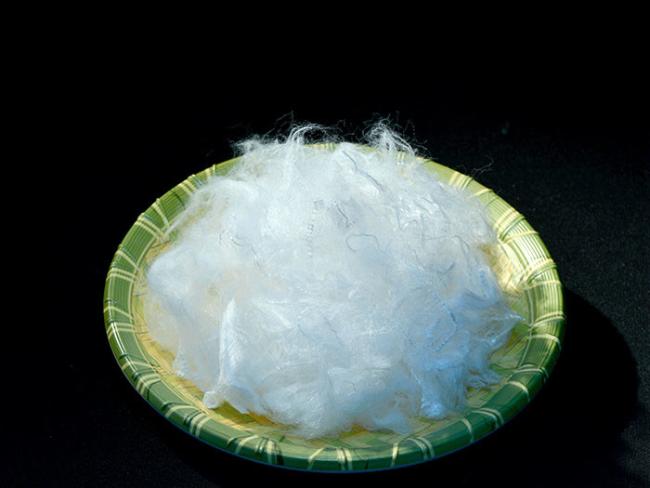
PLA 1.2D 38mm Natural Anti Bacterial Milk Fiber For Yarn
PLA 1.2D 38mm Natural Anti-Bacterial Milk Fiber For Yarn
PLA Degradable Fiber 1.5D For Medical Nonwoven
1 . Descriptions:
PLA is one of two common plastics used on FDM machines (3D printing) and is commonly available as a 3D printable filament; the other common 3D printer plastic is ABS. PLA filament for 3D printing is typically available in a myriad of colors. Polylactic Acid could be CNC machined but it is typically not available in sheet stock or rod form. It is, however, typically available as a thin film for thermoforming or in the form of plastic pellets for injection molding. To adjust material properties, plastic injection mold pellets are typically produced and/or blended together.
2 . Specifications:
| No | Test | Unit | Data | ||
| 1 | Titre | dtex | 1.2 | ||
| 2 | Tenacity at break | cN/dtex | 3.55 | ||
| 3 | Elongation at break | % | 38.27 | ||
| 4 | Length | mm | 39.2 | ||
| 5 | Crimp number | number/25mm | 15 | ||
| 6 | Defect | mg/100g | / | ||
| 7 | Over-length fiber | mg/100 | 2 | ||
| 8 | Oil content | % | 0.2 | ||
| 9 | Dry thermal shrinkage | % | 5 | ||
| 10 | Moisture | % | - | ||
3 . Advantages:
The production of bio-based polymers in comparison with the production of petrochemical plastics in most cases also leads to greenhouse gas emission savings. The biggest greenhouse gas emission savings can be found again when comparing bio-based polymers to polycarbonate (PC). For PLA, the average savings potential in this case amounts to 4.7 ± 1.5 kilograms of CO2 equivalents per kilogram of plastics.
For PHA, the average savings potential in this case amounts to 5.8 ± 2.7 kilograms of CO2 equivalents per kilogram of plastics. In comparison with PET and Polystyrene (PS), considerable savings potentials ranging between 2.5 and 4.2 kilograms of CO2 equivalents per kilogram of plastics are to be found in the production of bio-based polymers. The lowest savings potential are to be found when comparing bio-based polymers with polypropylene (PP).
However, the recycling infrastructure for PLA hasn’t been scaled up yet, mainly because end markets for the recycled material haven’t been developed.
While recycling PLA might be a viable solution in the future, we currently recommend composting as a preferred end-of-life option, especially as foodservice packaging is often contaminated with food scraps, making recycling impractical.
4 . More pictures:
Get in Touch
Have questions about our products or want to discuss a custom order? Our team is ready to help you.