
Membrane Filtration Pharmaceutical Sterility Test Isolator
class A ss316 sterility test isolator with 4 gloves for laboratory compounding aseptic containment isolator
Parameter
| model | YT-N1200A | YT-N1500A | YT-N1800A |
| size | 2000*800*2000 | 2300*800*2000 | 2600*800*2000 |
| size of operation | 1200*650*850 | 1500*650*850 | 1800*650*850 |
| Air lock chamber size | 750*650*850 | ||
| Power supply | AC220V 50Hz | ||
| Power | 800W | ||
| Operation port | single side 2+1 | single side 3+1 | single side 4+1 |
| Operating port size | 240mm diameter | ||
| Airflow mode | engineering turbulence | ||
| Maximum ventilation | 75m3/h | ||
| High efficiency filter | 99.98% H13 | ||
| Pressure control | -99Pa~0Pa | ||
| Operating port protection wind speed | 0.5m / s (refer to ISO 14644-7) | ||
| Hour leak rate | ≤0.5% (refer to ISO 14644-7) | ||
2, the system's efficient integrity detection
By detecting the amount of high-efficiency filter leakage from the sterile isolator, the high-efficiency filter and its defects during installation are found to take remedial action. The detection method uses the PAO method to evaluate the high-efficiency filter leakage rate by testing the aerosol concentration ratio upstream and downstream of the high-efficiency filter.
- PAO aerosol is generated as the dust source at the upstream end of the high-efficiency filter to be measured. After the aerosol is evenly mixed, the PAO concentration is tested, the concentration is set to 100% of the reference value, and then the spot-by-point scan is performed at the downstream end of the high efficiency filter. The aerosol concentration is detected. At this time, the photometer shows that the ratio of the concentration to the upstream concentration is the leak rate.
- The aerosol concentration at the upstream end reaches 20 to 80 ug/L.
- When the leak is detected, the sampling head is 2-3 cm away from the high-efficiency filter, and the scanning speed is 3-5 cm/s.
Judging criteria: the detection point transmittance is higher than 0.01%, which is the leak point, and the entire filter plane transmittance is less than 0.01%.
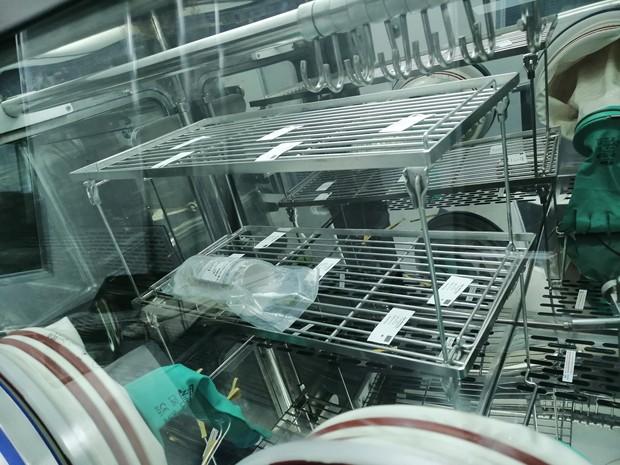
The second generation: With the development of aseptic isolation technology and sterilization technology, the aseptic isolator developed into a stainless steel material as the main structural material, but the structure still retains the turbulent flow design in the cabin. The sterilization method is mainly based on a hydrogen peroxide device connected to an external vaporization or spray.
The use of the sterile isolator essentially avoids direct contact between the operator and the experimental items. Instead of wearing a special cleansing suit, the operator does not need to wear the operating gloves or the half-length suit on the sterile isolator to inboard the items and instruments. Take action. Glove-sleeve assemblies or half-length suits are an integral part of a sterile isolator compartment that is made of a soft material and is compatible with the sterilant used.
Therefore, the aseptic sterilizer can perform sterility test to avoid contamination of the experimental articles and auxiliary equipment, and improve the accuracy of the sterility test results.
1. Confirmation of cabin tightness
Whether the sealing performance of the aseptic isolator meets the requirements is determined by the pressure maintaining capability of the sterile isolator in a fully static closed state.
- Close the doors and windows of the sterile isolator room to eliminate the influence of other equipment that has a great influence on temperature, and minimize the entry and exit of personnel.
- Close the aseptic isolator cabin door, the transfer door and all the detection ports, open the sterile isolator, enter the pressure operation interface, and click the “open pressure test” to start the automatic inflation pressure of the cabin to rise above 60Pa.
- When the display pressure slowly drops to 60Pa, the timer starts automatically. When the pressure drops to 42Pa, the timer will stop automatically. Click “Pressure Test Result Print” to print the test result (the transfer compartment seal test is equivalent).
- Calculate the hourly volume leak rate Q/V=60(Ps—Pt)/(Pt×t)
Where: Q/V: hour volume leak rate; Ps: initial absolute pressure Pt: end absolute pressure; t: mean pressure drop, min.
Judging criteria: 1 hour leak rate Q/V ≤ 0.5%. If the cabin is tested three times, the leakage rate is less than 0.5%, indicating that the sterile isolator has good sealing performance and can prevent the entry of external microorganisms.
Get in Touch
Have questions about our products or want to discuss a custom order? Our team is ready to help you.