
1.8 Degree Nema 17 42mm Small Geared Stepper Motor
1.8 Degree Gear Box Type Stepping Motor Nema17 Hybrid Stepper Motor 42mm
Gear Box Stepper Motor features
- Smooth surface
- Long lasting life
- Low cost for control achieved
- High torque at startup and low speeds
- Ruggedness
- Simplicity of construction
- Can operate in an open loop control system
- Low maintenance
- Less likely to stall or slip
- Will work in any environment
- Can be used in robotics in a wide scale.
- High reliability
- The rotation angle of the motor is proportional to the input pulse.
- The motor has full torque at standstill (if the windings are energized)
- Precise positioning and repeatability of movement since good stepper motors have an accuracy of 3 – 5% of a step and this error is non-cumulative from one step to the next.
- Excellent response to starting/stopping/reversing.
- Very reliable since there are no contact brushes in the motor. Therefore, the life of the motor is simply dependent on the life of the bearing.
- The motors response to digital input pulses provides open-loop control, making the motor simpler and less costly to control.
- It is possible to achieve very low-speed synchronous rotation with a load that is directly coupled to the shaft.
- A wide range of rotational speeds can be realized as the speed is proportional to the frequency of the input pulses.
specifications
| Number of phase | 2 |
| Basic step Angle | 1.8 degree |
| Rated Current | 2.0A |
| Resistance | 0.8ohm |
| Inductance | 3.7mH |
| Holding Torque | 0.72N.m |
| Weight | 0.5kg |
Description of Gear Box Stepper Motor
1. Accurate position Control
The angular displacement of the stepping motor can be precise controlled by the number of electrical pulses.Angle accuracy can be controlled within ±0.09°without any feedback devices.
2. Forward/Reverse Rotation,Pause and Hold
The forward /reverse rotation of the stepping motor can be controlled by the input sequence of the controlled electric pulses.
In the case of the a stepping motor lock(the motor winding is energized,there is no external electric pulse command),the stepping motor can still maintain a certain torque output.
3. Longer Life
Stepping motor is a mechanical structure,which does not need be changed by electric brush or Hall sensor,thus reducing the probability and increasing the motor life.Stepping motor life usually determined by the life of the bearing.
4. Strictly control the production of parts to improve the quality of parts.
5. Accurate position Control
The angular displacement of the stepping motor can be precise controlled by the number of electrical pulses.Angle accuracy can be controlled within ±0.09°without any feedback devices.
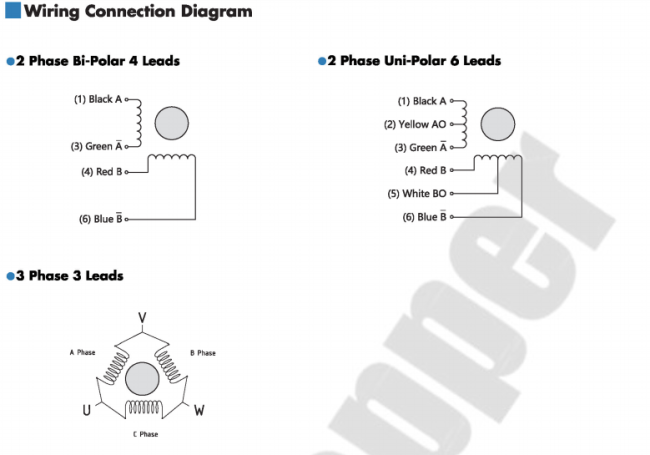


Gear Box Stepper Motor's specifications
- Stepping Accuracy: ± 5%
- Resistance Accuracy: ± 10%
- Inductance Accuracy: ± 20%
- Temperature Rise: 80°C Max.
- Ambient Temperature: -20°C ... +50°C
- Insulation Resistance: 100MOhm min. 500V DC
- Withstand: 500V AC, 1 Minute
Gear Box Stepper Motor Control by Varying Clock Pulses
Stepper motor control circuit is a simple and low-cost circuit, mainly used in low power applications. The circuit is shown in the figure,
A stepper motor is an electromechanical device it converts electrical power into mechanical power. Also, it is a brushless, synchronous electric motor that can divide a full rotation into an expansive number of steps. The motor’s position can be controlled accurately without any feedback mechanism, as long as the motor is carefully sized to the application. Stepper motors are similar to switched reluctance motors.
The stepper motor uses the theory of operation for magnets to make the motor shaft turn a precise distance when a pulse of electricity is provided. The stator has eight poles, and the rotor has six poles. The rotor will require 24 pulses of electricity to move the 24 steps to make one complete revolution. Another way to say this is that the rotor will move precisely 15° for each pulse of electricity that the motor receives.
Applications of 1.8 degree Stepper Motor
Stepper motors are diverse in their uses, but some of the most common include:
- Textile machines
- Printing presses
- Gaming machines
- Medical imaging machinery
- Small robotics
- CNC milling machines
- Welding equipment
Get in Touch
Have questions about our products or want to discuss a custom order? Our team is ready to help you.