
1.8 Degree Brake Nema 17 Bipolar Stepper Motor For 3D Printing Equipment
Price:
Negotiable
MOQ:
10pcs
Delivery Time:
7-25 work days
Brand:
Prostepper
Product Description
1.8degree Nema 17 Bi-Polar Brake Stepper Motor
Product description of 1.8 stepper motor
- It is possible to achieve very low-speed synchronous rotation with a load that is directly coupled to the shaft.
- Material quality: The coat is 304 stainless steel, the water jacket is the high compression casting aluminum tube, the red copper coil.
- A wide range of rotational speeds can be realized as the speed is proportional to the frequency of the input pulses.
Specifications
| Model | PST42H241-4L20M | PST42H249-4L20M | PST42H261-4L20M |
| Holding Torque | 0.4N.m | 0.48N.m | 0.72N.m |
| Related Current | 2A/Phase | 2A/Phase | 2A/Phase |
| Resistance | 1.05Ω/Phase | 1.35Ω/Phase | 1.75Ω/Phase |
| Inductance | 2MH/Phase | 2.9MH/Phase | 4MH/Phase |
| Inertia | 54g.cm² | 77g.cm² | 100g.cm² |
| Black Torque | 0.5N.m | 0.5N.m | 0.5N.m |
General specifications
| Specification | Motor Characteristics | |
| Insulation Class | Class B130°C | |
| Step Angle Accuracy | ±0.09° | |
| Withstand Voltage | AC500V (one minute) | |
| Insulation Resistance | 100MQ MIN. 500VDC | |
| Temperature Rise | 80*C MAX | |
| Radial Play | 0.025mm Max. (Load450g) | |
| Axial Play | 0.075mm Max. (Load950g) | |
| Temperature | -10~+50°C (Non Condensing) | |
| Operating Environment | Humidity | 85%RH MAX. (Non Condensing) |
| Medium | No corrosive gas or dust. Not directly in contact with water, oil, etc. | |
| Storage Environment | Temperature | 0~+50°C (Non Condensing |
| Humidity | 85%RH MAX. (Non Condensing) | |
| Life | 5000 Hours MIN. | |
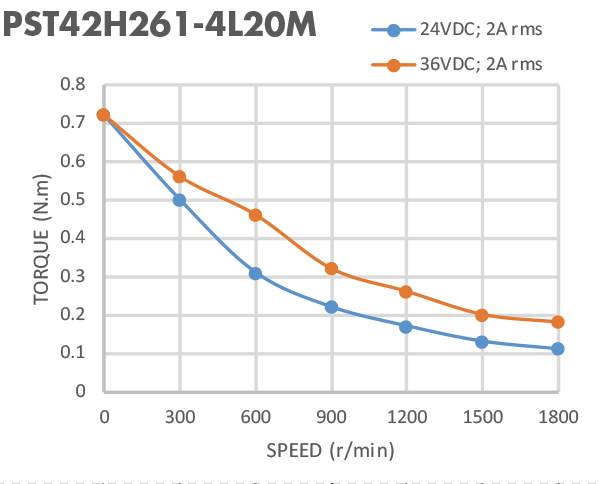
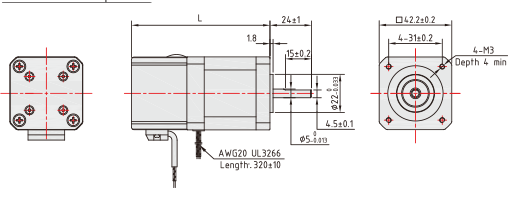
Speed/Torque Characteristics(Reference Value)
Ti What is stepper motor?
- Stepper motor is an actuator transforming electric pulse into angular displacement. Popularly, when receiving a pulse signal, the stepper motor wi ll rotate a fixed angle (namely ''stepping angle'') according to the direction set for the stepper motor. The angular displacement volume can be c ontrolled by controlling the pulse number to achieve the purpose of positioning accurately. In the meantime, the rotational velocity and acceleration of motor can be controlled by controlling the pulse frequency to achieve the purpose of speed control.

Operation of Stepper Motor:
Stepper motors operate differently from DC brush motors, which rotate when voltage is applied to their terminals. Stepper motors, on the other hand, effectively have multiple toothed electromagnets arranged around a central gear-shaped piece of iron. The electromagnets are energized by an external control circuit, for example, a microcontroller.
Applications of Stepper Motors
s stepper motors are diverse in their uses, but some of the most common include:
- 3D printing equipment
- Textile machines
- Printing presses
- Gaming machines
- Medical imaging machinery
- Small robotics
- CNC milling machines
- Welding equipment
Similar Products
Get in Touch
Have questions about our products or want to discuss a custom order? Our team is ready to help you.
Company
Changzhou Prostepper Co.,Ltd.
Location
3F, Block C,Tianan Industrial Park,New North District,Changzhou City, Jiangsu Province,China
Contact Person
Linda Liu