
Bi Polar 2 Phase Brake Stepper Motor NEMA 17
2 Phase Brake Stepper Motor NEMA23 Bi Polar
Product description
1. Accurate position Control
The angular displacement of the stepping motor can be precise controlled by the number of electrical pulses.Angle accuracy can be controlled within ±0.09°without any feedback devices.
2. Accurate Speed Control
The rotational speed of the stepping motor can be precisely controlled ,By controlling the frequency of the electric pulse.
Specifications
| Model | PST57H255-4L40M | PST57H276-4L50M |
| Holding Torque | 1.2N.m | 2N.m |
| Related Current | 4A/Phase | 5A/Phase |
| Resistance | 0.45Ω/Phase | 0.37Ω/Phase |
| Inductance | 1.4MH/Phase | 1.8MH/Phase |
| Inertia | 280g.cm² | 480g.cm² |
| Black Torque | 1.3N.m | 1.3N.m |
Radial Load&Axial Load
| Motor Size | Shaft Diameter (mm) | Radial Load (N) | Axial Load (N) | ||||||
| Distance from Mounting Surface (mm) | |||||||||
| 5 | 10 | 15 | 20 | 25 | 30 | 35 | |||
| NEMA8 | 4 | 15 | 12 | — | 3 | ||||
| NEMA 11 | 5 | 50 | 35 | 25 | — | 5 | |||
| NEMA 14 | 5 | 50 | 35 | 25 | 20 | — | — | — | 10 |
| NEMA 17 | 5 | 50 | 35 | 25 | 20 | — | — | 15 | |
| NEMA 23 | 8 | 270 | 180 | 130 | 100 | 90 | — | 20 | |
| NEMA 24 | 8 | 200 | 135 | 100 | 82 | 58 | — | — | 30 |
| NEMA 34 | 14 | 620 | 550 | 480 | 390 | 340 | 290 | 260 | 60 |
-
Speed/Torque Characteristics(Reference Value)
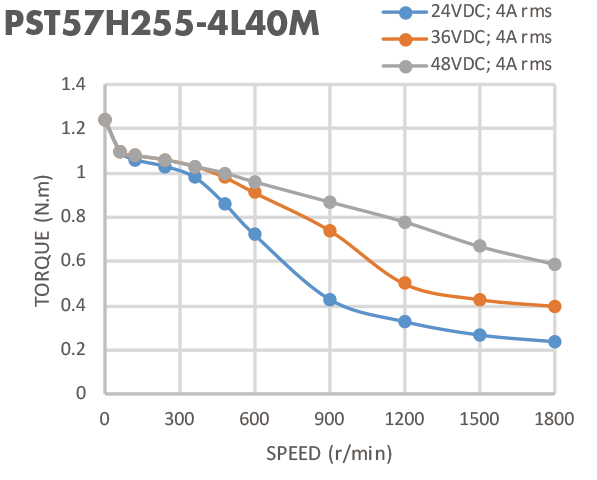

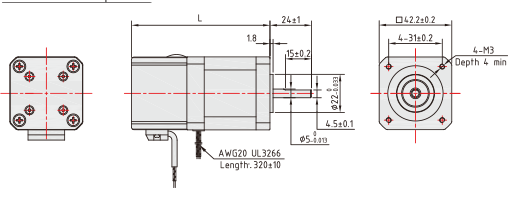
Ti What is stepper motor?
- Stepper motor is an actuator transforming electric pulse into angular displacement. Popularly, when receiving a pulse signal, the stepper motor wi ll rotate a fixed angle (namely ''stepping angle'') according to the direction set for the stepper motor. The angular displacement volume can be c ontrolled by controlling the pulse number to achieve the purpose of positioning accurately. In the meantime, the rotational velocity and acceleration of motor can be controlled by controlling the pulse frequency to achieve the purpose of speed control.

Operation of Stepper Motor:
Stepper motors operate differently from DC brush motors, which rotate when voltage is applied to their terminals. Stepper motors, on the other hand, effectively have multiple toothed electromagnets arranged around a central gear-shaped piece of iron. The electromagnets are energized by an external control circuit, for example, a microcontroller.
Applications of Stepper Motors
s stepper motors are diverse in their uses, but some of the most common include:
- 3D printing equipment
- Textile machines
- Printing presses
- Gaming machines
- Medical imaging machinery
- Small robotics
- CNC milling machines
- Welding equipment
Get in Touch
Have questions about our products or want to discuss a custom order? Our team is ready to help you.