
8P 18.5mm Pitch Nickel Strip for High-Capacity 18650 Packs — 99.6% Ni, Won't Corrode Under Sustained High Drain
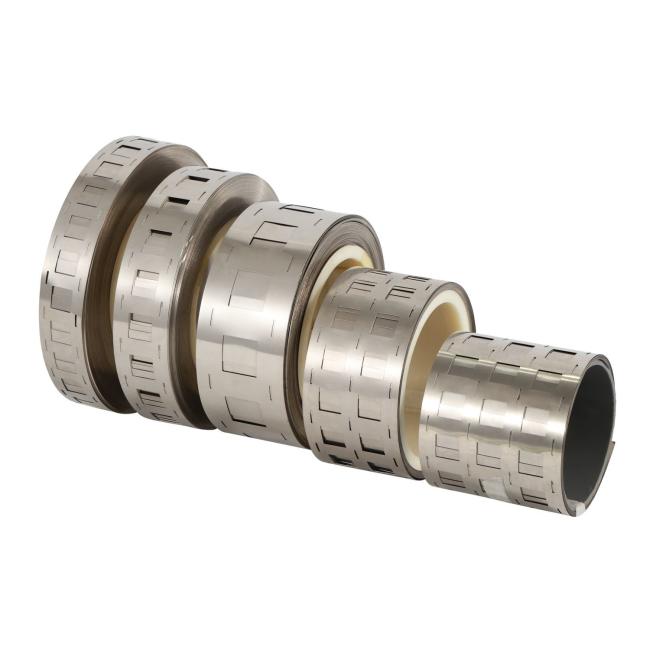
An 8P 18650 pack pulls serious current. With eight cells in parallel, you are running 40–80A continuous through a single strip plane in e-bike and power tool applications. At those currents, a nickel-plated steel interconnect develops hot spots within months — the plating micro-cracks at each weld point, the steel substrate oxidizes, contact resistance climbs, and the pack degrades. Pure nickel at 99.6% minimum content does not do this. No plating to fail, no substrate to rust, no creeping resistance to chase with a multimeter six months after assembly. DLX stamps 8P nickel strip at 18.5mm pitch — the tightest standard spacing for 18650 cells — in N4, N6, Ni200, and Ni201 grades across 0.1/0.15/0.2 mm thickness. Every connector in the spool holds the same pitch, the same surface, and the same chemistry as the first.

99.6% Minimum Nickel — No Rust, No Plating Failure, No Resistance Drift
Nickel-plated steel costs less at purchase but costs more over the pack's service life. When plating micro-cracks at each spot weld — and it will — the exposed steel rusts, contact resistance rises, and I²R heating accelerates degradation. Pure nickel at 99.6% Ni is the same material all the way through. There is no substrate to expose, no plating to fail, and no corrosion mechanism that activates under normal battery operating conditions.
18.5mm Pitch — Tightest Standard 18650 Spacing, No Dead Air
At 18.5mm center-to-center, cells sit with approximately 0.5mm clearance — the minimum gap compatible with standard 18650 cell holders. Every millimeter of unnecessary pitch adds pack length. For an 8P * 10S config, switching from 20.2mm to 18.5mm pitch saves over 13mm in pack width — often the difference between fitting a standard enclosure and paying for a custom housing.
8P Configuration — Pre-Formed, No Hand-Cutting Eight Links per Cell Group
Building an 8P pack with individual links means cutting, positioning, and welding 16 separate nickel pieces per series group. DLX ships 8P strip as a single pre-formed component: load the spool, index the strip, and weld all eight cells in one pass. Labor per pack drops from minutes to seconds. Alignment is repeatable because the strip geometry is, too.
0.1 / 0.15 / 0.2 mm Thickness — Match Current Without Oversizing
Three standard gauges, each hydrogen-annealed to consistent hardness. 0.1 mm for packs under 20A continuous. 0.15 mm — the industry workhorse — handles 20–50A with standard 8–12 Ws weld settings. 0.2 mm for 50–80A high-drain applications where cross-sectional area must keep I²R losses below 2% of pack capacity. Using 0.2 mm where 0.15 mm would suffice adds unnecessary weight and welding difficulty — we stock all three so you don't have to compromise.
Nickel-Only Facility — The Purity on the Certificate Is Real
DLX's 12,000 m² plant processes only nickel and nickel alloys. No stainless, no copper, no steel runs on the same production line. When your strip specification says 99.6% Ni minimum, the OES spectrometer reading on your heat confirms 99.6% Ni — not 99.6% minus whatever the previous campaign left behind. That distinction matters when the strip is carrying 80A through a pack you warrantied for three years.
| Grade | Ni Content | Corrosion Edge | Best Pack Application | Reference Price (FOB, USD/kg) |
|---|---|---|---|---|
| N4 | Ni+Co ≥ 99.9% | Maximum purity — trace Fe ≤ 0.04%. For marine and high-humidity pack environments where any corrosion is a warranty event. | Marine battery packs, outdoor energy storage, medical device batteries | 60 – 68 |
| Ni201 | Ni ≥ 99.0% (C ≤ 0.02%) | Low carbon prevents grain-boundary attack at sustained elevated temperatures above 315°C. For fast-charge packs with aggressive thermal cycling. | High C-rate fast-charge packs, EV modules with active thermal management | 46 – 54 |
| Ni200 | Ni ≥ 99.2% | Standard 99.6% rating — the industry benchmark. Excellent corrosion resistance for all normal battery operating environments. | E-bike packs, power tool modules, consumer electronics batteries | 36 – 42 |
| N6 | Ni+Co ≥ 99.5% | Cost-effective corrosion protection for indoor and climate-controlled pack deployments. | UPS modules, indoor energy storage, solar battery banks | 30 – 36 |
Prices FOB Shanghai, valid for 5–500 kg orders. Volume pricing for annual contracts. MOQ: 5 kg. Free sample of N6 or Ni200 (0.5 kg) for evaluation. 1P–8P configurations in stock; 18.5mm, 19mm, 19.5mm, and 20.2mm pitch available.

| Element | N4 | N6 | Ni200 | Ni201 |
|---|---|---|---|---|
| Ni+Co | ≥ 99.9% | ≥ 99.5% | — | — |
| Ni | — | — | ≥ 99.2% | ≥ 99.0% |
| Cu | ≤ 0.015 | ≤ 0.10 | ≤ 0.25 | ≤ 0.25 |
| Si | ≤ 0.03 | ≤ 0.10 | ≤ 0.35 | ≤ 0.35 |
| Mn | ≤ 0.002 | ≤ 0.05 | ≤ 0.35 | ≤ 0.35 |
| C | ≤ 0.01 | ≤ 0.10 | ≤ 0.15 | ≤ 0.02 |
| Mg | ≤ 0.01 | ≤ 0.10 | — | — |
| S | ≤ 0.001 | ≤ 0.005 | ≤ 0.01 | ≤ 0.01 |
| P | ≤ 0.001 | ≤ 0.002 | — | — |
| Fe | ≤ 0.04 | ≤ 0.10 | ≤ 0.40 | ≤ 0.40 |
Source: DLX Alloy product catalog. EN 10204 3.1 MTC with full composition included on every shipment.
| Property | Value | Unit |
|---|---|---|
| Tensile Strength (Rm) | ≥ 462 | MPa |
| Yield Strength (Rp0.2) | ~ 170 | MPa |
| Elongation (A5) | ≥ 35 | % |
| Hardness | 90 – 120 | HB (annealed) |
| Density | 8.908 | g/cm³ |
| Melting Point | 1435 – 1455 | °C |
| Electrical Resistivity (20°C) | 0.096 | μΩ·m |
| Thermal Conductivity | 70.2 | W/m·K |
| Corrosion Resistance | Excellent — no rust, no galvanic attack at bimetallic joints, stable in humid and marine environments | |
| Spot Weldability | Excellent — consistent nugget formation at 8–12 Ws on standard capacitive welders | |
| Magnetism | Ferromagnetic | |
Source: DLX Alloy product catalog. Values representative of hydrogen-annealed strip condition.
| Parameter | Standard Range | Notes |
|---|---|---|
| Material Grades | N4, N6, Ni200, Ni201 | Pure nickel only — no plated or clad variants |
| Pitch Distance | 18.5 mm | ±0.05 mm tolerance; also available: 19.0, 19.5, 20.2 mm |
| Configurations | 1P – 8P | Pre-formed, progressive-die stamped |
| Strip Thickness | 0.10 / 0.15 / 0.20 mm | ±0.01 mm tolerance |
| 8P Strip Width | ~ 110 mm | Eight cells * 18.5mm pitch = 129.5mm nominal span |
| Edge Finish | Burr-free (wire EDM slit) | < 0.01 mm burr height |
| Surface | Bright, hydrogen annealed | Oxide-free, ready to weld |
| Package | Spool in carton / coil in polybag | VCI paper interleave |
| MOQ | 5 kg | Free sample for evaluation |
- Melt chemistry gate. Every nickel heat OES-tested for full composition before entering production. Fe content verified against grade specification — N4 max 0.04%, N6 max 0.10%, Ni200/Ni201 max 0.40%.
- Thickness profile scan. Laser-scanned at five points across strip width every 50 meters of coil. ±0.01 mm tolerance enforced.
- Pitch verification. Optical comparator measurement at 20* magnification on first-article and in-process samples. Pitch maintained at ±0.05 mm; die re-indexed if drift exceeds ±0.025 mm.
- Burr inspection at 10*. Strip edges sampled at start, middle, and end of each stamping campaign. Any burr over 0.01 mm triggers tool change and coil re-inspection.
- Corrosion resistance coupon test. Sample strips from each production batch are exposed to 5% NaCl salt spray (ASTM B117) for 96 hours. Pure nickel must show zero red rust and zero visible pitting. Nickel-plated steel control coupons are run alongside for comparison and customer documentation.
- Spot weld pull test. One sample per 100 kg welded to 18650 cell cap at 10 Ws. Peel force ≥ 15 N required.
- Pre-formed strip on spool: Precision-wound on rigid plastic spools (DIN 200/300 mm). Interleaved with acid-free tissue between layers. Vacuum-sealed in anti-static PE film, packed in individual double-wall cartons. Max 20 spools per master carton.
- Bulk coil (uncut strip): Tight-wound, nylon-strapped, VCI paper + PE film, plywood case with foam edge protection for ocean freight.
- Labeling: Every spool and carton carries heat number, grade, pitch distance, configuration (e.g., "8P / 18.5mm / 18650"), thickness, net weight, and wind direction arrow. EN 10204 3.1 MTC in external document pouch.
Delivery: 3–7 working days after payment. Air freight for < 30 kg; sea freight for bulk. Departure: Shanghai.
Changzhou DLX Alloy Co., Ltd. does not just claim corrosion resistance — we test it. Every production batch of nickel strip is sampled for 96-hour accelerated salt spray exposure (ASTM B117, 5% NaCl). Pure nickel strip must show zero red rust and zero visible pitting to clear the gate. We run nickel-plated steel control coupons alongside as a reference — so our customers see, quantitatively, what they are choosing between. This testing discipline, combined with our nickel-only 12,000 m² facility and ISO9001-certified quality system (established 2002), means the anti-corrosive property you specify is a verified specification, not a marketing claim. Serving battery pack manufacturers across 40+ countries, DLX ships 500 tons of nickel strip per month — each coil backed by a heat-specific EN 10204 3.1 MTC.
Q: Why does 8P nickel strip cost more than nickel-plated steel — and is it worth it?
Nickel-plated steel costs 40–60% less at purchase. The cost shows up later: in a pack that has been in the field for 12–18 months, the plating micro-cracks that form at every spot weld allow electrolyte vapor and ambient humidity to reach the steel substrate. Rust begins. Contact resistance rises from milliohms to tens of milliohms. I²R heating accelerates. The pack loses capacity and, in a worst case, develops localized hot spots that trip the BMS or worse. Pure nickel at 99.6% Ni has no substrate to expose and no plating to fail. It stays conductive. It stays connected. For packs with a warranty longer than six months, the math favors nickel.
Q: What is the practical difference between 18.5mm and 19mm pitch?
0.5 mm per cell. In an 8P strip, that is 3.5 mm across the full width — small enough that both pitches fit standard 18650 cell holders, large enough that a jig machined for 19mm will not align correctly with 18.5mm strip. Measure your cell holder or welding fixture center-to-center distance. That measurement is the pitch you need. If you are designing a new pack and space is tight, 18.5mm is the most compact standard option.
Q: Can you supply 8P strip in both plain (H-type) and continuous (U-type) patterns?
Yes. H-type (individual cell links connected by a spine) and U-type (continuous serpentine) patterns are both available in 8P configuration. H-type is more common for packs where individual cell fusing is desired — the narrow link between the cell tab and the main bus acts as a sacrificial fuse. U-type provides the lowest possible resistance for high-current packs where fusing is handled by a separate BMS circuit. Specify your preference at inquiry.
Q: How do you verify that your strip won't corrode in my application?
We run ASTM B117 neutral salt spray testing on sample strips from every production batch: 5% NaCl at 35°C for 96 continuous hours. Acceptance criteria: zero red rust, zero visible pitting at 10* magnification. If your application involves a specific electrolyte chemistry or environmental condition beyond standard salt spray, we can arrange application-specific corrosion coupon testing. Provide your test protocol and we will quote the validation run.
Q: What thickness should I use for an 8P pack?
For an 8P pack, the eight parallel current paths share the load, reducing the per-strip current compared to lower-P configurations. 0.15 mm is the standard recommendation for most 8P 18650 builds — it welds reliably at 8–12 Ws and handles the aggregate current of a typical 8P pack. Use 0.2 mm if your continuous discharge exceeds 60A per parallel group or if your pack experiences mechanical shock or vibration (power tools, EV modules). Use 0.1 mm only for low-current applications under 15A per group where weight and welding energy are the primary constraints.

Get in Touch
Have questions about our products or want to discuss a custom order? Our team is ready to help you.