
From Principles to Applications: A Comprehensive Analysis of Decanter Centrifuges in Industrial Wastewater Treatment
From Principles to Applications: A Comprehensive Analysis of Decanter Centrifuges in Industrial Wastewater Treatment
In industrial wastewater treatment, municipal sludge dewatering, and various material separation processes, the efficiency and reliability of solid-liquid separation equipment directly determine operational costs and environmental compliance. Thanks to its advantages—continuous operation, high automation, and strong processing capacity—the decanter centrifuge has become the preferred choice for users across numerous industries worldwide.
1. Equipment Overview: A Separation System Built for Continuous Operation
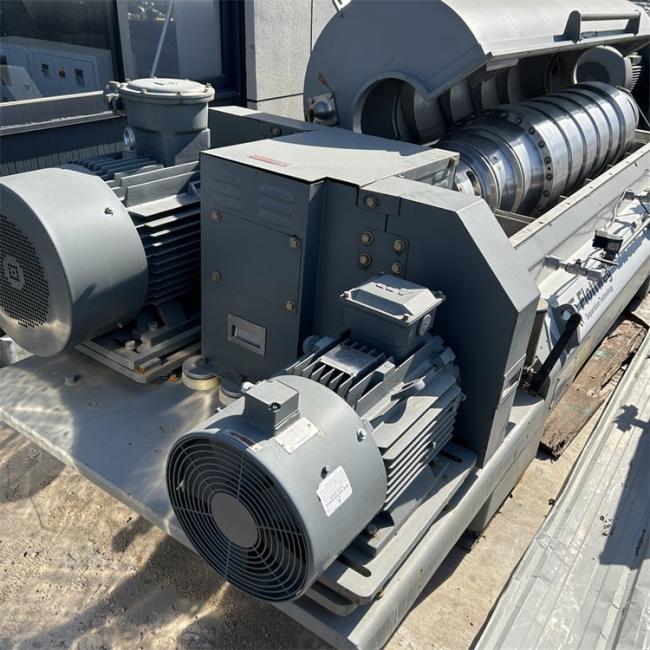
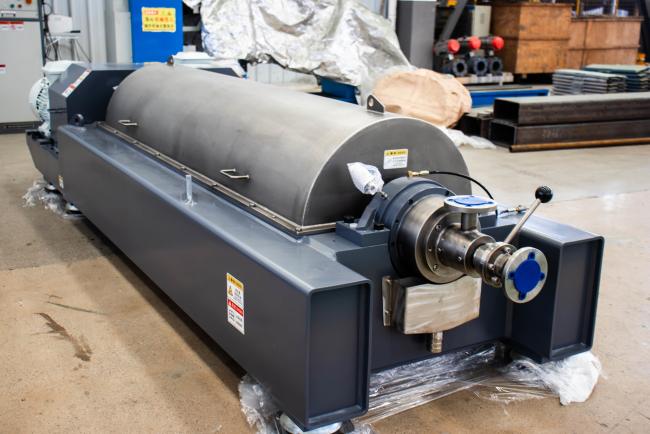
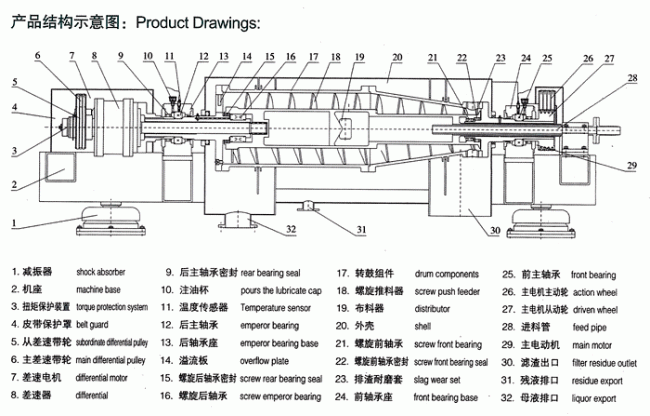
A decanter centrifuge is a mechanical device that utilizes centrifugal sedimentation to continuously separate solids from liquids. Its main components include:
- Rotating bowl (rotor)
- Scroll conveyor (screw conveyor)
- Differential gearbox
- Drive system
- Control system
During operation, feed slurry enters the rapidly rotating bowl through the feed pipe. Under intense centrifugal force, denser solid particles quickly settle onto the bowl wall and are continuously pushed toward the discharge end by the scroll conveyor. Meanwhile, the clarified liquid phase overflows from the opposite end, achieving automatic solid–liquid separation.
This design distinguishes the decanter centrifuge from batch-type separators, offering the following key features:
- Continuous feeding and discharging, eliminating downtime for sludge removal
- Fully enclosed structure, preventing splashing and ensuring a clean working environment
- Fully automated operation, enabling 24/7 unattended running
- High adaptability, capable of handling materials with varying concentrations and particle sizes
2. Core Advantages: Why Global Users Choose Decanter Centrifuges
2.1 High Capacity & Low Operating Cost
A single decanter centrifuge can process over 150 m³/h, far exceeding traditional filter presses. It requires no filter cloths, thus avoiding clogging issues. Routine maintenance involves only periodic checks of bearings, lubrication systems, and wear-resistant linings—significantly reducing maintenance expenses. Additionally, optimized energy consumption ensures industry-leading power efficiency per unit of processed material.
2.2 Superior Separation Performance & High Resource Recovery
Precise differential speed control and an optimized bowl geometry enable simultaneous production of high-dryness cake and low-turbidity centrate. Typical performance includes:
- Cake dry solids content: 15%–35%
- Centrate suspended solids: ≤ 0.05%
For applications involving valuable solids recovery—such as starch extraction, catalyst recovery, or mineral concentrate thickening—solid recovery rates can exceed 99%.
2.3 Wear Resistance & Durability in Harsh Conditions
Critical components feature multi-layer protection:
- Scroll blades and discharge ports can be equipped with tungsten carbide cladding, tungsten carbide coating, or replaceable ceramic tiles.
- In high-abrasion scenarios (e.g., piling slurry, mining tailings), these enhancements extend service life by 3–5 times.
2.4 Intelligent Control & User-Friendly Operation
Equipped with an advanced PLC control system and a 10-inch color touchscreen, the interface is intuitive and responsive. Real-time monitoring includes:
- Main & auxiliary motor currents
- Bowl speed & differential speed
- Vibration levels
- Bearing temperatures
The system supports self-diagnosis, automatic alarms, protective shutdowns, and offers remote communication interfaces for data upload and remote maintenance.
3. Technical Specifications
| Parameter Category | Technical Specification |
|---|---|
| Model Series | LW250 / LW350 / LW450 / LW520 / LW650 / LW760 |
| Bowl Diameter | 250 – 760 mm |
| Length-to-Diameter Ratio | 3.5:1 – 4.5:1 (optional) |
| Max Rotational Speed | 2500 – 4000 rpm (diameter-dependent) |
| Max G-Force (Separation Factor) | 1500 – 3000 G |
| Differential Speed Range | 0.5 – 30 rpm (infinitely variable) |
| Main Motor Power | 11 – 160 kW |
| Auxiliary Motor Power | 4 – 75 kW |
| Processing Capacity | 1 – 150 m³/h (material-dependent) |
| Cake Dry Solids | 15% – 35% |
| Centrate Suspended Solids | ≤ 0.05% – 0.1% |
| Bowl Material | Duplex stainless steel (2205 / 2304) / 316L |
| Scroll Material | Duplex stainless steel + wear-resistant protection |
| Casing Material | 304 stainless steel / carbon steel with anti-corrosion coating |
| Wear Protection Options | Tungsten carbide coating / cladding / ceramic tiles |
| Drive System | Dual-motor dual-inverter with common DC bus / hydraulic differential |
| Control System | PLC + 10" touchscreen, with data logging & remote communication |
| Communication Protocols | Modbus RTU / Modbus TCP / Profibus / Profinet (optional) |
| Safety Protections | Bearing temp. monitoring, vibration monitoring, motor overload, differential overload, emergency stop |
| Vibration Isolation | Rubber mounts / spring mounts / foundation-free installation (optional) |
4. Industry Applications: Serving Global Industrial Sectors
| Industry Sector | Typical Applications |
|---|---|
| Municipal & Environmental | Sewage sludge dewatering, water treatment plant sludge, dredged sediment processing |
| Petrochemical | Oily sludge dewatering, refinery sludge separation, drilling mud treatment |
| Food & Beverage | Juice clarification, distiller’s grains dewatering, starch separation, plant protein extraction |
| Pharmaceutical & Fermentation | Antibiotic mycelium dewatering, fermentation broth separation, vitamin recovery |
| Mining & Metallurgy | Coal washery effluent, metal tailings dewatering, stone slurry purification |
| Industrial Manufacturing | Electroplating wastewater, textile sludge, paper mill white water recovery |
| Livestock & Agriculture | Manure treatment, biogas digestate concentration, farm wastewater separation |
5. Selection Guide: How to Choose the Right Decanter Centrifuge
Proper selection is critical for optimal performance. We recommend providing the following information for accurate sizing:
- Material characteristics: Name, solid/liquid composition, pH, temperature
- Processing requirements: Feed flow rate, inlet solids concentration, target cake dryness, target centrate clarity
- Site conditions: Power supply (voltage/frequency), installation space, ambient temperature, explosion-proof needs
- Operation mode: Continuous vs. batch, level of automation required
Based on this data, we offer end-to-end support—from lab-scale testing and pilot trials to full-scale industrial deployment.
6. Global Service Network: Rapid Response, Full Lifecycle Support
With extensive international experience, we’ve built a robust global service infrastructure to ensure timely, professional support for every customer:
- Pre-Sales: Technical consultation, process analysis, customized selection, ROI calculation
- In-Sales: Detailed installation drawings, on-site commissioning guidance, trial run support
- After-Sales: Operator training, regular follow-ups, spare parts supply, remote diagnostics
- Emergency Response: 24/7 technical hotline; on-site support within 72 hours for critical issues
Conclusion
As global environmental regulations tighten and industrial operations demand greater precision, the decanter centrifuge stands out as an efficient, reliable, and intelligent solution for solid–liquid separation. We are committed to delivering high-quality equipment and professional services to help enterprises achieve both regulatory compliance and economic efficiency.
Contact us today to receive a tailored selection proposal and technical documentation for your specific application.
Get in Touch
Have questions about our products or want to discuss a custom order? Our team is ready to help you.