
Global Applications of Decanter Centrifuges in Industrial Water Treatment and Solid-Liquid Separation: Technical Principles, Key Parameters, and Selection Guidelines
Growing Global Demand for High-Efficiency Solid-Liquid Separation Equipment in Water Treatment
As industrial wastewater discharge standards become increasingly stringent and municipal sludge treatment requirements continue to rise, decanter centrifuges have emerged as a core technology for solid-liquid separation in water treatment projects worldwide. Thanks to their advantages—continuous operation, fully enclosed design, high throughput, and high automation—they are now indispensable in both municipal and industrial applications.
Demand is especially strong in overseas markets such as the Middle East, Southeast Asia, South America, Africa, and Eastern Europe, where infrastructure development and industrial modernization are accelerating. In these regions, decanter centrifuges are highly valued for their ability to handle high-solids-content and high-viscosity feed materials reliably and efficiently.
Key Advantages of Decanter Centrifuges
- Continuous Feeding and Discharge: No filter cloths or screens required; enables 24/7 uninterrupted operation, ideal for large-scale treatment plants.
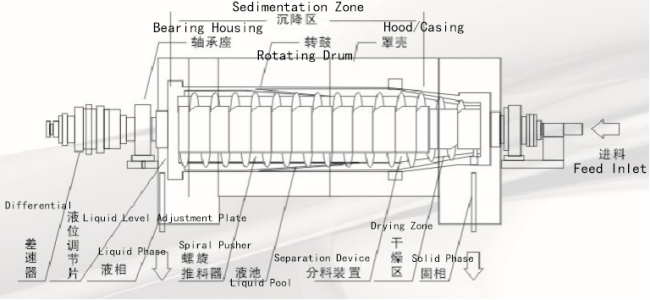
- High Cake Dryness: By adjusting differential speed and liquid pool depth, cake dry solids content can reach 25–35% or higher.
- Low Operating Costs: Minimal polymer (flocculant) consumption, very low wash water usage, and energy-efficient motor designs.
- Fully Enclosed Construction: Prevents splashing and odor emissions, meeting strict environmental and safety regulations in Europe and North America.
- Modular Design: Facilitates containerized shipping and rapid on-site installation—perfect for international EPC (Engineering, Procurement, and Construction) projects.
Typical Application Scenarios
- Municipal Wastewater Treatment: Thickening and dewatering of waste activated sludge (WAS)
- Oil & Gas Industry: Drilling mud processing, oily sludge volume reduction
- Chemical & Pharmaceutical Manufacturing: Solid-liquid separation of high-salt, high-COD mother liquors
- Food & Beverage Processing: Separation of fruit pomace, spent grain (distillers’ grains), and plant protein extraction
- Mining & Metallurgy: Tailings dewatering, coal washery effluent treatment
- Livestock & Poultry Farming: Digestate separation, manure solid-liquid fractionation
Comprehensive Technical Specifications of Decanter Centrifuges
The following parameters represent general ranges suitable for municipal and industrial wastewater applications. Custom designs are available based on specific throughput requirements and feed characteristics.
Core Parameter Summary Table
| Parameter Category | Parameter Item | Technical Range |
|---|---|---|
| Physical Dimensions | Bowl Diameter (mm) | 250 / 360 / 450 / 550 / 650 / 750 / 900 |
| Length-to-Diameter Ratio (L/D) | 3.5 – 4.5 (high-dryness models: 4.0–5.0) | |
| Speed & Separation Performance | Max Bowl Speed (rpm) | 3000–4500 (small diameters); 1500–2800 (large diameters) |
| G-Force (Separation Factor) | 1500 – 4000 | |
| Differential Speed Range (rpm) | 0.5 – 20 (infinitely adjustable) | |
| Drive System | Main Motor Power (kW) | 7.5 – 132 |
| Auxiliary (Scroll) Motor Power (kW) | 2.2 – 45 | |
| Capacity & Efficiency | Max Throughput (m³/h) | 2 – 120 (water-equivalent; varies with sludge type) |
| Solids Recovery Rate (%) | ≥95% – 99% | |
| Separation Performance | Cake Dry Solids Content (%) | 20 – 40 (typical municipal sludge: 25–30%) |
| Liquid Phase Suspended Solids (mg/L) | ≤500 – 5000 (with optimized flocculation: <200 mg/L achievable) | |
| Operational Conditions | Noise Level (dB(A)) | ≤85 (at 1 m distance, with enclosure) |
| Vibration Severity (mm/s) | ≤4.5 | |
| Operating Temperature (°C) | 0 – 80 (special designs up to 120°C) | |
| Operating Pressure | Slight negative pressure or atmospheric (fully enclosed) | |
| Materials of Construction | Bowl Material | Duplex 2205 / 316L stainless steel / Abrasion-resistant carbon steel |
| Scroll (Screw Conveyor) | 316L + tungsten carbide cladding / ceramic tiles | |
| Casing Material | 304 / 316L stainless steel | |
| Control & Electrical | Control System | PLC + HMI touchscreen interface |
| Automation Features | Remote start/stop, auto differential speed control, alarm logging, load feedback | |
| Communication Protocols | Modbus RTU/TCP, Profibus DP, Profinet (optional) | |
| Protection Rating | IP54 / IP55 (motors); Control cabinet: IP42 | |
| Explosion Protection | Ex d IIB T4 (optional, for oil/gas, chemical, pharma) | |
| Other | Approx. Weight (kg) | 800 – 12,000 (model-dependent) |
| Installation Method | Anti-vibration rubber mounts or spring isolators; no anchor bolts required |
Optional Accessories (Project-Specific Add-ons)
| Accessory | Function Description |
|---|---|
| Centripetal Pump | Enhances liquid clarity and minimizes solids carryover in centrate |
| Back Pressure Plate (Beach Plate) | Increases cake dryness, especially effective for high-moisture feeds |
| Temperature Sensors | Monitors main bearing and gearbox temperatures to prevent overheating |
| Vibration Sensors | Complies with ISO 10816; enables real-time condition monitoring |
| Acoustic Enclosure | Reduces noise levels to <75 dB(A) for sensitive environments |
| Nitrogen Purging System | Provides inert atmosphere for explosion-proof operation in hazardous areas |
| In-Line CIP Nozzles | Enables automatic cleaning for sticky or adhesive materials, reducing downtime |
| Wear-Resistant Coatings (Tungsten Carbide / Ceramic) | Extends service life in highly abrasive applications (e.g., mining tailings, sand-laden wastewater) |


Get in Touch
Have questions about our products or want to discuss a custom order? Our team is ready to help you.