
Premium Quality, Customizable, and Cost-Effective Railway Concrete Ties for Reliable Track Performance
In the early times of Indian Railway, wood was the only material of making the sleeper in world. With the development of concrete technology in the nineteenth century, cement concrete had established its place as a versatile building material and could be adopted suitably to meet the requirements of a railway sleeper. Concrete sleepers have been designed by the Research Design and Standard Organization (RDSO) wing of Indian Railway.
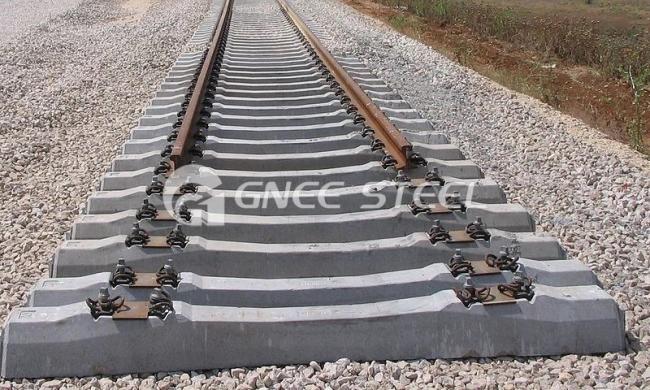
BG sleeper
Concrete sleeper includes various types: pre-stressed concrete sleeper, pre-tension concrete sleeper, post-tension concrete sleeper and two-block concrete sleeper. Different types of concrete sleepers are manufactured by Indian Railway.
Table 2 Different types of concrete sleepers
| Gauge | Sleeper type | Rail section | Standard drawing number | Sleeper design number |
| BG | Mono block | 60kg | RDSO/T-2496 | PDS-14 |
| BG | Mono block | 52kg | RDSO/T-2495 | PDS-12 |
| BG | Mono block | 60kg/52kg | RDSO/T-3602 | Post-tension type |
| BG | Mono block | 90R/75R | RDSO/T-2521 | RCS-6 |
| BG | Mono block | 90R | RDSO/T-2503 | PCS-17 |
| MG | Twin block | 75R/60R | RDSO/T-3518 | PCS-12 |
| BG | Twin block | 75R | RDSO/T-153 | PCS-11 |
Concrete rail sleepers
Concrete timber sleepers have many advantages like longer lifespan, high stability, small maintenance, low damage rate and low scrap rate. They are widely used in high speed railway and the stability is much higher than wood sleepers. Many countries chose concrete sleepers to build high speed passenger line. While concrete sleepers still have many disadvantages like heavy weight, difficult to transport and environment limits. They are not suitable for frozen earth, heavily polluted area and busy routes of mineral.

Advantages of concrete rail sleepers
1. Offer higher longitudinal and transverse stability
2. Easy to maintain gauge, cross level and alignment
3. Suitable for modern methods of track maintenance
4. Can be used in track circuited areas
5. Longer life (40-50years) allows renewal of both rail and sleeper together
6. Suitable for mass production with locally available materials
7. Not susceptible to (corrosion, fire hazards and pest attack)
Disadvantages
1. Heavy to handle
2. Track laying needs mechanical method
3. Damage is heavy at the time of derailment
4. Have no scrap value

Get in Touch
Have questions about our products or want to discuss a custom order? Our team is ready to help you.