
50mm Hole Saw HSS M35 Cobalt Bi-Metal Cutter Bit For COPPER
1. Problem: Material Galling and Thermal Binding in Copper
-
The Problem: Copper is a "soft but sticky" metal that creates unique challenges during large-diameter boring
. Standard bi-metal saws often suffer from "material galling," where copper shavings weld themselves to the tooth tips due to friction heat . -
The Result: This leads to an immediate loss of cutting efficiency, smoke buildup, and ragged, oversized holes that fail to meet plumbing or electrical specifications
.
2. Cause: Inadequate Heat Dissipation and Harmonic Chatter
-
Thermal Accumulation: Standard M3 steel cannot dissipate the heat generated by the high-speed friction of a 50mm diameter cup against copper
. -
Mechanical Resonance: Uniform tooth spacing causes the saw to vibrate or "chatter" against the copper pipe or plate, resulting in a scalloped edge that requires extensive deburring
.
3. Solution: The M35 Cobalt Engineering Advantage
-
Metallurgical Stability: Our 50mm Master Series utilizes HSS M35 (5% Cobalt) metallurgy
. The addition of cobalt increases the "Red Hardness" of the tool, preventing the teeth from softening even during continuous boring in heavy-gauge copper manifolds . -
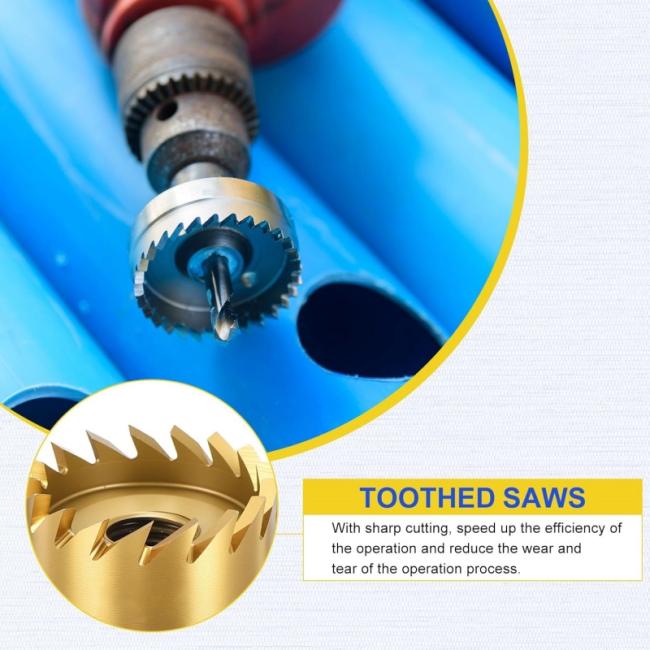
Variable Pitch Geometry: The 4/6 TPI Non-Linear teeth disrupt harmonic resonance
. This ensures a smooth, quiet cut and a perfectly circular 50mm opening, essential for high-pressure copper fittings .
4. Technical Specifications (E-E-A-T Data)
| Technical Pillar | Specification Detail | Industrial Benefit |
| Material Grade | HSS M35 (5% Cobalt) |
Thermal Integrity: Prevents copper "galling" at high RPMs
|
| Boring Accuracy | TIR (Runout) ≤ 0.22mm |
Precision Fit: Ensures exact 50mm clearance for 2" pipes
|
| Tooth Geometry | 4/6 TPI Variable Pitch |
Burr-Free Finish: Drastically reduces secondary deburring time
|
| Cutting Depth |
38mm (1-1/2") Cup |
High Capacity: One-pass boring through thick copper plates
|
| Welding Standard | Electron-Beam Fusion |
Shatter-Proof: Permanent bond between HSS edge and alloy base
|
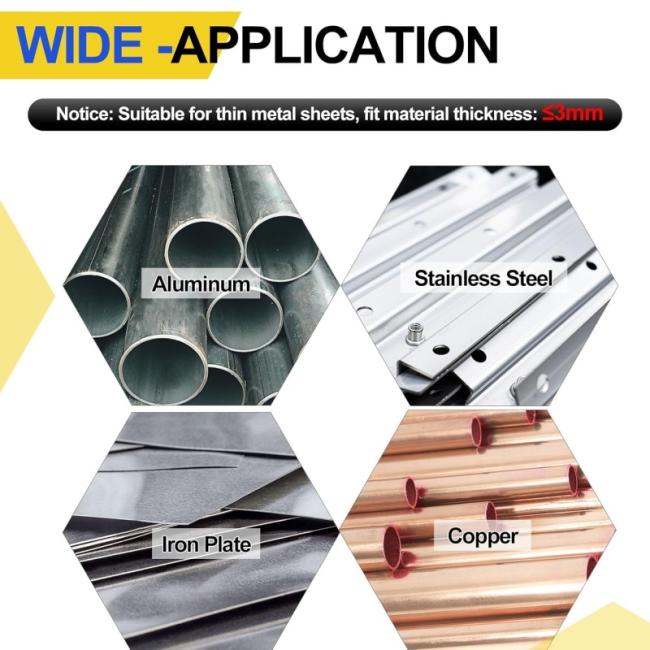
5. Professional Applications for Copper
• Industrial Plumbing Infrastructure: Creating precision entries for 2-inch copper main lines in commercial water treatment systems
• Electrical Busbar Fabrication: Clean boring in high-conductivity copper busbars for switchgear and power distribution panels
•HVAC Heat Exchangers: Reliable, high-speed boring in copper fins and manifold plates where thermal management is critical
6. How to Choose: Why M35 for Copper?
-
Selection Logic: While M42 (8% Cobalt) is excellent for stainless steel, M35 (5% Cobalt) provides the optimal balance of toughness and heat resistance for non-ferrous metals like copper
. -
Durability: M35 offers a significant increase in service life over standard M3 saws in copper applications, maintaining a sharp edge even after repetitive cuts
.
7. FAQ: Expert Technical Support
-
Q: What is the optimal RPM for 50mm in Copper?
-
A: For best results, run between 130 - 150 RPM
. Using a higher speed without lubricant will lead to material welding and premature tooth failure . -
Q: Do I need cutting oil for Copper?
-
A: Yes
. Always use a specialized lubricant or cutting wax to prevent copper chips from sticking to the gullets -
Q: Can this be used for copper-nickel alloys (CuNi)?
-
A: Absolutely
. The HSS M35 edge is specifically designed to handle the increased hardness of marine-grade copper alloys
8. Technical Quality & Trust Information
-
Hardness Standard: Teeth hardened to HRC 64-66 for long-term edge retention
. -
Concentricity: Verified Total Indicator Runout (TIR) ≤ 0.22mm for stable, zero-wobble operation
. -
Compliance: Manufactured in accordance with international industrial engineering standards
.
Get in Touch
Have questions about our products or want to discuss a custom order? Our team is ready to help you.