
NPT 1/8in To 2in Threading Drill Bits Metric Taps And Dies For Gas Fittings
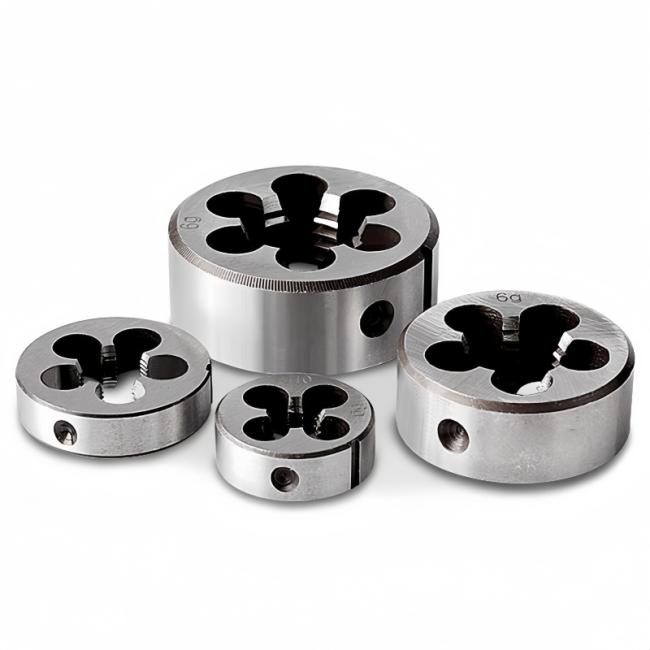
Professional NPT 1/8" to 2" Threading Dies | Fully Ground HSS-M2 for Oil & Gas Fittings
Problem: Spiral Leakage Paths and Fitting Failure
In the North American industrial sector, using a non-compliant 55° die on a 60° NPT system is a recipe for disaster, leading to immediate high-pressure leaks.
Standard dies often fail to maintain the precise 1:16 taper ratio, creating "shoulders" on the pipe that prevent a true metal-to-metal interference fit.
For contractors, a single leaking NPT joint can mean hours of expensive rework and potential safety hazards in gas or fluid transmission lines.
Cause: Geometric Incompatibility and Poor Edge Retention
NPT threads rely on the "crushing" of the thread crests and roots to create a seal; if the die's 60° angle is off by even 1 degree, the seal will fail.
Inferior alloy dies quickly dull when cutting through thick-walled American schedule pipes, causing "ragged" threads that compromise the thread's sealing integrity.
Without a synchronized CNC-ground lead-in, the die will struggle to "bite" the pipe, often resulting in skewed threads that are impossible to torque correctly.
Solution: 100% CNC Ground NPT Precision Technology
Our HSS-M2 NPT Dies are engineered strictly to ANSI/ASME B1.20.1 standards, ensuring a perfect 60°thread profile and a consistent 1:16 taper.
The vacuum-hardened High-Speed Steel substrate (HRC 63-65) provides the necessary "bite" to cut through galvanized, carbon, and stainless steel pipes without edge collapse.
Every die features an optimized "Large-Eye" chip port design, specifically balanced to handle the high volume of material removed during tapered pipe threading.
Technical Specifications: NPT Series (High-Demand Sizes)
| Size (NPT) | TPI (Threads Per Inch) | Outer Diameter (O.D.) | Thickness (H) | Best Pipe O.D. |
| NPT 1/8" | 27 | 30 mm | 11 mm | 0.405" (10.3 mm) |
| NPT 1/4" | 18 | 38 mm | 14 mm | 0.540" (13.7 mm) |
| NPT 3/8" | 18 | 38 mm | 14 mm | 0.675" (17.1 mm) |
| NPT 1/2" | 14 | 45 mm | 18 mm | 0.840" (21.3 mm) |
| NPT 3/4" | 14 | 55 mm | 22 mm | 1.050" (26.7 mm) |
| NPT 1" | 11.5 | 65 mm | 25 mm | 1.315" (33.4 mm) |
| NPT 1-1/4" | 11.5 | 75 mm | 25 mm | 1.660" (42.2 mm) |
| NPT 1-1/2" | 11.5 | 90 mm | 30 mm | 1.900" (48.3 mm) |
| NPT 2" | 11.5 | 105 mm | 30 mm | 2.375" (60.3 mm) |
Application: Engineered for American Industrial Duty
Oil & Gas Exploration: Specialized NPT dies for manufacturing and repairing pressurized sensors, valves, and manifold connectors.
North American HVAC: The standard tool for threading steel pipes in heating, ventilation, and fire sprinkler systems across the USA and Canada.
Hydraulic Component MRO: Essential for maintaining high-pressure pump fittings and hydraulic cylinders that utilize American pipe standards.
Chemical Processing: Reliable performance for threading stainless steel corrosive-fluid lines requiring high-integrity tapered seals.
Selection Guide: Professional Integration
1. Gauge Compliance: Our dies are designed to meet L1 gauge requirements, ensuring the pipe threads sit at the correct "hand-tight" plane.
2. Tapered Starting: NPT threading requires more initial force; ensure the die is perfectly perpendicular to the pipe before applying full torque.
3. Sealant Synergy: While NPT is a metal-to-metal seal, always recommend using high-quality pipe dope or PTFE tape to lubricate the assembly.
4. Material Grade: For high-volume production in stainless steel, inquire about our HSSE-V3 series for enhanced anti-galling properties.
Professional FAQ (Expert Support)
Q: What is the difference between NPT and NPTF?
A: NPT requires a sealant for a leak-proof joint. NPTF (Dryseal) is designed to seal without tape, though for most industrial MRO, standard NPT is the preferred choice.
Q: Can I use an NPT die on a BSPT (RC) pipe?
A: No. Although both are tapered, NPT is 60°and BSPT is 55°. They are not compatible and will result in a joint that will leak under any pressure.
Q: Why is the thickness (H) of NPT dies greater than standard dies?
A: Due to the 1:16 taper, the die must be thicker to accommodate the gradual increase in thread diameter across the full length of the engagement.
Get in Touch
Have questions about our products or want to discuss a custom order? Our team is ready to help you.