
Tomato Stainless Steel Mvr Evaporator System Electricity Heating For Lactic Acid
Price:
100000
MOQ:
1set
Delivery Time:
90days-150days
Brand:
Hanpu
Product Description
Tomato Stainless Steel MVR Evaporator System - Electricity Heating For Lactic Acid
 Engineer-to-order MVR (Mechanical Vapor Recompression) evaporator in food-grade stainless steel (SS316L/duplex), designed for tomato paste concentration and lactic acid process duties. The system uses electricity-driven vapor recompression to recycle latent heat, enabling low-temperature, energy-efficient evaporation with consistent product quality and predictable OPEX.
Key Benefits
- Energy Efficiency: Electric-duty MVR minimizes fresh steam, reducing utility cost and carbon footprint.
- Quality Protection: Vacuum operation and tight ΔT control preserve tomato color/aroma and lactic acid integrity.
- Hygienic Construction: Food-contact stainless steels, drainable layouts, optional CIP/SIP for rapid turnaround.
- Process Flexibility: Recipes for tomato brix ramp-up and lactic acid concentration with controlled residence time.
- High Availability: 24/7 automatic operation, redundancy on critical skids, predictive fouling monitoring.
Process & Thermal Economy
Secondary vapor is mechanically compressed (electric VFD) to raise saturation temperature and reused as the heating medium. Optimized Δ T/LMTD and circulation rates deliver gentle evaporation for tomato puree and thermally sensitive lactic acid streams while maximizing heat-transfer efficiency.
Materials & Hygiene
Wetted parts in SS316L/duplex (electropolish on request), FDA-compliant elastomers, sanitary connections, sloped/drainable piping, and validated CIP/SIP programs supporting HACCP/ISO 22000.
Process Overview -- Tomato & Lactic Acid
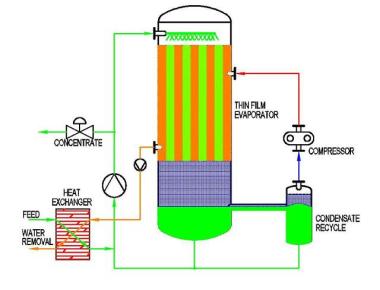
- Feed preparation: filtration/degassing; pH trim for lactic acid; seed/skin removal for tomato.
- MVR evaporation (vacuum): electric compressor sets ΔT for gentle concentration and target Brix/acid strength.
- Condensate management: polished for reuse (CIP water, boiler make-up) per site standards.
- Finishing: tomato: final Brix adjustment and sterilization; lactic acid: downstream polishing/neutralization as required.
- Automation: recipe-based control for product changeover and seasonal variability.
Key Components
- MVR evaporator (falling film / forced circulation) with vapor-liquid separator
- Electric-driven mechanical vapor compressor (turbo/Roots) with VFD
- Preheaters, main heater, condensers, vacuum/NCG handling
- PLC/HMI/SCADA with historian; instruments (T/P/flow/cond/level/Brix)
- CIP/SIP skid; optional aroma recovery and condensate polishing filters
Performance & Sizing
| Parameter | Typical Range* |
|---|---|
| Operation | Continuous, 24/7 |
| Electric use (MVR) | ~15-40 kWh per ton of water evaporated (duty/CR dependent) |
| Product temperature | Low-temp vacuum duty to protect color/aroma/organics |
| Tomato concentrate | Target Brix (e.g., 28-38 °Bx) with aroma retention options |
| Lactic acid concentration | Duty-specific solids/acid strength with controlled residence time |
| Materials | SS316L/duplex; Ti/Hastelloy available for corrosives |
*Actual performance depends on feed composition, viscosity/fouling tendency, compression ratio, and HX design.
FAQ
Can one line handle both tomato and lactic acid?
Yes--via recipe-based setpoints (ΔT, residence time, pressure) and sanitary changeover with validated CIP/SIP.
How is product quality protected?
Vacuum boiling lowers temperature; uniform thin-film/forced circulation and tight ΔT avoid over-cooking and degradation.
What about energy sources?
The main duty is electric (MVR). Fresh steam is minimal after start-up; heat recovery options further reduce OPEX.
Application
Similar Products
Get in Touch
Have questions about our products or want to discuss a custom order? Our team is ready to help you.
Company
Jiangsu Hanpu Mechanical Technology Co., Ltd
Location
Junmin Road, Huangqiao Industrial Park, Taixing, Jiangsu, China (Mainland)
Contact Person
Jim(General Director)