
Brine Treatment Mvr Evaporator Chemical Effluent Desalination Steam Compressor
Price:
100000
MOQ:
1set
Delivery Time:
90days-150days
Brand:
Hanpu
Product Description
Brine Treatment MVR Evaporator with Steam Compressor
Engineer-to-order MVR (Mechanical Vapor Recompression) evaporator for brine treatment and chemical effluent desalination. A high-efficiency steam compressor mechanically recompresses secondary vapor to provide the heating duty, cutting fresh steam consumption and enabling continuous, low-OPEX operation for ZLD and resource recovery schemes.

Key Benefits
- Deep desalination: high condensate quality for reuse; significant brine volume reduction.
- Energy savings: latent heat recycled by steam compressor; minimal fresh steam after start-up.
- Scalant control: optimized ΔT/LMTD and velocities reduce scaling on saline/chemical feeds.
- Continuous uptime: 24/7 automatic operation with redundancy and CIP-ready design.
- ZLD-ready: integrates with crystallizer, centrifuge, and dryer for solid salt discharge.
Process & Thermal Economy
Secondary vapor is mechanically compressed to elevate saturation temperature and reused as the primary heat source. Tight control of pressure, ΔT, and circulation rates maximizes heat-transfer efficiency, lowers utilities, and stabilizes product quality across variable effluents.
Controls & Safety
PLC/HMI with closed-loop regulation of level, pressure, ΔT, and conductivity. Interlocks for compressor/VFD, vacuum/NCG handling, condensate quality guard, and alarm/event historian. Power-quality mitigation (AFE/harmonic filters) optional per site codes.
Materials & Cleanability
Wetted parts in SS316L/duplex (Ti/Hastelloy on request), drainable layouts, anti-scale dosing, and validated CIP for long campaigns. Elastomers and surface finishes selectable for chemical/environmental duties.
Process Overview -- Brine Desalination
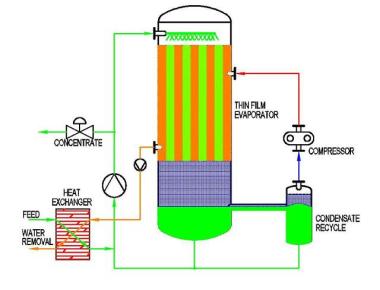
- Feed conditioning: filtration/softening, pH trim, and deaeration to limit scaling/corrosion.
- MVR evaporation (vacuum): steam compressor sets discharge pressure; shell vacuum defines boiling point.
- Condensate polishing: optional filters/RO/activated carbon to meet reuse/discharge limits.
- Concentrate handling: to crystallizer/centrifuge/dryer for solids or recycle per flowsheet.
- Automation: recipe-based operation for changing chemistries and seasonal conditions.
Key Components
- MVR evaporator/forced-circulation body with circulation pumps and vapor-liquid separator
- Steam compressor (centrifugal/turbo or Roots) with VFD for pressure/ΔT control
- Main heater, preheaters, condensers, vacuum/NCG handling skid
- PLC/HMI/SCADA; instrumentation (T/P/flow/cond/level); historian & remote access
- CIP skid; anti-scale dosing; optional condensate polishing filters/RO
Performance & Sizing
| Parameter | Typical Range* |
|---|---|
| Operation | Continuous, 24/7 |
| Shell pressure (vacuum) | ~6-25 kPa(abs) (duty-dependent) |
| Compressor discharge pressure | ~45-120 kPa(abs) (sets ΔT and capacity) |
| Electric use (MVR) | ~15-40 kWh per ton of water evaporated |
| Fresh steam demand | Very low after start-up (backup/ancillary only) |
| Turndown | 50-100% with stable ΔT and quality |
| Availability | ≥95-98% with redundancy and planned CIP |
| Materials | SS316L / duplex; Ti/Hastelloy on request |
*Actual performance depends on brine chemistry, viscosity/fouling tendency, compression ratio, and heat-transfer design.
FAQ
Can the system meet strict discharge/reuse limits?
Yes. Condensate polishing and conductivity/TOC guards ensure compliance with site-specific reuse or discharge standards.
Yes. Condensate polishing and conductivity/TOC guards ensure compliance with site-specific reuse or discharge standards.
How is scaling managed on high-salinity feeds?
By controlling ΔT/LMTD and velocity, using anti-scale dosing, and scheduling CIP based on predictive fouling indicators.
By controlling ΔT/LMTD and velocity, using anti-scale dosing, and scheduling CIP based on predictive fouling indicators.
Can it integrate into a ZLD train?
Absolutely. Common flowsheets pair membrane pre-concentration with MVR, followed by crystallization and solid handling.
Absolutely. Common flowsheets pair membrane pre-concentration with MVR, followed by crystallization and solid handling.
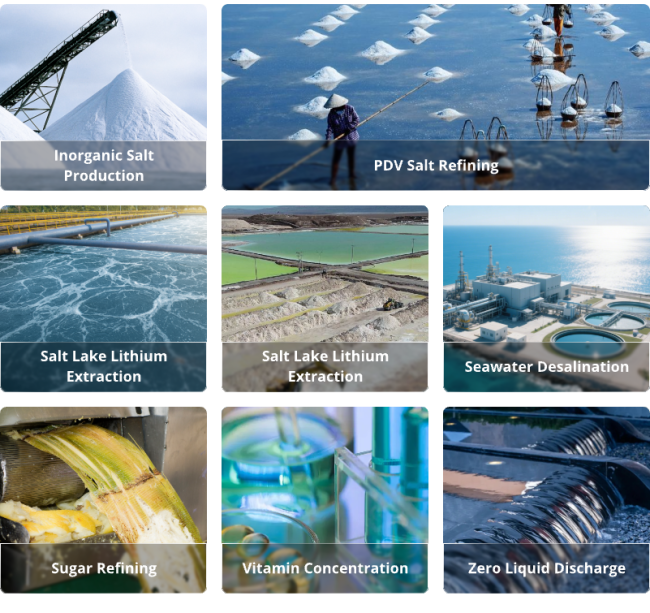
Application
Similar Products
Get in Touch
Have questions about our products or want to discuss a custom order? Our team is ready to help you.
Company
Jiangsu Hanpu Mechanical Technology Co., Ltd
Location
Junmin Road, Huangqiao Industrial Park, Taixing, Jiangsu, China (Mainland)
Contact Person
Jim(General Director)