
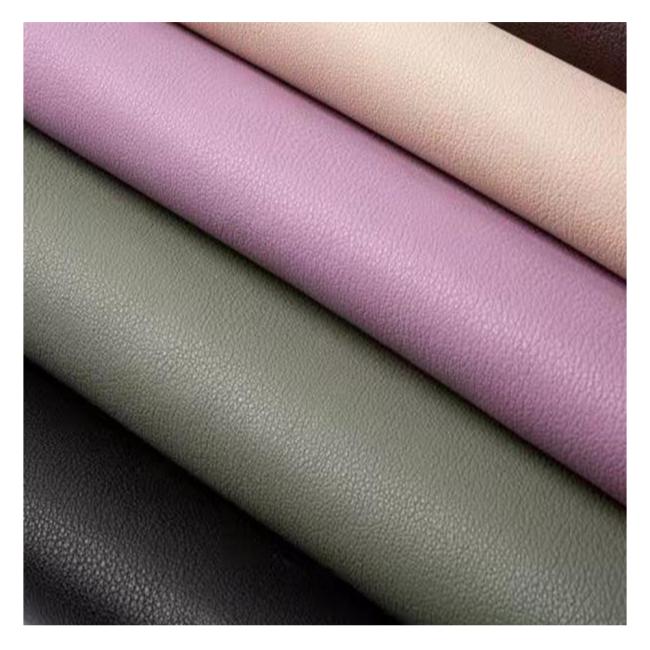
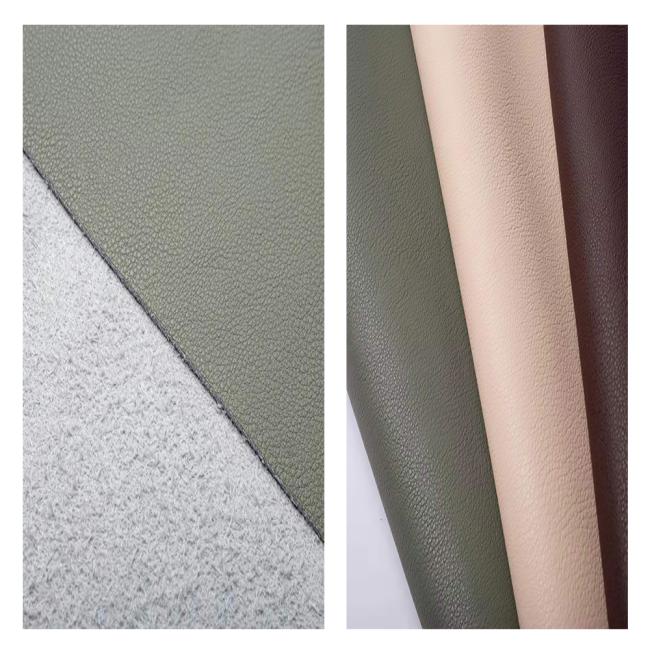
Abrasion Resistant Apricot Upholstery PVC Leather 1.4mm To 1.6mm Thick
Synthetic Pvc Leather Fabric Coated Microfiber Fabric Abrasion-Resistant For Decoration
splittable fibres as the world knows them today. The cross-section is commonly referred to as ‘pie wedge’ or ‘citrus’, and the wedges are alternately made of nylon and polyester. It is common for such a fibre to have 16 segments. The conventional purpose of making a fibre like this is to form a card web of typically 3 denier per filament fibres, and then pass the web under hydroentangling jets which simultaneously split the fibres into individual wedges and entangle the fibres to give the fabric strength and integrity. As a result, the fabric contains fibres down to 0.2 denier per filament, but most of the throughput and processing advantages of a 3 denier fibre are maintained.
| Thickness | 01.0-1.2mm |
| Width | 137-140cm |
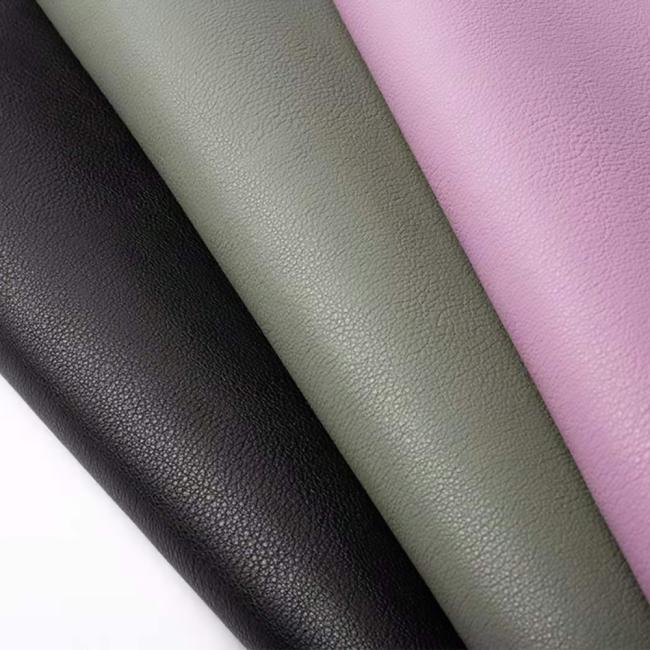
| Color | By your requests |
| Pattern | Embossed |
| Usage | Sofa,Decorative, Furniuture, Belt, Chair, Car,Car Seat, Notebook ect |
| Feature | Abrasion-Resistant, Anti-Mildew, Elastic,Waterproof, Eco- friendly etc |
| Packing details | By your requirements |
| Other | Anti-yellow, Anti-fire, Anti-bacterium, Hydrolysis resistance, Low Temperature Flexibility, Tear Strength, Weathering Resistance and Long Lived Deal ect can be tailor-made |
|
MATERIAL
|
PVC |
|---|---|
|
THICKNESS
|
Can be customized by customers |
|
COLOR
|
Various color available,can be customized |
|
TOUCH FEELING
|
Soft or hard,as your requirement |
|
CHARACTER
|
Abrasion-Resistant,Anti-Mildew,Anti-scratch,etc |
|
USAGE
|
Bags,Totes,Belt,Bagspurses,Other,etc |
Polymer micro and microstructured fiber Bragg gratings
Polymer microfiber gratings
- Polymer microfiber Bragg grating is another recent addition to the polymer FBG family, which can improve the measurement capabilities of the polymer gratings. A two-stage process was reported by Rajan, Noor, Ambikiarajah, Farrell, & Peng (2013) to fabricate the polymer microfiber in which the fiber was etched to a certain diameter and then tapered down to a final diameter. This method ensured that a sufficient amount of photosensitive core was retained within the fiber. After etching, the fiber is placed in between the heating plates (temperature is around 160 °C) for 5 min to ensure that the fiber was heated uniformly, and then it is pulled from both sides using a pair of translation stages, resulting in a polymer microfiber with a diameter of 16 μm.
- The Bragg grating structures were fabricated in the polymer microfiber by a phase mask technique using a He–Cd laser emitting light at 325 nm. The Bragg peak started appearing just after the fiber was illuminated with the UV laser and grew thereafter, reaching saturation, and then decreasing as shown in Figure 8.8 with maximum reflected power obtained in 3 min. This grating growth behavior was similar to that of the original photosensitive polymer fibers, but the exposure time to obtain the maximum peak was lower than that of nontapered PFBG, which is normally 7–10 min with the same experimental setup. This phenomenon is attributed to the relation between the thickness of the polymer fiber and the UV laser power, in which the effective power in the core of the fiber is dependent on the penetration depth. A small shift is observed for the reflection peak of the polymer microfiber grating due to the decrease in the effective refractive index of the polymer fiber at smaller radii.
Get in Touch
Have questions about our products or want to discuss a custom order? Our team is ready to help you.