
Bedroom Appliances Home Use UV Sterilizer Low Noise Air Purifiers
Bedroom Appliances Home Use UV Sterilizer Low Noise Air Purifiers
Introduction To Products
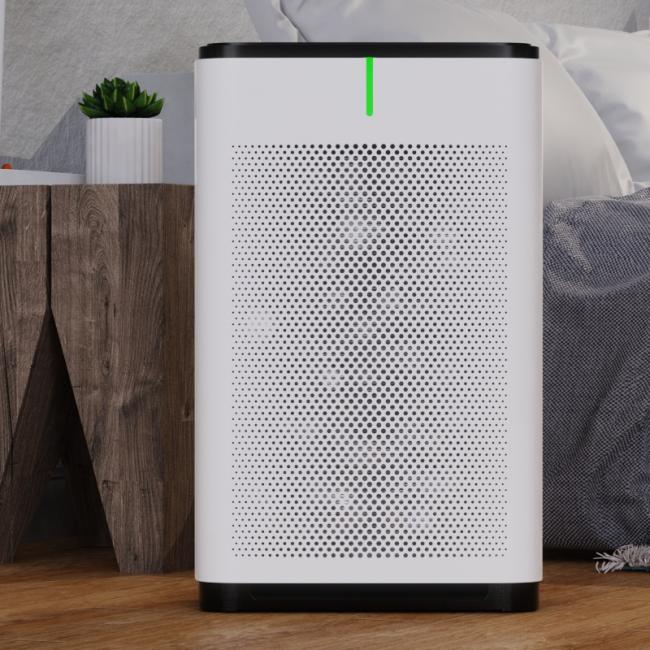
| Product Name | Home Air Purifiers |
| Product Model | y24a |
| Product Sensor | High precision dust sensor |
| Product Motor | Alternating current dynamo |
| Material | ABS |
| Color | White/Customized |
| Brand | Customized |
| Filter | Hepa Filter |
About Hepa Filter And Carbon Filter
HEPA is a type of pleated mechanical air filter. It is an acronym for "high efficiency particulate air [filter]" (as officially defined by the U.S. Dept. of Energy). This type of air filter can theoretically remove at least 99.97% of dust, pollen, mold, bacteria, and any airborne particles with a size of 0.3 microns (µm). The diameter specification of 0.3 microns responds to the worst case; the most penetrating particle size (MPPS). Particles that are larger or smaller are trapped with even higher efficiency. Using the worst case particle size results in the worst case efficiency rating (i.e. 99.97% or better for all particle sizes).
All air cleaners require periodic cleaning and filter replacement to function properly. Follow manufacturer's recommendations on maintenance and replacement.
Activated carbon filters are small pieces of carbon, typically in granular or powdered block form, that have been treated to be extremely porous. It is so cavernous, in fact, that just one gram of activated carbon can easily have a surface area of 500m2 or higher. Vast surface area enables these carbon filters to adsorb exponentially more contaminants and allergens than traditional carbon.
Adsorption is a distinct process where organic compounds in the air or water react chemically with the activated carbon, which causes them to stick to the filter. The more porous the activated carbon is, the more contaminants it will capture. These filters are most notably used to remove hazardous compounds in home air purification systems.
Product Parameters
1. Rated power: 120W
2. Voltage: 220V/50Hz
3. Wind speed: 3 speed
4. Applicable area: 42m³
5. Particulate clean air quantity: 350m³/h
6. Removal rate of Staphylococcus albus :99.99% 7.Removal rate of natural bacteria in air: 99.54%
UV wavelength: 253.7mm
UV illuminance: 99UW /cm²
8. Color: Ivory/Rose gold/Champagne gold (customizable)
9. Sensor type: Dust infrared sensor
Function Of Product
1. Support air purification/plasma/uv/sterilization purification /PM2.5 particle purification
2. Support filter replacement reminder
3. Support 3 speed adjustment
4. Support PM2.5 digital real-time monitoring display
5. Support intelligent automatic mode
6. Support display mode LED touchscreen display
7. Support sleep mode/silent mode
8. Support child lock function
9. With disinfection product test report/production qualification and product record,
Applicable to schools/hospitals/nursing homes/banks/offices and crowded places for sterilization and disinfection
Quick Details
Q:Is it worth getting a HEPA filter?
A;In short, it depends on what you're trying to accomplish or alleviate. For people with severe allergies, HEPA filters can help trap pet dander and other larger allergens. If you're simply attempting to freshen up your air, then the price tag may not be worth it. In other words, air purifiers aren't a cure for everyone.
Q:What is the difference between an air purifier and a HEPA air purifier?
A:Air purifiers use one or more filtration and air treatment methods to remove pollutants from the air. Air purifiers that use HEPA filtration can filter air particles down to 0.3 microns in size with a 99.97% efficiency rating.
Q:What are the two disadvantages of HEPA filters?
A:Won't remove every particle: Unfortunately, HEPA filters will not remove pollutants from the air that are smaller than 0.3 microns, including viruses, some bacteria, and volatile organic compounds (VOCs). VOCs are household items like hairspray and ammonia that are too small for a HEPA filter to eliminate.
Q:Do HEPA air filters remove coronavirus?
A:When used properly, air cleaners and HVAC filters can help reduce airborne contaminants including viruses in a building or small space. By itself, air cleaning or filtration is not enough to protect people from COVID-19.
Get in Touch
Have questions about our products or want to discuss a custom order? Our team is ready to help you.