
24V BLDC Vacuum Motor Vacuum Cleaner Motor 1.32A 9737RPM 5.37W KG-2430DC24 Go-Gold
Vacuum Cleaner Motor 24V 1.32A 9737RPM 5.37W KG-2430DC24 Go-Gold
Performance Specifications
| Rated Voltage | 24V | Output Power | 5.37W |
| No-load Current | 0.09A | No-load Speed | 9737RPM |
Motor Details
Warranty: 3years
Place of Origin: Guangdong, China
Brand Name: Go-Gold
Model Number: KG-2430DC24
Usage: Vacuum Cleaner
Torque: 324g.cm
Commutation: DC
Speed(RPM): 9737RPM
Continuous Current(A): 1.32A
Product Name: Vacuum Cleaner Motor DC Motor
Motor type: BLDC Motor
Certification: ISO
Rated Voltage: 24V/ Customized
Keywords: Vacuum Cleaner Motor
Noise: Low
Lead Time
| Quantity(pcs) | 1-1000 | 1001-10000 | >10000 |
| Lead Time(days) | 15 | 30 | To be negotiation |
Drawings
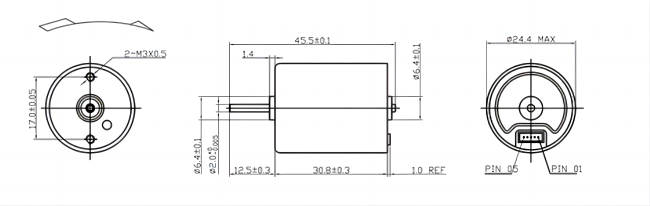
Motor Picture
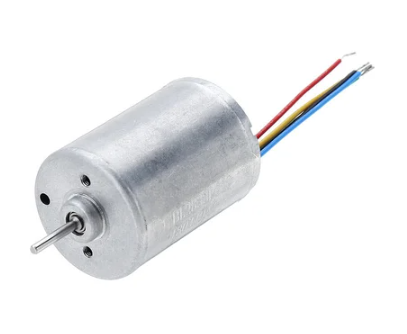
Motor Application

Working principle of BLDC Motor
BLDC Motor use electronic commutation, the coil does not move and the magnetic pole rotates. A set of electronic equipment is used to sense the position of the permanent magnet pole through the Hall element. Based on this induction, the electronic circuit is used to switch the direction of the coil current in a timely manner to ensure that the magnetic force in the correct direction is generated to drive the motor.
Advantages of BLDC Motor
- The traditional brushed mechanical commutation method is removed, and electronic commutation is adopted, with a fully enclosed structure, which makes the performance more reliable and the failure rate lower.
- It has better external characteristics, can output greater torque at low speed, and can provide relatively large starting torque.
- The no-load current is small, the speed range is relatively wide, and it can operate at full power at different speeds.
The difference between Brushed DC Motor and BLDC Motor speed control methods
In fact, the control of both motors is voltage regulation, but because the brushless DC uses electronic commutation, it can only be realized with digital control, while the brushed DC commutates through carbon brushes, using thyristors, etc. Traditional analog circuits can be controlled and are relatively simple.
- The Brushed Motor speed adjustment process is to adjust the motor power supply voltage. The adjusted voltage and current are converted through the commutator and brush to change the strength of the magnetic field generated by the electrodes to achieve the purpose of changing the rotation speed. This process is called variable voltage speed regulation.
- The BLDC Motor speed adjustment process is to keep the voltage of the motor's power supply unchanged, change the control signal of the ESC, and then change the switching rate of the high-power MOS tube through the microprocessor to achieve the change in rotation speed. This process is called variable frequency speed regulation.
Get in Touch
Have questions about our products or want to discuss a custom order? Our team is ready to help you.