
Sliver 240V AC Vacuum Cleaner Motor 1600W 98dB A KG-107106DC240 Go-Gold
Vacuum Cleaner Motor 240V 1600W 98dB A KG-107106DC240 Go-Gold
Performance Specifications
| Rated Voltage | 240V | Input Power | 1600W |
| Max Vacuum Degree | ≥27Kpa | Noise | ≤98dB A |
Motor Details
Warranty: 3Years
Place of Origin: Guangdong, China
Brand Name: Go-Gold
Model Number: KG-107106DC240
Usage: Vacuum Cleaner
Commutation: AC
Product Name: Vacuum Cleaner Motor AC Motor
Certification: ISO
Rated Voltage: 240V/ Customized
Keywords: Vacuum Cleaner Motor
Noise: Low
Lead Time
| Quantity(pcs) | 1-1000 | 1001-10000 | >10000 |
| Lead Time(days) | 15 | 30 | To be negotiation |
Motor Pictcure
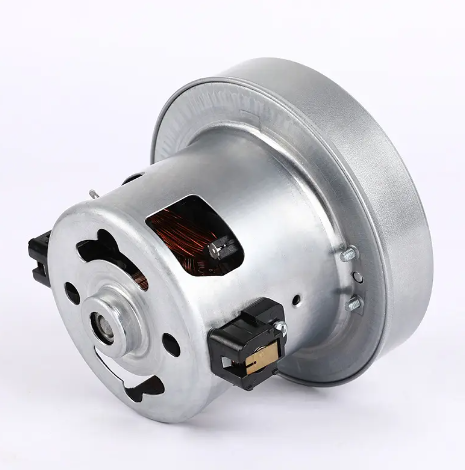
Concept of AC Motor
AC Motor refers to an electric motor that works with alternating current and generates mechanical energy through magnetic force mixed with alternating current. The AC Motor structure includes coils to generate a rotating magnetic field within the attached rotor towards the output shaft so that a second magnetic field can be generated.
Working Principle of AC Motor
The basic working principle of AC Motors mainly depends on magnetism. A basic AC Motor consists of a coil and two permanent magnets located near the shaft. Once alternating current is supplied to the coil, it turns into an electromagnet that produces a magnetic field. AC Motor include two basic components: a stator and a rotor. The stator includes wire rings, solid metal shafts, freely movable conductive metal parts, coils, squirrel cages, etc.
In the stator of an AC Motor, power can be transmitted to an external coil, forming a stationary part like the stator. Coils can be activated in pairs, in series, to produce a magnetic field that roughly rotates the outside of an AC Motor.
According to the laws of electromagnetism, the rotor remains balanced in a changing magnetic field. The magnetic field can produce an electric current in the rotor.
If the conductor used here is a wire or a ring, then the current will form a loop around it, or if the conductor is just a solid piece of metal, then eddy currents will flow around it. Induced current can produce a collision field, and according to another electric collision law, a rotating magnetic field will also rotate. Once the magnets interact, the coils of wire and shaft will begin to turn the motor.
The Structure of AC Motor
In an AC Motor, there are two basic parts: the stator (stationary part) and the rotor (rotating part). In addition to these, there are some other parts, which are introduced in turn:
- Stator, the stator in an AC Motor is a non-moving part whose main function is to transmit a rotating magnetic field to interact with the rotor.
- Stator core, the stator core in the motor is designed with laminations or thin metal sheets, mainly used to reduce energy loss. The fixed windings in the motor will be loaded together to form a hollow cylinder. The stator core coil slots for insulated wires are protected. Once the assembled AC motor is in process, the stator windings can be connected to the power source. Once a current supply is provided, each coil set with a steel core becomes an electromagnet.
- Rotor, the rotating part in the motor is the rotor, which is an important component connected to the shaft. In AC motors, the most common type of rotor is the squirrel-cage rotor, which is a cylindrical shape made by stacking lightly stacked steel sheets.
- Shaft, rotor assembly can be formed by pressing on a steel shaft that expands on the outside of the motor housing, allowing connections to external systems to transmit rotational power.
- Bearings, placed on the motor's shaft, provide support for the rotor and allow it to rotate. Some types of motors utilize a fan by placing it on the rotor shaft to cool the motor as the shaft rotates. In AC motors, bearings are used to hold the shaft in place. Here, the bearings will reduce friction on the shaft connected to the housing, which can improve motor efficiency.
- Housing,the motor housing consists of a frame or frame and two end brackets. The stator is located within the frame and the rotor is arranged within the stator via a small air gap that separates the stator from the stator. There is no direct physical link between the rotor and the stator. In addition, the casing within the motor protects the internal components from ecological elements and water. This part includes two-person end stands and a frame.
Get in Touch
Have questions about our products or want to discuss a custom order? Our team is ready to help you.