
High Purity China Supply Best Price Cylinder Gas 99.9999% Gas Ar Argon
Product Description
Argon (Ar) is a chemical element and a colorless, odorless, and tasteless gas. It belongs to the noble gas group in the periodic table, along with helium, neon, krypton, xenon, and radon. Here are some key points about argon gas:
-
Properties: Argon is the third most abundant gas in the Earth's atmosphere, constituting about 0.93% by volume. It is monatomic, meaning it exists as single atoms rather than molecules. Argon is denser than air and is considered a non-reactive or inert gas. It has a boiling point of -185.7°C (-302.3°F) and a melting point of -189.3°C (-308.7°F).
-
Occurrence: Argon is primarily obtained from the Earth's atmosphere through air separation processes. It is present in trace amounts in the atmosphere and is produced by the decay of potassium-40 in rocks and minerals. Argon is also found in small quantities in some natural gas deposits.
-
Industrial Applications:
-
Welding: Argon is widely used as a shielding gas in welding processes. It helps protect the weld area from atmospheric contamination, particularly in processes like Tungsten Inert Gas (TIG) welding and Gas Metal Arc Welding (GMAW).
-
Lighting: Argon is used in some types of gas discharge lamps, such as fluorescent lamps and some high-intensity discharge (HID) lamps. It aids in achieving the desired light color and stability.
-
Semiconductor Manufacturing: In the semiconductor industry, argon is employed during various manufacturing processes. It acts as a carrier gas, cooling agent, or protective atmosphere in the production of semiconductors, integrated circuits, and other electronic devices.
-
Scientific Research: Argon is commonly used in laboratories and scientific research due to its inert nature. It is used as a blanketing gas to create an oxygen- and moisture-free environment for sensitive experiments, such as the handling of air-sensitive compounds.
-
-
Safety Considerations: Argon gas is generally considered non-toxic and non-reactive. However, it can displace oxygen in confined spaces, leading to asphyxiation. When working with argon or any other inert gas, proper ventilation and safety precautions should be observed to ensure a safe working environment.
Argon gas has various industrial and scientific applications, ranging from welding and lighting to semiconductor manufacturing and scientific research. Its inert nature and abundance make it a valuable component in many processes and applications.
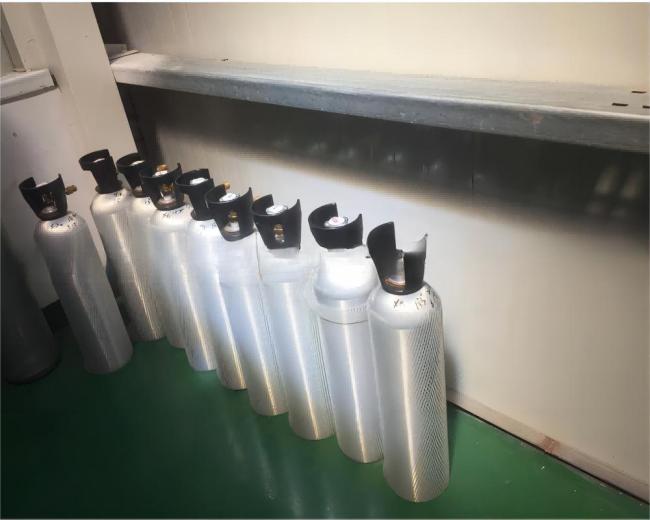
Argon is colorless, odorless, tasteless, and nontoxic, which is plentiful compared to other rare atmospheric gases.
High purity argon is used as shield in gas metal-arc welding, in metal processing;
UHP argon gas is used as gas filler for incandescent light bulbs;
Argon gas is used as carrier in gas-liquid and gas-solid chromatography;
UHP argon gas is used a filler gas and as a high purity inert shield gas in the manufacture of silicone and germanium crystals used in the semiconductor industry.
| Ar, Assay % | ≥99.9999 | 99.9999 | ||||||||
| H2, ppm | ≤0.1 | <0.1 | ||||||||
| O2, ppm | ≤0.15 | <0.1 | ||||||||
| N2, ppm | ≤0.2 | <0.2 | ||||||||
| CO, ppm | ≤0.1 | <0.05 | ||||||||
| CO2, ppm | ≤0.1 | <0.05 | ||||||||
| CH4, ppm | ≤0.1 | <0.05 | ||||||||
| H2O, ppm | ≤0.1 | <0.1 | ||||||||


Get in Touch
Have questions about our products or want to discuss a custom order? Our team is ready to help you.