
Conical Alumina Ceramics pipes Alumina Pipe Liner Industrial Grade Alumina Ceramics Tubes
Product Description
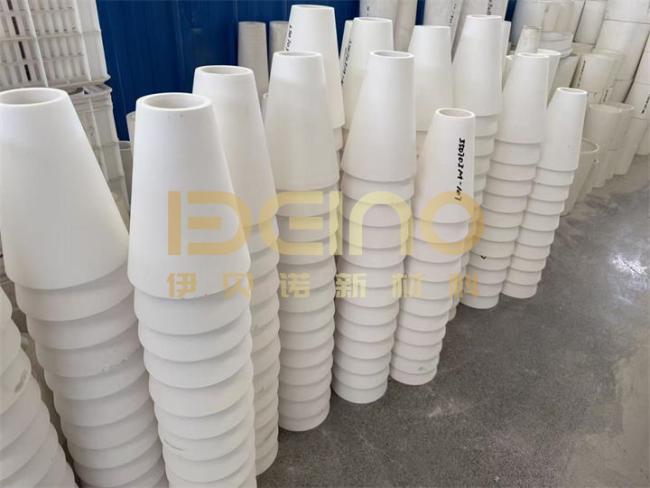
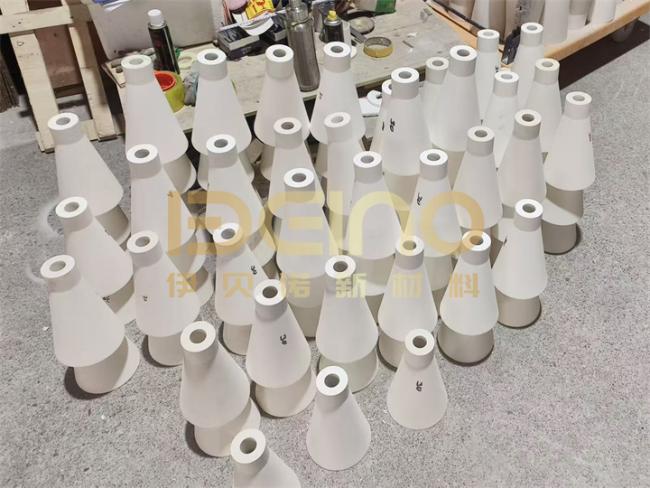
Conical alumina ceramic tubes are used at transitions where the internal diameter or shape of a material-conveying passage changes. They are normally manufactured according to drawings for reducers, discharge outlets, feed cones, and other specially shaped wear areas. The ceramic provides the wear-resistant contact surface, while the surrounding steel housing usually carries the structural and installation loads.
The Cone Has to Match the Surrounding Pipe
The purpose of a conical ceramic liner is to protect a changing flow section without leaving an abrupt step between two different diameters. Whether it works correctly depends on the inlet diameter, outlet diameter, taper length, wall thickness, and connection profile.
If the ceramic bore does not align with the adjoining pipe, the raised edge may repeatedly intercept the moving particles. Local turbulence and impact can then concentrate wear around the connection, even if the ceramic material itself remains intact.
For this reason, the finished dimensions are as important as the alumina grade.
One-Piece Ceramic for a Difficult Geometry
A tapered section is difficult to line neatly with flat ceramic tiles. Cutting and assembling multiple pieces can create additional joints and uneven transitions.
A one-piece conical alumina ceramic tube provides a continuous internal surface without longitudinal tile joints. Depending on the equipment design, it can be bonded, clamped, mechanically retained, or installed as a replaceable insert inside a steel casing.
The connection areas at both ends still need careful inspection. Installation clearance, concentricity, exposed steel, and the height difference between the ceramic and adjoining pipe should be checked before commissioning.
Technical parameters
| Items | Specifications | |
| Content of alumina | ≥92% | ≥95% |
| Density | ≥3.6 g/cm3 | >3.8g/cm3 |
| Rockwell A hardness | ≥82HRA | ≥85HRA |
| Impact strength | ≥1200 MPA | ≥1500 MPA |
| Fracture toughness | ≥3.8MPa·m1/2 | ≥4.0MPa·m1/2 |
| Vickers hardness | ≥1150HV10 | ≥1200HV10 |
| Bending Strength | ≥290MPa | ≥330MPa |
The values above are typical material parameters. Final values should follow the confirmed ceramic grade and order specification.
Typical Installation Positions
Conical alumina ceramic tubes can be considered for:
- Pipe reducers and transition sections
- Powder feeding and discharge outlets
- Pneumatic conveying connections
- Cyclone inlet or outlet components
- Ash and mineral conveying equipment
- Replaceable ceramic wear inserts
- Other components with changing internal diameters
The product is intended for abrasive material contact. Other functions, such as pressure containment, electrical insulation, chemical compatibility, or high-temperature operation, should be evaluated separately according to the complete equipment design.
Points to Confirm Before Production
The production drawing should show the inlet diameter, outlet diameter, overall length, wall thickness, taper angle, steps, grooves, and mounting surfaces. Dimensional tolerances should be agreed upon before manufacturing.
The conveyed material, particle size, operating temperature, impact direction, installation method, and required quantity should also be provided. These details help determine the ceramic grade and whether subsequent machining is required.
FAQ
How is a conical ceramic tube different from a straight ceramic sleeve?
A straight sleeve maintains the same internal diameter along its length. A conical tube connects two different diameters or follows a tapered equipment section.
Can the dimensions be customized?
Yes. Inlet diameter, outlet diameter, length, wall thickness, taper angle, grooves, steps, and mounting surfaces can be manufactured according to drawings.
Should 92% or 95% alumina be selected?
The 95% grade generally provides higher density and hardness. Selection should consider wear severity, impact, component geometry, required tolerance, and project cost.
Can the ceramic tube be used as a load-bearing pipe?
It is normally used as a liner or replaceable wear component. It should not be treated as a load-bearing steel pipe unless the complete assembly has been specifically designed for that purpose.
How is the ceramic component installed?
Installation may use bonding, clamping, mechanical retention, or a steel housing. The appropriate method depends on the component geometry, temperature, and surrounding equipment.
How can you avoid a wear step at the connection?
The finished ceramic bore should match the adjoining pipe or steel housing. Concentricity, transition alignment, installation clearance, and exposed steel at both ends should be checked before production and installation.
ELACERA® manufactures conical alumina ceramic tubes according to confirmed drawings. Please provide the component dimensions and operating conditions for a technical review before production.
Get in Touch
Have questions about our products or want to discuss a custom order? Our team is ready to help you.