
SS304 SS316 Vicarb Heat Exchanger Plates 0.5mm 0.6mm Thickness
Product Description
0.5mm 0.6mm Thickness SS304 SS316 Vicarb Heat Exchanger Plate For Cooling And Condensation
Vicarb Heat Exchanger Plates
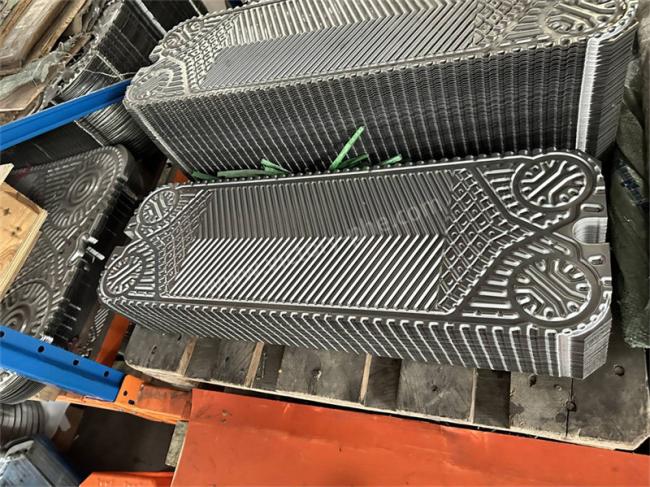
- Heat exchanger plates are essential components consisting of metal plates and sealing gaskets. The metal plates serve as the primary heat transfer elements. They are designed with corrugated patterns on their surfaces, sealing grooves along the plate edges, and corner holes around them. The sealing gaskets are installed in the grooves to ensure a tight seal between the plates, preventing any fluid leakage. Additionally, the gaskets also seal some of the corner holes, allowing the two fluids to flow alternatively on both sides of the thin plates for efficient heat exchange.
- The plate heat exchanger plates are typically printed with corrugations, commonly available in two styles: "herringbone" and "horizontal straight". The herringbone style offers advantages such as higher pressure resistance, improved heat transfer coefficient, and increased fluid resistance when compared to the horizontal straight style. These features make the herringbone-style plates suitable for applications requiring higher performance and efficiency.
| Brand | Model |
|
Vicarb |
V4,V8,VU8,V13,V20,V28,V45,V60 |
Plate heat exchanger plate thickness configuration
- AISI 304 is usually 0.4 or 0.5 mm thickness
- AISI 316 is always 0.5 and 0.6 mm
- 254 SMO (high alloy) typically 0.6 mm
- Titanium plates are always 0.5 and 0.6 mm
- Some have thicker plates (for high pressure applications)
- Some PHEs have 0.4 mm (low pressure operation)
- Hastelloy C-276 (nickel alloy) typically 0.6 mm
| Material | Specification |
| Stainless Steel |
SUS304 316 316L 310S 904 |
| Titanium and titanium-palladium alloy | TAi TAi-Pd |
| Hastelloy |
C276 D205 B2G |
| Nickel | Ni200 Ni201 |
| Molybdenum | 254 |
Types and materials of plate heat exchanger plates:
Corner heat exchanger plates
The shape of this plate is similar to a rhombus, with sharp angles at the corners. The gaps between the angular plates can form heat exchange channels.
Corrugated heat exchanger plates
The surface of this plate is wavy, which improves heat exchange efficiency by increasing the surface area. Corrugated sheets are commonly used in high temperature, high pressure and high flow applications.
Hook type heat exchanger plates
This kind of plate is suspended inside the plate heat exchanger through a hook on one side, and the other side is free. Hook-type plates are often used in applications that require frequent cleaning because they can be easily removed.
Stainless steel heat exchanger plates
Stainless steel sheets are the most common choice because they offer good corrosion resistance and strength.
Titanium heat exchanger plates
Titanium plates are often used for heat exchange with highly corrosive media because of their high corrosion resistance and chemical inertness.
Nickel Alloys heat exchanger plates
Nickel alloy sheets are often used in high temperature and pressure applications because of their high heat resistance and strength.
Other metal materials heat exchanger plates
Depending on the specific application scenario and medium characteristics, plates made of copper, aluminum, steel and other metal materials can also be selected.
Applacations
| Plate material | Suitable for fluids |
| Stainless steel (SUS304.316, etc.) | Purified water, river water, edible oil, mineral oil |
| Titanium and titanium palladium (Ti, Ti-Pd) | Sea water, salt water, salt compounds |
| 20Cr,18Ni,6Mo(254SMO) | Dilute sulfuric acid, dilute salt aqueous solution, inorganic aqueous solution |
| Nickel (Ni) | High temperature, high concentration caustic soda |
| HASTELLOY alloy (C276, D205, B2G) | Concentrated sulfuric acid, hydrochloric acid, phosphoric acid |

Get in Touch
Have questions about our products or want to discuss a custom order? Our team is ready to help you.