
Materials For Road Markings With Good Reflectivity Durability Ability To Enhance Road Traffic Safety
Coating for road markings
Overview
Hot-melt marking paint is a type of coating applied to roads to mark road markings. Road markings are safety signs, and in road traffic, they are also a kind of silent "language".
Usage Overview
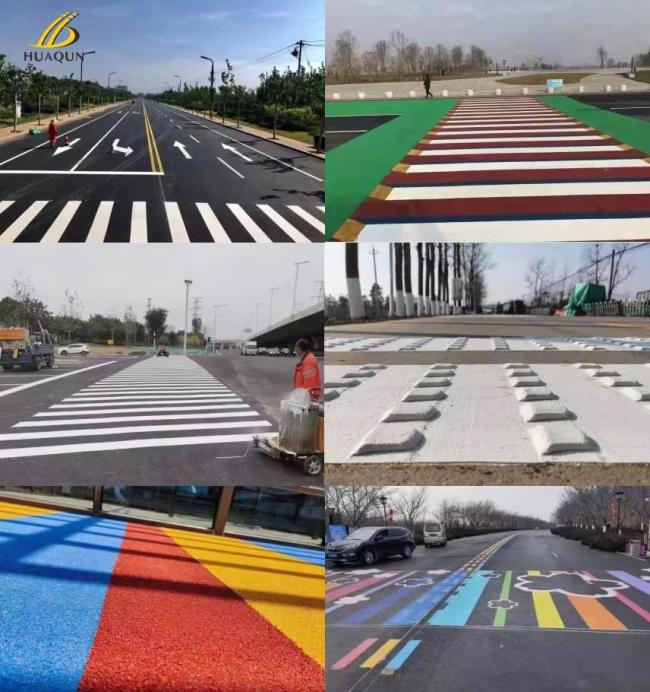
Hot-melt reflective pavement marking paint is mainly used on highways and expressways of grade 2 and above. The coating thickness of the markings made by this paint is (1.0 - 2.5) mm. The paint contains reflective glass beads and during the marking construction, reflective glass beads are scattered on the surface. This type of marking has good night-time reflective performance and a long service life. The demand for various road marking paints depends on the traffic volume of the highway construction and the quality of the paint itself. Generally, it can last for (2 - 3) years. The construction of hot-melt paint requires special heating equipment. When re-coating old markings, the thicker old coating must be removed before applying the new coating.

Product Description
Composition:
It is mainly composed of resins, pigments, fillers, and additives. The resins provide excellent adhesion and durability. Pigments give it various colors for different application scenarios. Fillers enhance the physical properties of the coating, and additives improve its processing performance.
Features:
- High temperature resistance. It can maintain its integrity and performance under relatively high - temperature conditions, suitable for applications where heat exposure is a factor.
- Strong adhesion. It firmly adheres to a wide range of substrates such as asphalt, concrete, and metal surfaces, ensuring long - term stability.
- Good durability. Resistant to wear, weathering, and chemical corrosion, making it ideal for both indoor and outdoor use.
Firstly, they have excellent flexibility. They can deform along with the expansion and contraction of the substrate without cracking easily. For example, on the surface of some metals that often have tiny deformations, thermoplastic coatings can adhere well and remain intact, just like putting an elastic "coat" on the surface.
Secondly, they have strong processability. They can be applied in a variety of ways such as spraying, dipping, and brushing, which makes them convenient to be used on the surfaces of objects with different shapes and sizes.
Thirdly, they have good chemical resistance. They can resist the erosion of many chemical substances. For example, common acid - base solutions have less impact on them. In an industrial environment with chemical substances, thermoplastic coatings can effectively protect the coated objects.
Finally, they can dry and solidify quickly. This can reduce the construction time and waiting time and improve work efficiency.
- Road marking. Widely used for creating clear and durable markings on roads, highways, and parking lots to guide traffic.
- Industrial floor coating. Provides a protective and anti - slip layer on industrial floors, improving safety and durability.
| Density (g/cm3) | 1.8-2.3 |
| Softening point(℃) | 90-125 |
| Compressive strength(MPa) | ≥12 |
| Glass bead content(%) | 0-30%(Customized) |
| Liquidity | 35±10 |
| Packing | 25kg/bag±0.2 |
| Color | White/Yellow/Blue/Green/Customized |
| Executive standard | JT/T280-2004/AASHTO/BS3262/Customized |
| Appearance | Powder |
| Construction temperature | 180℃-220℃ |
| Whiteness | 70-85(Customized) |
| Inverse coefficient | 50-550 |
| Warranty | 365days |
| Storage Method | Avoid light and moisture |
| Packing size | 45×70×5cm |


Get in Touch
Have questions about our products or want to discuss a custom order? Our team is ready to help you.