
Custom Carbon Steel Shoulder Metal Bolts Phillips Slotted Furniture Bolts In 1/6 8/12 1
| Attribute | Value |
|---|---|
| Usage | Fastening |
| Style | shoulder bolt |
| Size | Various sizes available |
| Head Style | cap head/shoulder bolt |
| Strength | High |
| Finish | Plain |
| Manufacturer | JIA SHAN Hardware Company |
| Length | As customisation |
| Package | Small Packing+Carton Packing+Pallet |
| Standard | DIN |
| Package Quantity | 100 pieces |
| Shape | Self Tapping Screws |
| Measurement System | INCH, Metric |
| Port | Shenzhen |
| Quality | Inspection before shipment |
| Color | As customisation |
| Material | stainless steel |
A shoulder bolt, also referred to as a shoulder screw or stripper bolt, is a specialized fastener designed for applications requiring precision, alignment, and controlled movement. Its unique design distinguishes it from standard bolts, making it a critical component in machinery, automation, and mechanical systems.

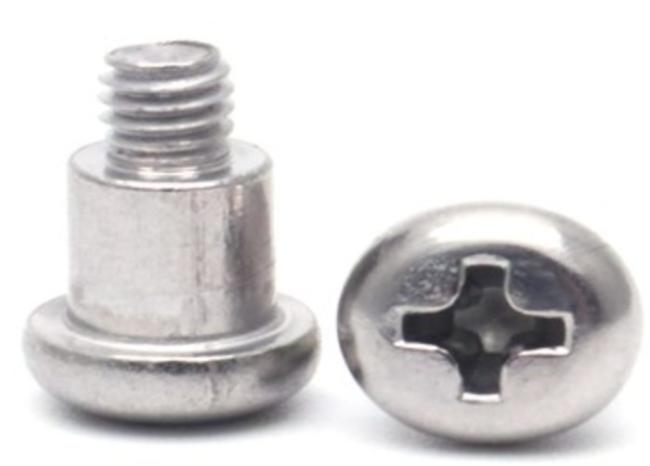
A shoulder bolt is characterized by its three-part structure:
- Head: Typically designed for tool engagement, such as a hex head or socket head, to allow for easy installation and removal.
- Shoulder (Unthreaded Section): A smooth, cylindrical shank with a precise diameter, larger than the threaded portion. This section acts as a bearing surface or spacer.
- Threaded End: A smaller-diameter threaded section that secures the bolt into a tapped hole or nut.
The shoulder's length and diameter can be customized to meet specific mechanical requirements, making it adaptable to a wide range of applications.
The features of plug-in screws mainly include the following:
High anti-theft: with hexagonal design, it needs to use special hexagonal spanner to tighten, and it is not easy to be opened by ordinary spanner or screwdriver, thus improving its anti-theft performance.
Good sealing: the external and internal threads are tapered, this design can form a good seal with the matching parts, effectively preventing the leakage of liquid or gas.
High strength: the selection of high-strength metal materials, such as stainless steel, copper, aluminium, etc., so that the plug screws have a large tensile and shear torque, able to withstand large loads.
- Machinery: Essential for ensuring precise alignment and smooth movement in sliding components
- Automotive: Commonly found in suspension systems, engines, and brakes
- Electronics: Crucial in maintaining proper spacing between circuit boards
- Mold Manufacturing: Used for guiding parts within molds
- Furniture Hardware: Used in hinges and sliding rails
- Aerospace: Applied in aerospace components where high precision is necessary
- Industrial Automation: Supports smooth movement in robotic arms
- Medical Equipment: Ensures smooth, controlled movement in devices
- Tooling & Fixtures: Key in maintaining alignment in manufacturing jigs
- Construction & Heavy Equipment: Provides stable movement under heavy loads
- Automotive: Suspension pivots, throttle linkages
- Aerospace: Control surface hinges, actuator mounts
- Manufacturing: Jigs, fixtures, robotic joints
- Consumer Electronics: Hinges for laptops, rotating displays
- The shoulder must fit snugly into its bore to prevent misalignment
- Thread engagement length should match the tapped hole depth to avoid stripping
- Lubrication may be required for high-rotation applications
Carbon steel, also known as mild steel or plain carbon steel, is a versatile and widely used material in various industries. It is an alloy of iron and carbon, with carbon content typically ranging from 0.05% to 2.1% by weight.
| No. | C% | Cr% | Ni% | Mo% |
|---|---|---|---|---|
| 304 | 0.07 | 17.5-19.5 | 8.0-10.5 | / |
| 316 | 0.08 | 16.0-18.0 | 10.0-14.0 | 2.00-3.00 |
| 301 | 0.15 | 16.0-18.1 | 6-8 | / |
| 310 | 0.08 | 24-26 | 19-22 | / |
| 304L | 0.03 | 18-20 | 8-12 | / |
| 316L | 0.03 | 16-18 | 10-14 | 2-3 |
| 321 | 0.08 | 17-19 | 9-12 | / |
201, 304, 316 are austenitic stainless steel, according to the performance of the non-magnetic, some of the performance of the weak magnetic because of the smelting of the composition of the segregation or improper heat treatment leads to the austenite in a small amount of martensite or ferrite. Austenitic stainless steel corrosion resistance comes from the formation of chromium oxide protective layer on the metal surface.
304 is a general-purpose stainless steel that is widely used to make equipment and machine parts that require good all-round performance (corrosion resistance and formability). In order to maintain the corrosion resistance inherent in stainless steel, the steel must contain more than 18% chromium, more than 8% nickel content. 304 stainless steel is a grade of stainless steel produced according to the American ASTM standard.
A2 stainless steel and A4 stainless steel, A2 is a class of 304 stainless steel, A4 is a class of 316 stainless steel, the main difference between the two is here, some of the fastener industry will be 302HQ and 304 referred to as: A2, 316 and 316L (C content of carbon C is less than 03% of the stainless steel, you can increase the 'L' logo) called A4.
What is the difference between a270 and a470 stainless steel bolts Nuts are usually used in conjunction with bolts. Hexagonal nuts are more widely used.C-grade hexagonal nuts are used in steel structures, machinery and equipment with rough surfaces and low requirements for precision.A-grade and B-grade hexagonal nuts are mainly used in machinery and equipment with smooth surfaces and high requirements for precision.


Get in Touch
Have questions about our products or want to discuss a custom order? Our team is ready to help you.