
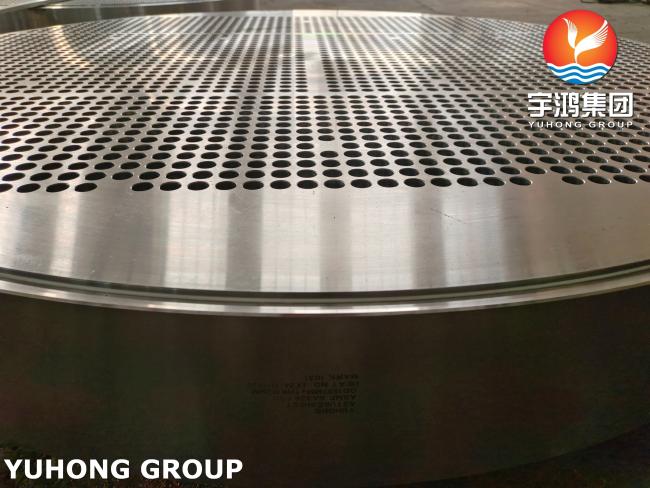
ASME SA336 F5N Forged Tube Sheet Chrome Moly Steel Heat Exchanger Tube Sheet
ASME SA336 F5N Tubesheet: Forged Chrome-Moly Steel Heat Exchanger Part
What role does the tube sheet play in the heat exchanger?
A tubesheet is a critical component in shell-and-tube heat exchangers, pressure vessels, and reactors, serving as a structural anchor for tubes while maintaining separation between shell-side and tube-side fluids. The ASME SA-336 F5N tubesheet is a specialized forged steel component designed for high-temperature, high-pressure (HPHT), and corrosive service environments. This grade is widely used in industries such as petrochemical refining, power generation, and hydrogen processing due to its exceptional strength, creep resistance, and resistance to hydrogen embrittlement.
1. Material Specifications
ASME SA-336 F5N is a normalized and tempered 5% chromium-molybdenum-vanadium (Cr-Mo-V) steel forging, compliant with ASME Boiler and Pressure Vessel Code (BPVC) Section II. The "N" suffix denotes normalization heat treatment.
Chemical Composition (Weight %)
| Element | Min (%) | Max (%) |
|---|---|---|
| Carbon (C) | 0.15 | 0.20 |
| Manganese (Mn) | 0.30 | 0.60 |
| Silicon (Si) | 0.50 | 1.00 |
| Chromium (Cr) | 4.00 | 6.00 |
| Molybdenum (Mo) | 0.45 | 0.65 |
| Vanadium (V) | 0.25 | 0.35 |
| Phosphorus (P) | - | 0.025 |
| Sulfur (S) | - | 0.025 |
Mechanical Properties
| Property | Value |
|---|---|
| Tensile Strength | 620–795 MPa (90–115 ksi) |
| Yield Strength | ≥ 415 MPa (60 ksi) |
| Elongation | ≥ 18% (in 50 mm) |
| Reduction of Area | ≥ 45% |
| Hardness | 200–250 HBW (Brinell) |
| Impact Toughness | ≥ 54 J @ -18°C (Charpy V-notch) |
2. Heat Treatment
SA-336 F5N undergoes normalization (heated to 900–980°C) followed by tempering (650–750°C) to achieve:
-
Uniform microstructure (fine-grained bainite/martensite).
-
Balanced strength, ductility, and resistance to hydrogen-induced cracking (HIC).
- Improved creep resistance at temperatures up to 565°C (1,050°F).
3. Key Advantages
-
High-Temperature Strength: Retains mechanical properties under prolonged exposure to 500–565°C.
-
Hydrogen Resistance: Resists hydrogen embrittlement and blistering in sour (H₂S) or high-pressure hydrogen environments.
-
Creep Resistance: Suitable for long-term cyclic thermal loads (e.g., refinery hydrocrackers).
-
Weldability: Compatible with shielded metal arc welding (SMAW) and submerged arc welding (SAW) with proper preheat (200–300°C) and post-weld heat treatment (PWHT).
4. Design and Manufacturing Standard
-
ASME BPVC Section VIII: Governs design rules for pressure vessels.
-
ASME BPVC Section IX: Specifies welding and PWHT procedures.
-
TEMA Standards: Guides tube layout, pitch, and drilling tolerances.
-
NDT Requirements:
-
Ultrasonic Testing (UT): Detects internal flaws in forgings.
-
Magnetic Particle Testing (MT): Identifies surface cracks.
-
Radiographic Testing (RT): Optional for critical applications.
-
5. Applications
SA-336 F5N tubesheets are ideal for:
-
Hydrogen Processing Units: Hydrocrackers, hydrodesulfurization (HDS) reactors.
-
Power Generation: High-pressure steam generators, feedwater heaters.
-
Petrochemical: Catalytic reformers, delayed cokers.
-
Nuclear: Reactor coolant systems (secondary circuits).
6. Fabrication Considerations
Machining
-
Requires carbide-tipped tools due to high hardness.
-
Tube hole drilling tolerance: ±0.05 mm for precision alignment.
Welding
-
Filler Metals: AWS E8018-B2 (SMAW) or ER80S-B2 (GTAW).
-
PWHT: Mandatory at 650–700°C for 1 hour per 25 mm thickness to relieve residual stresses.
Cladding
-
Optional stainless steel (e.g., 309L/347) or nickel alloy (Inconel 625) cladding for severe corrosion resistance.
7. Comparison with Similar Grades
| Grade | SA-336 F5 | SA-336 F5N | SA-387 Gr. 5 Cl. 2 |
|---|---|---|---|
| Heat Treatment | As-rolled/annealed | Normalized + tempered | Normalized + tempered |
| Impact Toughness | Lower | Higher (due to vanadium) | Moderate |
| Cost | Lower | Moderate | Higher |
8. Limitations
-
Not Suitable for Cryogenic Service: Limited toughness below -20°C.
-
Corrosion in Chloride Environments: Requires cladding for seawater or acidic chloride exposure.

Get in Touch
Have questions about our products or want to discuss a custom order? Our team is ready to help you.