
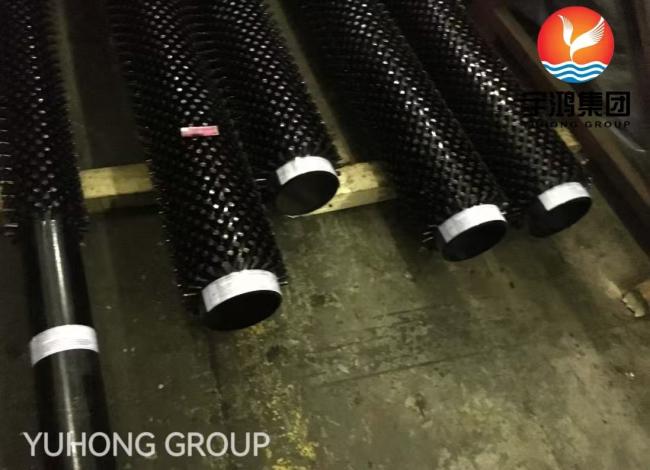
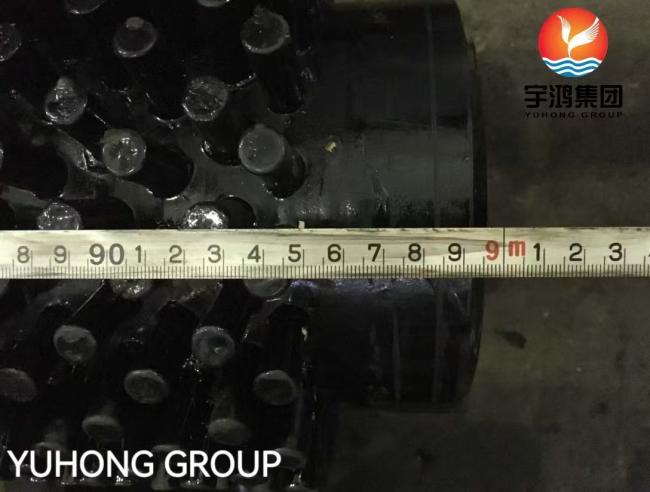
A335 P9 Alloy Steel Fin Tube Heat In Waste Heat Recovery Boiler And Super Heater
| Certification | ASME, U STAMP, API, ASME, ABS, LR, DNV, GL, BV, KR, TS, CCS |
|---|---|
| Base Tube Material | Alloy Steel, P5, P9, P11, P12, P22, P91 |
| Length | Max 43M/PC |
| Fin Wall Thickness | 0.8-3mm |
| Fin Pitch | FPI: 3-25 |
| Fin Height | 5-30mm |
- Boiler and Heat Exchanger: Used in waste heat recovery boiler, waste heat boiler, gas boiler, waste heat recovery device, gas turbine exhaust system.
- Petrochemical Industry: Used in catalytic cracking unit (FCCU), reforming unit, hydrotreating unit. Improves heat transfer efficiency and optimizes reaction conditions. Resistant to high temperature and corrosive media.
- Power Industry: Used in coal-fired power plants, waste incineration power plants. Improves boiler thermal efficiency and resists wear from fly ash and particulate matter.
- Metallurgical Industry: Used in blast furnace, hot blast furnace, heating furnace. Improves heat exchange efficiency and resists corrosion and wear from high temperature flue gas.
- Efficient Heat Transfer: Nail head design increases surface area and turbulence effect, significantly improving heat transfer efficiency.
- Wear-Resistant and Durable: Nail head protects the base tube, extending service life.
- Strong Adaptability: Different materials and designs can be selected according to working conditions.
- Reduces Scaling: Turbulent effect of the nail head reduces scaling and deposition.
A335 P9 material can typically withstand temperatures up to 1,000°F (538°C). The exact temperature limit depends on the specific application and operating conditions.
Studded fin tubes are made by welding studs onto the base tube (A335 P9). The studs are usually made of the same or compatible material to ensure uniform thermal expansion and corrosion resistance.
Material: ASTM A335 P9 (base tube), studs (compatible material). Stud arrangement is customizable based on heat transfer requirements. Dimensions including tube diameter, wall thickness, stud height, and spacing can be customized. Standards include ASTM A335 for the base tube, with additional standards for welding and testing.
Consider these factors: operating temperature and pressure, corrosive environment, required heat transfer efficiency, tube dimensions and stud arrangement, and compatibility with other system components.
Regular inspection for corrosion, stud wear, and tube integrity. Cleaning to remove soot, ash, or other deposits that may reduce heat transfer efficiency. Monitoring for leaks or damage in high-stress areas.
Get in Touch
Have questions about our products or want to discuss a custom order? Our team is ready to help you.