
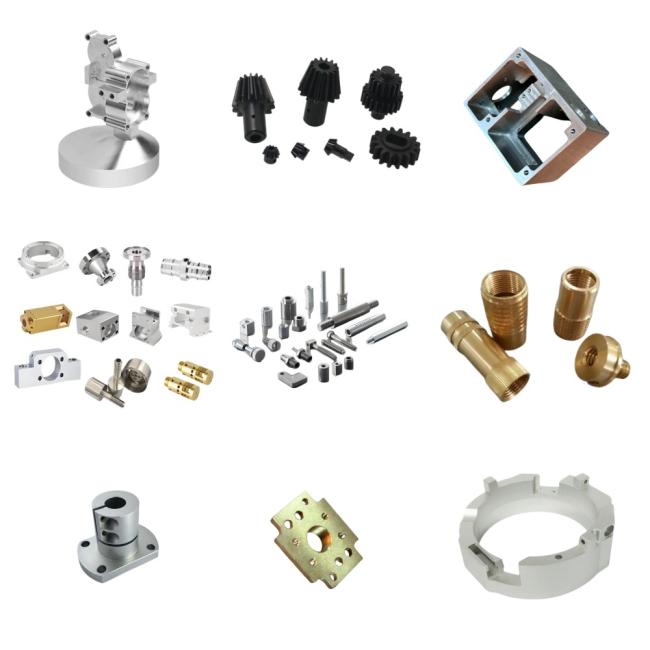
High Precision Customized Size CNC Turning Parts with Anodized Aluminum Alloy CNC Machined Components
High Precision Custom Machined Metal Parts Anodized Aluminum Alloy Titanium Components Turning Polishing Cnc Machining Services
|
Materials
|
Aluminum, copper, brass, stainless steel, steel, iron, alloy, zinc etc.
Other Special Materials:Lucite/Nylon/wood/titanium/etc |
|||
|
Surface Treatment
|
Anodizing,Brushing,Galvanized,laser engraving, Silk printing,polishing,Powder coating,etc
|
|||
|
Tolerance
|
+/-0.01mm, 100% QC quality inspection before delivery, can provide quality inspection form
|
|||
|
Testing equipment
|
CMM;Tool microscope;multi-joint arm;Automatic height gauge;Manual height gauge;Dial gauge;Marble platform;Roughness measurement
|
|||
|
Processing
|
Broaching, DRILLING, Etching / Chemical Machining, Laser Machining, Milling, Other Machining Services, Turning, Wire EDM, Rapid Prototyping
|
|||
|
File Formats
|
Solid Works,Pro/Engineer, AutoCAD(DXF,DWG), PDF,TIF etc.
|
|||
|
Service Project
|
To provide production design, production and technical service, mould development and processing, etc
|
|||
|
Quality Assurance
|
GB/T 19001-2016/IS0 9001:2015
|
|||
Machining is a manufacturing process that involves removing material in a controlled manner to create a desired final shape. Because this process primarily relies on machine tools, such as machining centers, to remove material, it is often referred to as a subtractive manufacturing process, in contrast to additive manufacturing (which involves adding material).
In the turning process, the workpiece rotates around a central axis while a cutting tool removes material from the workpiece. This method is suitable for manufacturing workpieces with symmetrical shapes and can achieve high-precision machining with computer-controlled tools.
Milling involves a rotating cutting surface moving across the workpiece to create various planar shapes. The cutting shapes can range from simple straight cuts to specific angles and bevels for particular applications. A variety of milling tools are used in this process, such as bed mills, column mills, gantry mills, C-frame mills, knee mills, turret mills, and ram-type mills.
Drilling is one of the simplest machining operations, designed to move a drill bit into a workpiece to create holes. These holes can be used for inserting screws, secondary assembly, or for aesthetic purposes. Boring tools are used to enlarge previously drilled holes, typically using a single-point cutting tool. Boring primarily machines the inner diameter, while turning handles the outer diameter. Reaming is a process that slightly enlarges a drilled hole to improve accuracy and surface finish, used when the drilling tool cannot achieve the required standards.
Grinding is used to remove small amounts of unwanted material from a workpiece to increase surface finish and ensure highly accurate dimensions. This process uses an abrasive surface called a grinding wheel as the cutting tool. A wide variety of grinding tools exist, including manual and computer-controlled equipment such as angle grinders, die grinders, and bench grinders.
Planing uses a machine called a planer to create flat surfaces on a workpiece. Planers achieve cutting through the relative motion between a single-point cutting tool and the workpiece, and in addition to linear planing, they can also be used for helical planing applications.
Sawing is one of the earliest machining methods, using a sharp blade (sometimes replaced by wire or chain) with a toothed edge. It is commonly used in woodworking but also finds applications in metalworking and stone cutting.
Broaching removes unwanted material using a toothed cutting tool called a "broach." Broaching comes in two forms – linear broaching and rotary broaching, with linear broaching being more common. This process is highly effective for precision machining of small groove shapes.,
Get in Touch
Have questions about our products or want to discuss a custom order? Our team is ready to help you.